Support
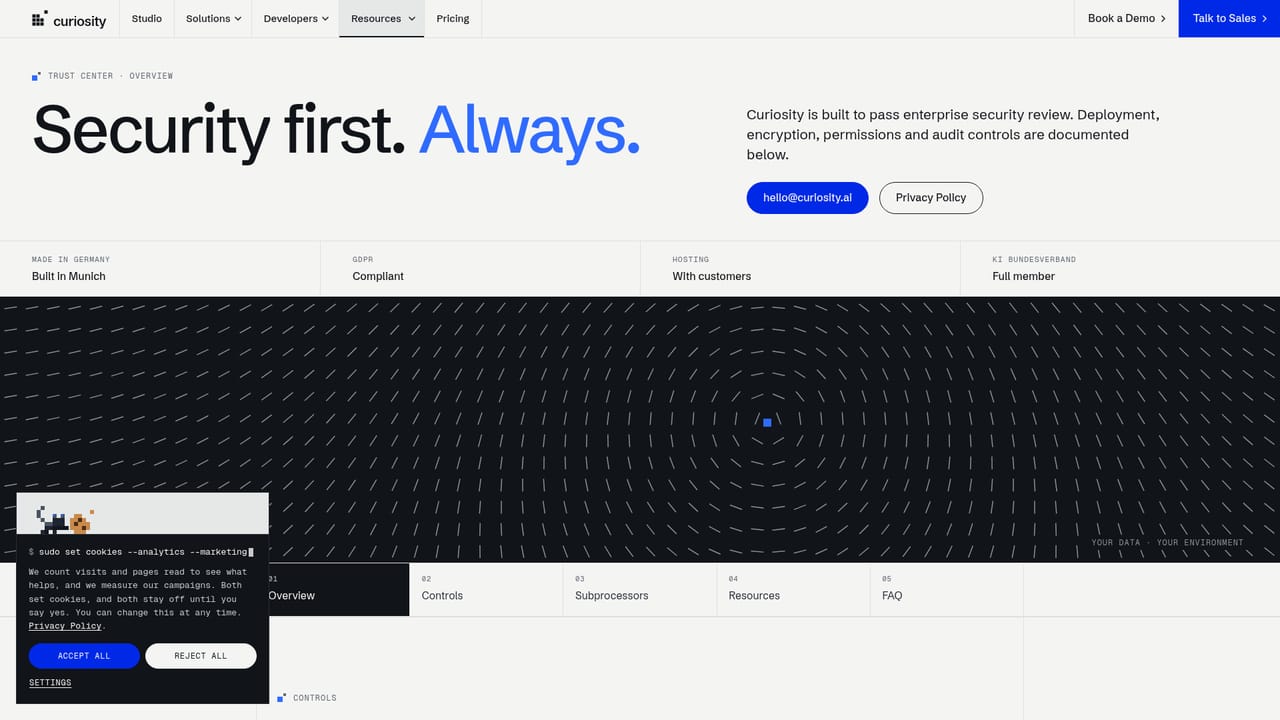
Support runs through demo booking, a sales contact route and a trust center covering security, residency and compliance documentation. No public help centre or ticket portal is listed.
Learn moreDescribe an internal tool in one sentence, get working software on your own data

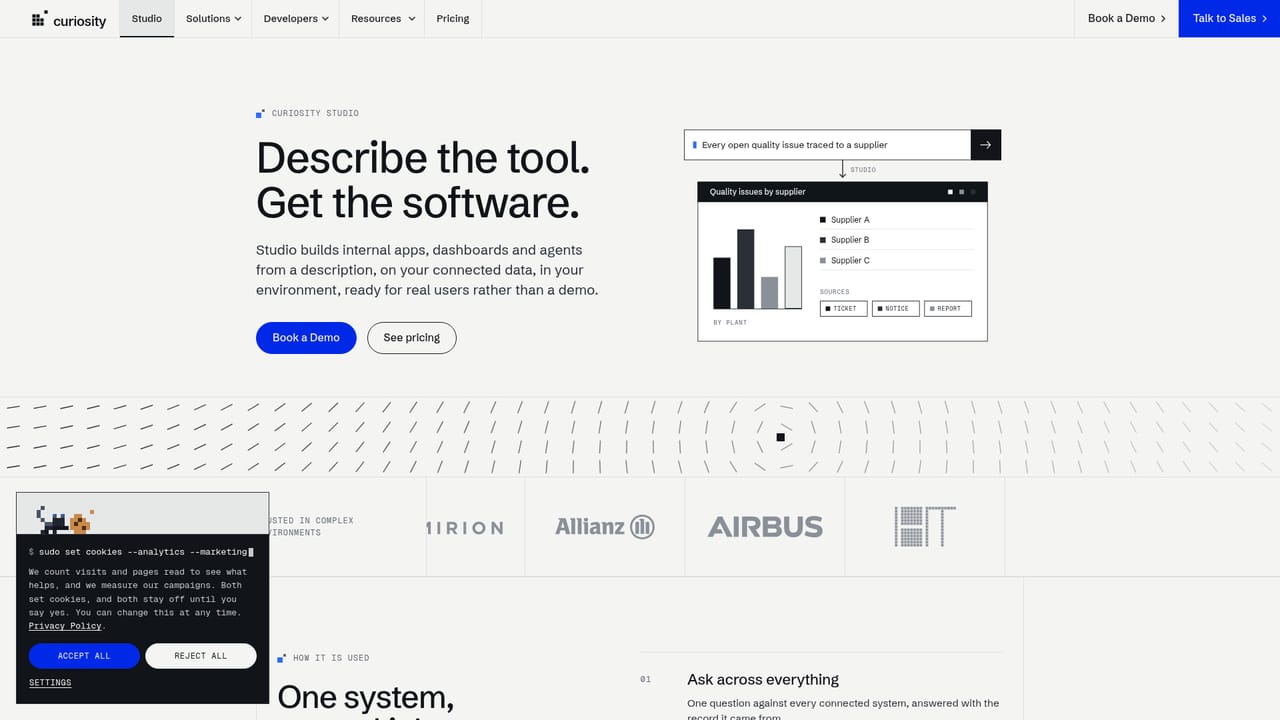
Curiosity.AI is an AI project builder tool. Curiosity Studio converts a plain-language request into a working internal app, dashboard or agent built on your connected enterprise data, inside your existing permissions, on your own infrastructure. Made in Munich for regulated, data-heavy industries.
Curiosity Studio is a German enterprise AI platform that turns a written description of an internal tool into working software, built on top of a company's own connected records. A user types a request such as "show every open issue for the A320 line" or "flag late supplier notices" and Studio assembles a running application, complete with charts and result lists, from data drawn across tickets, part records, supplier notices and field reports. The product is built in Munich and aimed squarely at organisations with complex operational data: aerospace and defense, rail and mobility, energy and infrastructure, industrial manufacturing and life sciences. The mechanism that separates it from generic prompt-to-app builders is the context graph. Studio does not start from a blank interface and hope the data behaves; it starts from a graph of connected records, so every application it generates is grounded in source systems and inherits the access rules those systems already enforce. A generated tool cannot surface a record to a user that the underlying source would not have shown them, and each answer carries the record it came from. That grounding, combined with a full audit trail of queries, downloads and data access, is the argument for letting generated software touch production workflows. Deployment is the second differentiator. Studio runs on premises or in a private cloud, including certified data centers in Europe, with the customer's choice of model. Data stays in the region selected, single sign-on and enforced MFA apply, and the vendor states GDPR compliance and data residency commitments. Teams with engineering capacity can drop to the API for the same graph and permissions inside their own code and models. The practical buyer is an enterprise platform, data or innovation team sitting on a long internal tool backlog, where small requests queue behind quarterly roadmaps and teams fall back on spreadsheets. Curiosity's positioning is that the hard part of enterprise prompt-to-app is governance rather than the interface, and it prices and sells accordingly, through demo and sales conversations rather than published self-serve tiers.
Support runs through demo booking, a sales contact route and a trust center covering security, residency and compliance documentation. No public help centre or ticket portal is listed.
Learn moreStudio works from a context graph of your connected enterprise systems, with permissions inherited from those source systems. Specific connectors and named source applications are not listed on the homepage.
Describe an internal tool, dashboard or agent in plain language and get running software built on your connected records. Tools inherit source system permissions, every answer carries its source record, and a full audit trail logs queries, downloads and data access. Deploy on premises or in a private cloud with your choice of model, SSO and enforced MFA, regional data residency, and an API for engineering teams that need more control.
Learn more AI Angels400+ customizable AI girlfriends for NSFW chat, voice calls, and roleplay
 Candy AIExperience the future of companionship with AI friends who chat, role-play, and connect with you on a human level.
 ourdream.aiA vast AI roleplay platform with millions of characters for chat, images, video and voiceAI Angels400+ customizable AI girlfriends for NSFW chat, voice calls, and roleplayCandy AIExperience the future of companionship with AI friends who chat, role-play, and connect with you on a human level.ourdream.aiA vast AI roleplay platform with millions of characters for chat, images, video and voice


