Dual Web

Builds agentic applications and syncs your site for AI crawlers

Advanced
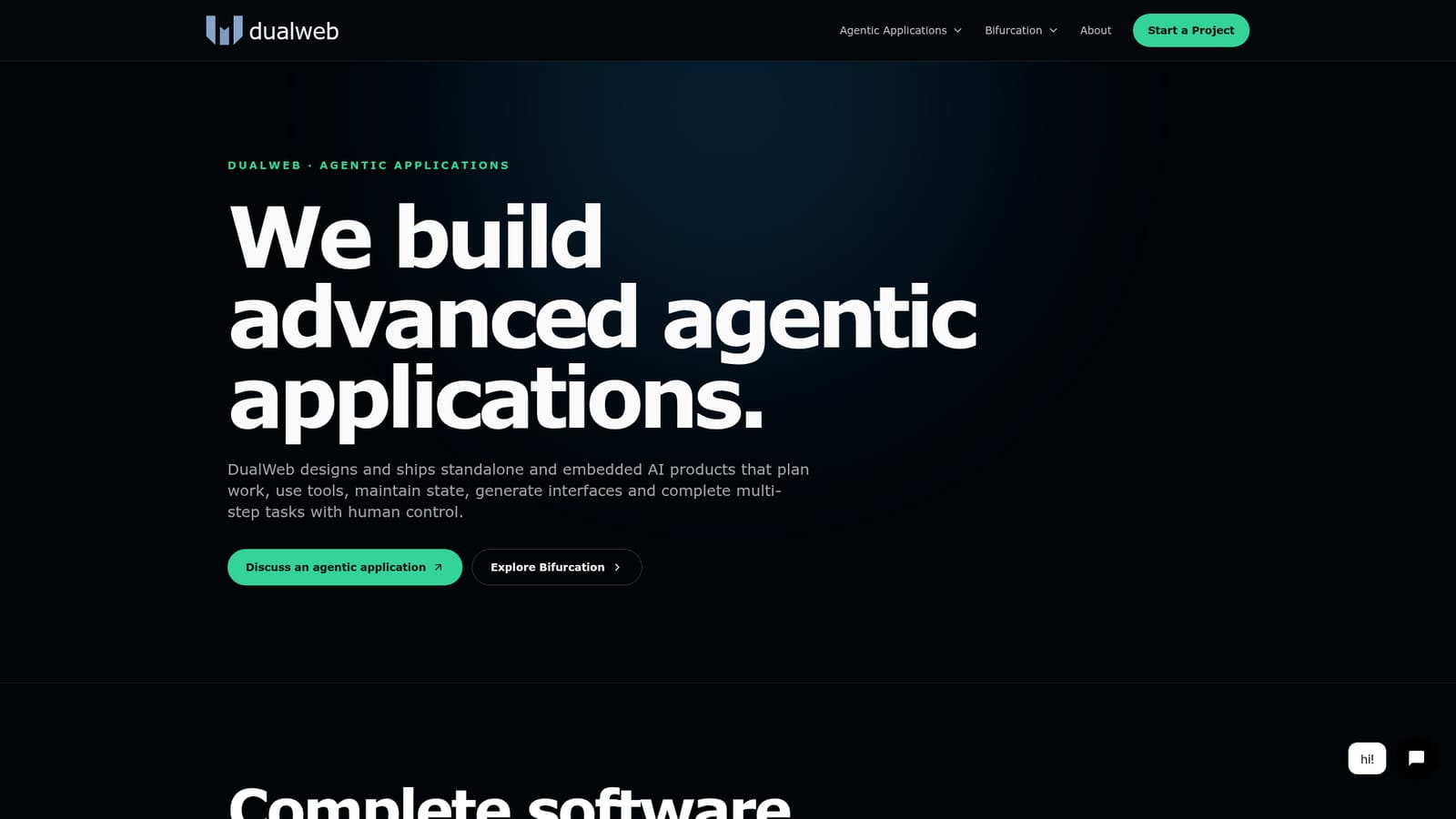
Screenshot of Dual Web, Builds agentic applications and syncs your site for AI crawlers

What is Dual Web?

Dual Web is an AI project builder tool that builds agentic applications and syncs your site for AI crawlers. A build studio for agentic applications plus Bifurcation, a layer that serves a synchronized structured version of a site to AI crawlers.

Dual Web is a build studio rather than a self-serve tool. It ships two distinct products: agentic applications, meaning complete software with its own interface and persistent runtime, and Bifurcation, a delivery layer that serves a structured representation of a site to AI crawlers while the human site stays as it is. On the application side, the work is scoped around a defined user and outcome. A blueprint fixes boundaries, tool access and approval points before implementation. From there Dual Web connects one workflow end to end as a working vertical slice, then completes the surface, integrations, background execution, tenancy and observability. The definition of agentic here is specific: the runtime sequences actions as tool results arrive, holds state across interruptions, exposes progress, pause, resume and cancellation, and stops consequential writes at a human approval gate. Before handover the build is exercised against failure paths, permission boundaries, cost limits and regression scenarios, and the client receives source, tests, evaluation fixtures and runbooks. Bifurcation addresses a narrower problem. It classifies relevant AI crawler requests, serves an approved structured representation that stays in factual parity with the source content, and logs delivery evidence. A scanner and a worked delivery example are published so the mechanism can be inspected before committing. The audience is teams with operational work to automate rather than marketing teams wanting a redesign. Case management, quoting configurators, research workspaces and computer-use tasks in software without a dependable API are the stated fits. Dual Web also says plainly when a deterministic workflow is the better answer and declines ordinary website design, fixed automation and unbranded chatbots. Alternatives are usually agencies or low-code agent platforms; this leans toward custom builds with client-controlled deployment, which means budget and a project cycle rather than a signup form. What is not on the homepage: rates, contract terms, timelines, supported integrations in detail, or any customer results. The published trace is explicitly a fictional fixture, not a benchmark.

How do you use Dual Web?

  1. 1Read the agentic qualification criteria
    Work through the six criteria on the homepage (multi-step execution, tools, persistent state, background work, human control, adaptive interfaces) and check which apply to your task.
    Dual Web — Read the agentic qualification criteria
  2. 2Inspect the Bifurcation contract
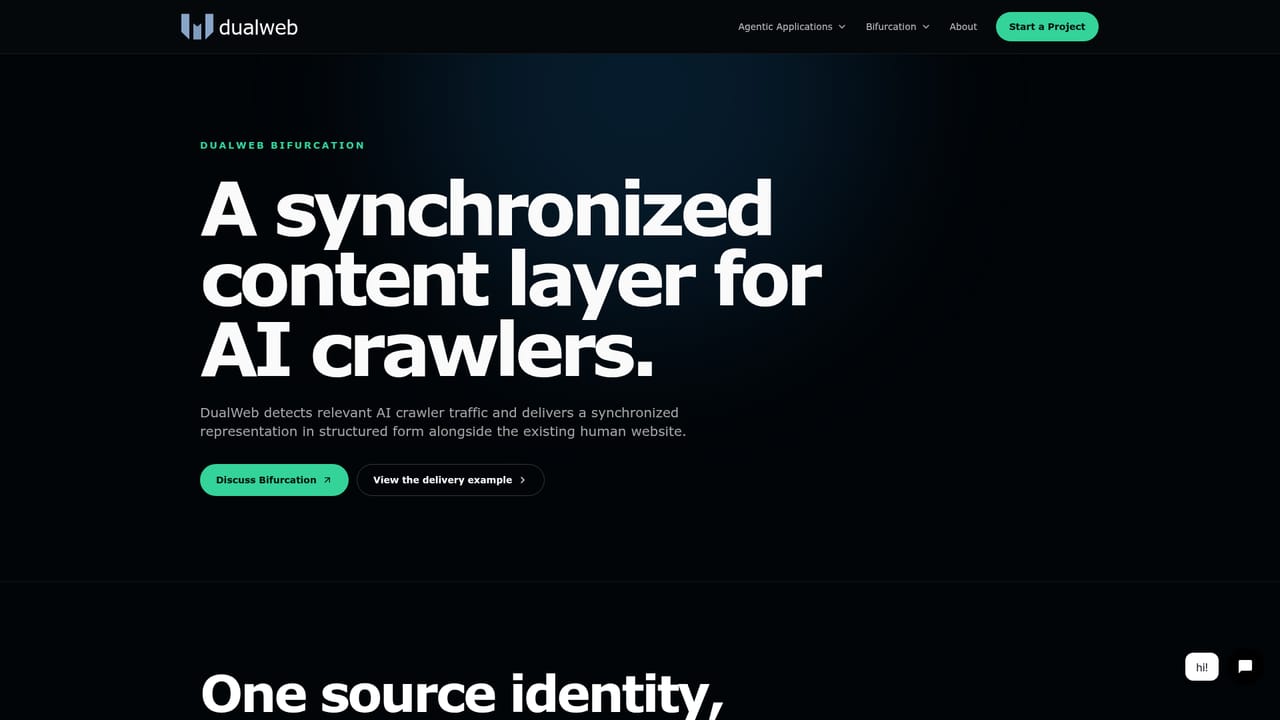
    Review what the delivery layer covers: request classification, an approved structured representation, parity with source content and delivery evidence.
    Dual Web — Inspect the Bifurcation contract
  3. 3Run the scanner
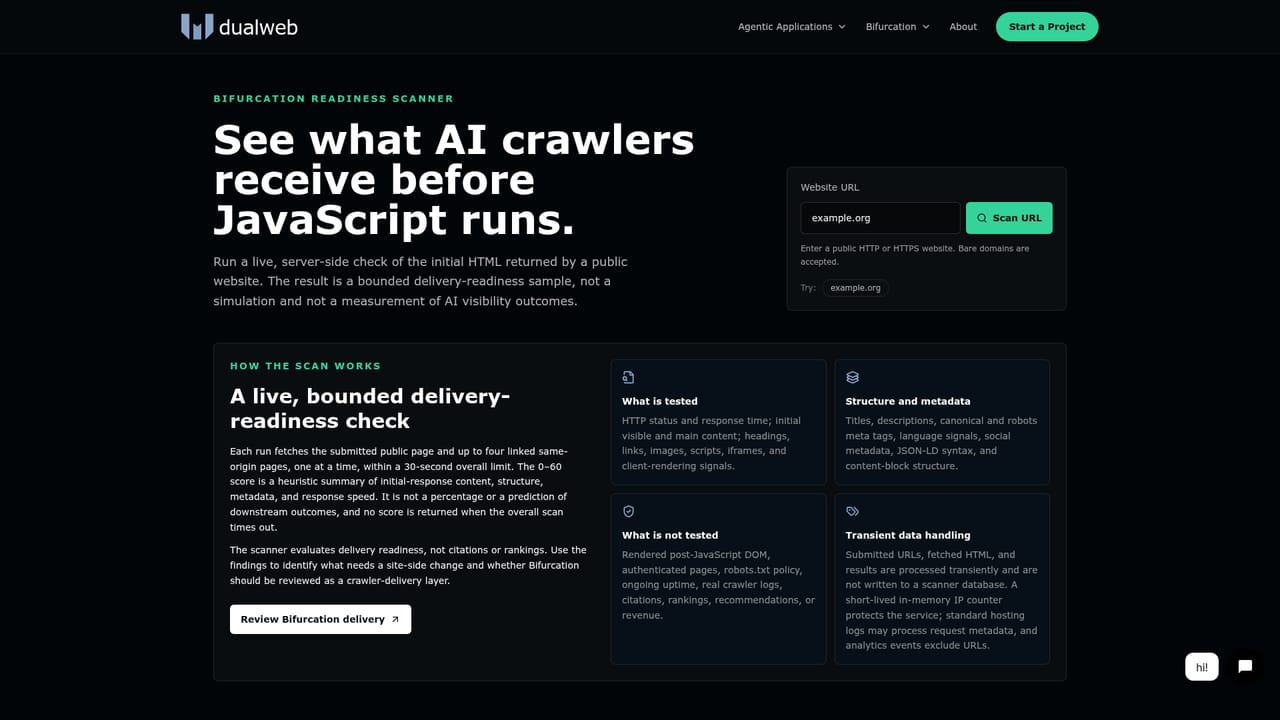
    Use the published scanner to see how AI crawler traffic is detected against a real site before deciding on an installation.
    Dual Web — Run the scanner
  4. 4Study the delivery example
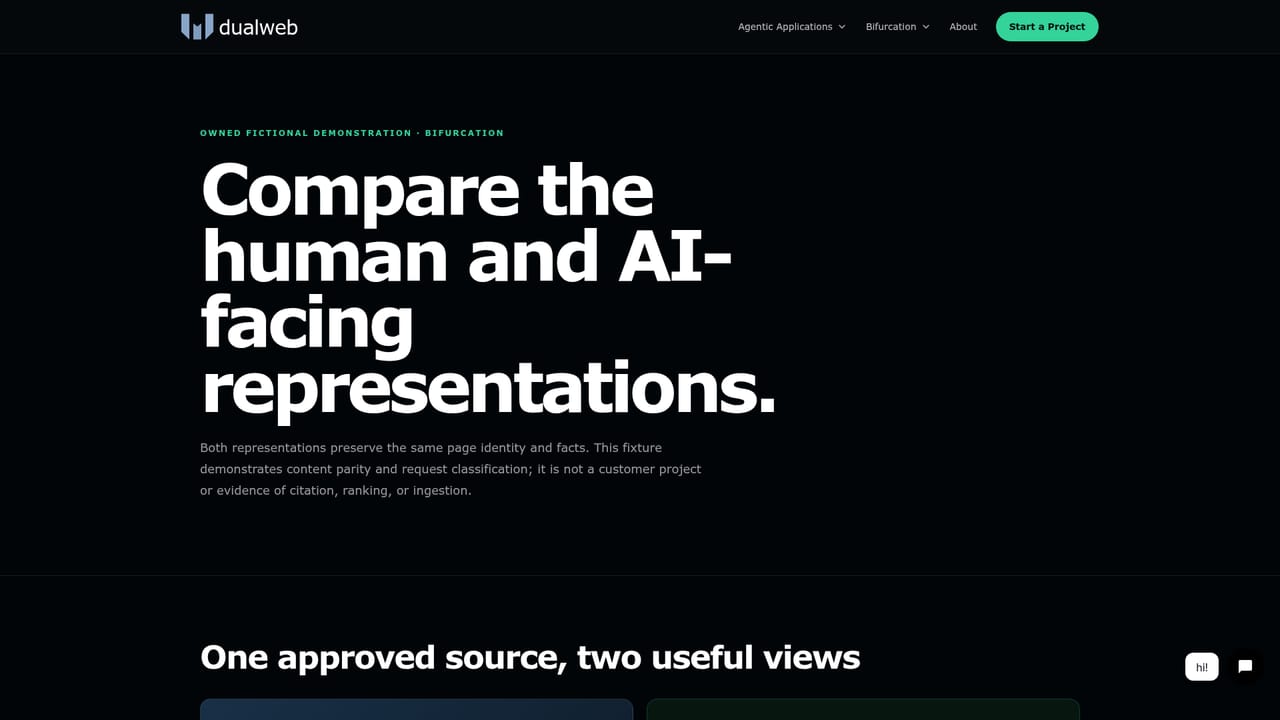
    Walk the worked example to see the response selected for each traffic class and the routing, status, latency and freshness evidence.
    Dual Web — Study the delivery example
  5. 5Open a scoping discussion
    Bring the workflow, the systems it touches and the approval points. Dual Web will confirm whether the work needs an agentic application, Bifurcation or a deterministic system.

Pros and cons

Pros

  • Runtime design covers approvals, permissions, recovery, budgets and audit history as first-class requirementsAI
  • Bifurcation separates AI crawler delivery from the human site, so no rebuild is requiredAI
  • Delivery includes source, tests, evaluation fixtures and runbooks for a client-controlled environmentAI
  • Published scanner and delivery example let you inspect the mechanism before committingAI
  • The team states when deterministic software beats an agent, which is a credible editorial stanceAI

Cons

  • No published pricing, timelines or contract terms, so budgeting starts with a sales conversationAI
  • It is a bespoke build service, not a self-serve product you can trial on your ownAI
  • No customer outcomes or benchmarks are shown; the only trace is a declared fictional fixtureAI
  • Bifurcation's benefit depends on crawler classification, which the homepage does not quantifyAI
  • Scope is narrow by design: marketing sites and simple chatbots are declined, so it fits few small teamsAI

How much does Dual Web cost?

Features

Agentic applications with multi-step execution, tool and data access, persistent state, background work with pause and resume, human approval gates, tenant and role scoped permissions, visible action and cost budgets, audit history and outcome-based release checks. The Bifurcation product adds AI crawler request classification, synchronized structured delivery, content parity controls and delivery logs.

Learn more

Frequently asked questions about Dual Web

  • How do you use Dual Web?
    The walkthrough on this page covers 5 steps: 1. Read the agentic qualification criteria 2. Inspect the Bifurcation contract 3. Run the scanner 4. Study the delivery example 5. Open a scoping discussion.
  • What platforms does Dual Web support?
    Dual Web is available on Web App.
  • What are the limitations of Dual Web?
    No published pricing, timelines or contract terms, so budgeting starts with a sales conversation. It is a bespoke build service, not a self-serve product you can trial on your own. No customer outcomes or benchmarks are shown; the only trace is a declared fictional fixture.

Status

StatusActive
Views0
Outbound clicks0
Added10/21/2026

Platforms

Web App

Pricing

Paid