Integrations
The homepage names ATS, CRM, email and Slack as integration categories, without listing specific vendors or setup details.
AI sourcing that hands recruiters shortlists, not search filters

Fetcher is a lead generation tool. Fetcher combines AI screening with a human sourcing team to deliver curated candidate shortlists, then runs automated outreach sequences and reports on pipeline performance. It connects to existing ATS, CRM, email and Slack tools rather than replacing them.
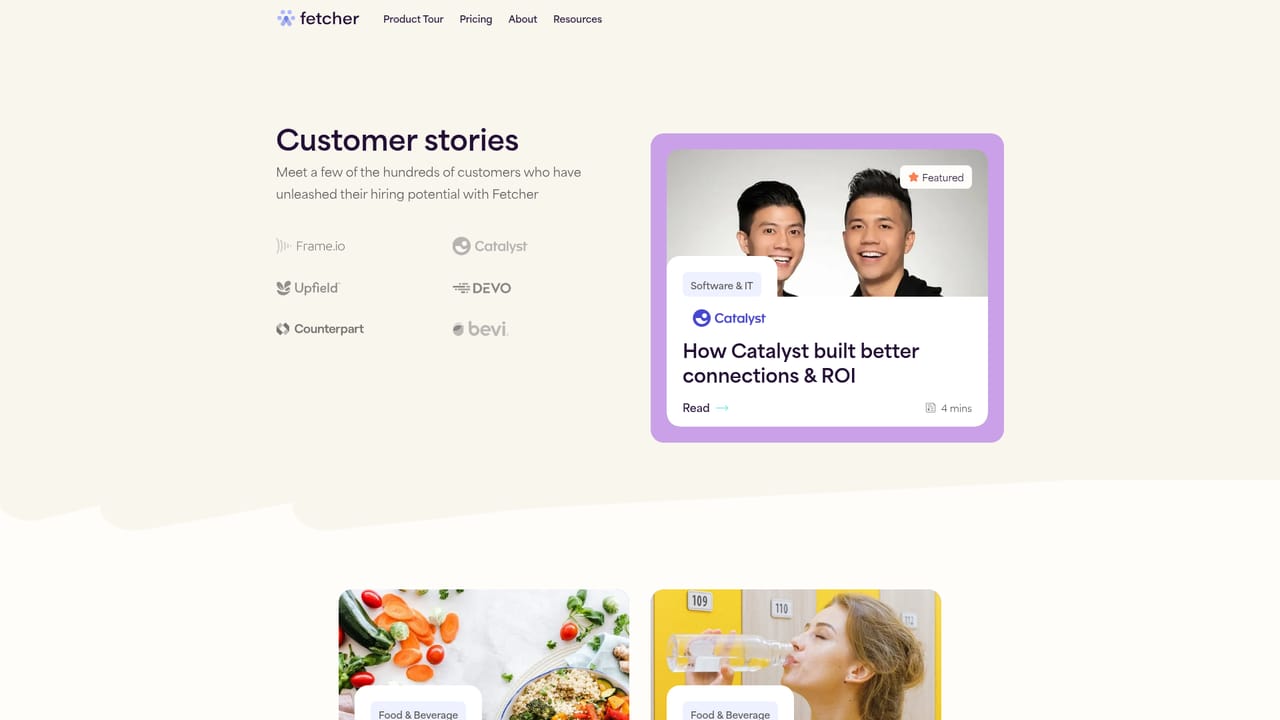
Fetcher is a sourcing and candidate engagement tool built for recruiting teams. Rather than acting as another search interface layered on a resume database, it pairs AI screening with a human sourcing team to deliver curated candidate profiles that match an open role. The stated goal is to remove the manual digging through job boards and resumes that consumes recruiter hours, so the team can spend its time on candidate experience and closing hires. The product covers three connected jobs. Talent sourcing generates candidate batches against a role brief, with AI screening used when applicant volume is high and outbound sourcing switched on when talent is scarce. Candidate engagement centers on automated email sequences, which the company reports average a 40 percent response rate. Recruitment analytics then track how those campaigns and pipelines perform. Search criteria can also include specific diversity goals, which is a notable design choice since most sourcing tools leave representation targets to manual filtering. In practice, a recruiter reviews a sourced batch in roughly 15 minutes according to a customer quoted on the site, adds selected profiles to an email campaign, and waits for replies. The pitch is aimed at in-house talent acquisition teams and people leaders at growing companies, including smaller teams without the headcount to run sourcing manually. Named customers span Flatiron, Shutterstock, Docker, Deutsche Telekom, Gorgias, Roofstock and Magnite. Fetcher sits between pure sourcing databases and full applicant tracking systems. It connects to existing ATS, CRM, email and Slack setups rather than replacing them, and its differentiator is the combination of automation with human sourcers. Buyers should note one important context: the homepage states that Juicebox has acquired Fetcher's assets, so anyone evaluating the product should confirm current availability and roadmap before committing.
The homepage names ATS, CRM, email and Slack as integration categories, without listing specific vendors or setup details.
Core features are AI-assisted talent sourcing with an optional human sourcing team, candidate screening for high-volume roles, outbound sourcing for hard-to-fill positions, automated email engagement sequences, recruitment analytics, diversity-aware search criteria, and integrations with ATS, CRM, email and Slack.
Learn more AI Angels400+ customizable AI girlfriends for NSFW chat, voice calls, and roleplay
 Candy AIExperience the future of companionship with AI friends who chat, role-play, and connect with you on a human level.
 ourdream.aiA vast AI roleplay platform with millions of characters for chat, images, video and voiceAI Angels400+ customizable AI girlfriends for NSFW chat, voice calls, and roleplayCandy AIExperience the future of companionship with AI friends who chat, role-play, and connect with you on a human level.ourdream.aiA vast AI roleplay platform with millions of characters for chat, images, video and voice


