Fluent

Boutique change consulting for teams navigating transformation

Intermediate
Screenshot of Fluent, Boutique change consulting for teams navigating transformation

What is Fluent?

Fluent is an AI project builder tool. A boutique consulting practice covering change enablement, product management, planning, and leadership development. Engagements are co-created with client teams and tailored to culture and constraints rather than delivered from standard playbooks.

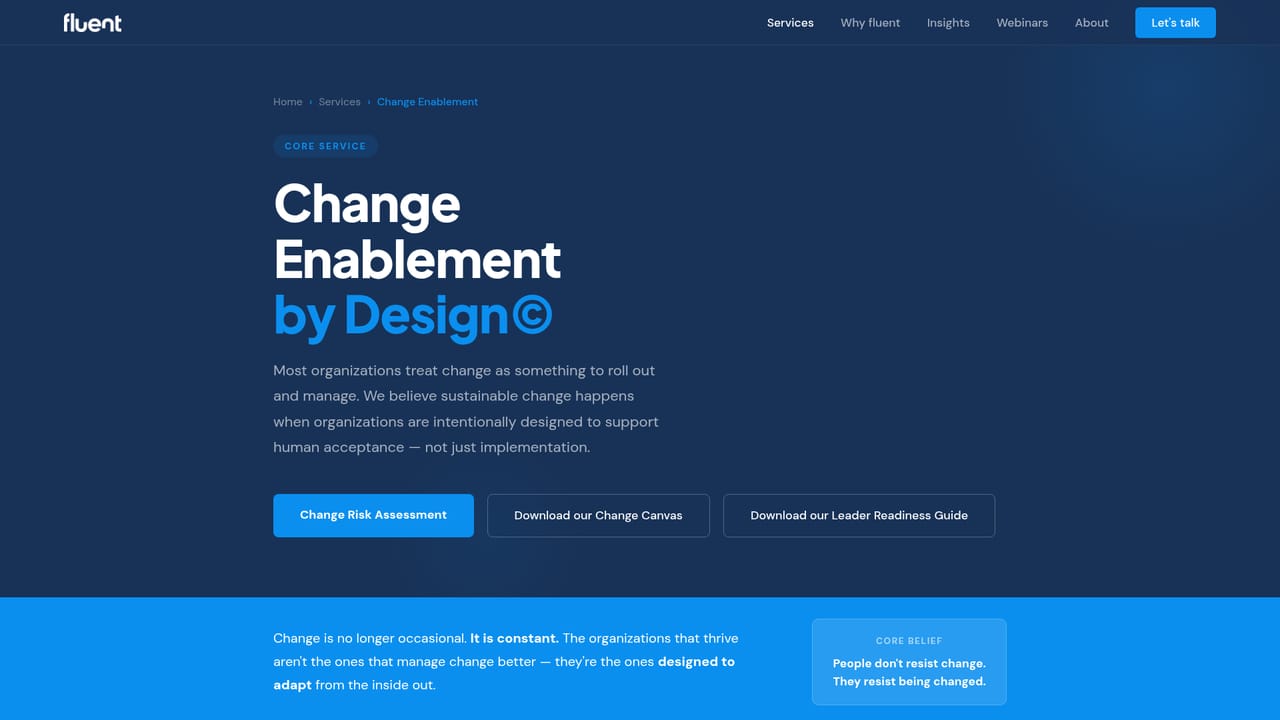
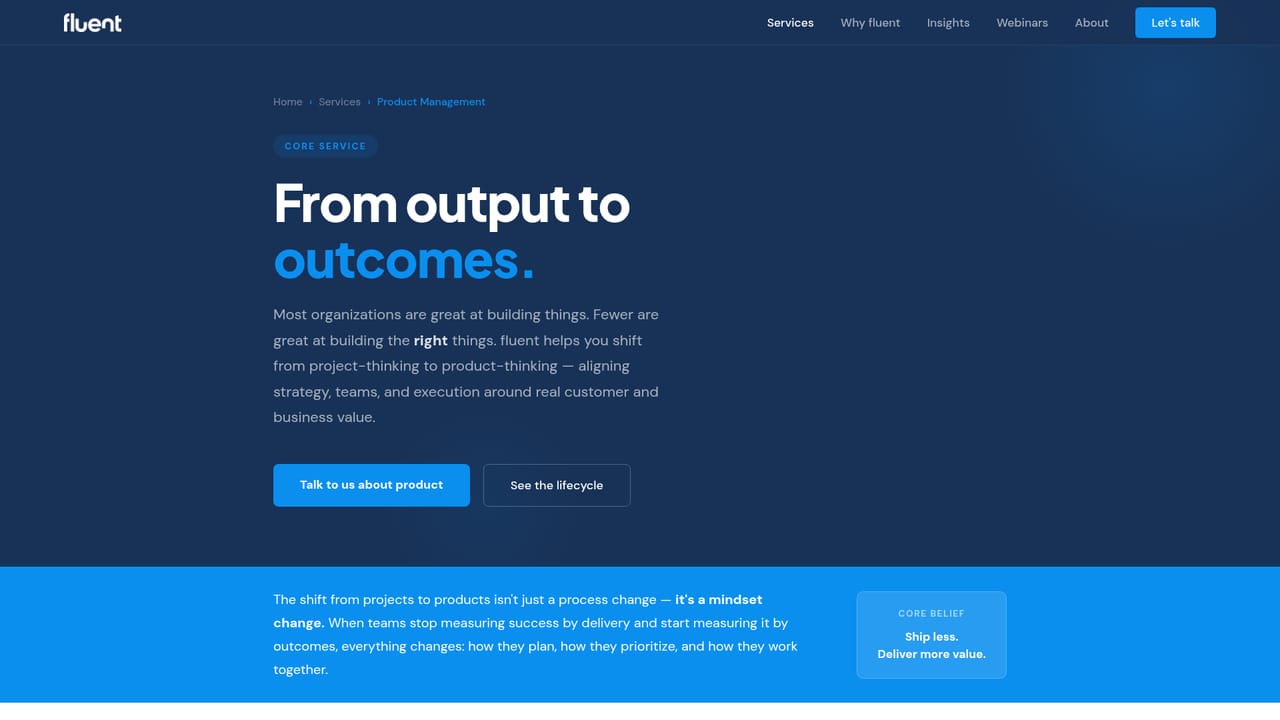
Fluent is a boutique consulting practice, not a language app and not a software product. The site presents four capabilities: Change Enablement, Product Management, Planning, and Leadership Development. Each is offered either as a standalone engagement or combined with the others, and each is adapted to the client's culture, constraints, and goals rather than delivered from a standard playbook. The Change Enablement work runs on an in-house framework the firm calls Change Enablement by Design, which is positioned around helping staff carry change forward rather than merely endure it. The engagement model is deliberately hands-on. Fluent says it co-creates work alongside client teams, avoids off-the-shelf playbooks and hand-off decks, and stays involved until the change holds. That positioning suits organizations in the middle of a transformation where internal capacity exists but direction or confidence is missing: engineering and product groups moving from project to product models, PMOs trying to connect strategy to execution, and leadership benches that need to operate well under complexity. In practice the work looks like embedded consulting. Planning engagements reach from daily stand-ups up to long-term vision so that strategy turns into execution. Product Management engagements focus on shifting the operating model around customer and business outcomes. Leadership Development builds awareness and capability across management levels. Change Enablement sits across all of it. The site backs this with client quotes from senior directors and general managers in business operations, PMOs, and engineering services, plus a small library of written insights on change, leadership, and meeting design. Buyers should treat Fluent as a services firm and compare it against other consultancies and internal change programs rather than against software. There is no published rate card, no self-serve tier, and no product to trial. The site names no certifications, team size, or sector specializations, so fit has to be established in conversation through the contact page. For teams that want a partner embedded rather than a deck delivered, the co-creation and independence framing is the main differentiator on offer.

How do you use Fluent?

  1. 1Read the four capability pages
    Start with the homepage overview, then open each capability page to see how Change Enablement, Product Management, Planning, and Leadership Development are scoped and where they overlap.
    Fluent — Read the four capability pages
  2. 2Sample the published thinking
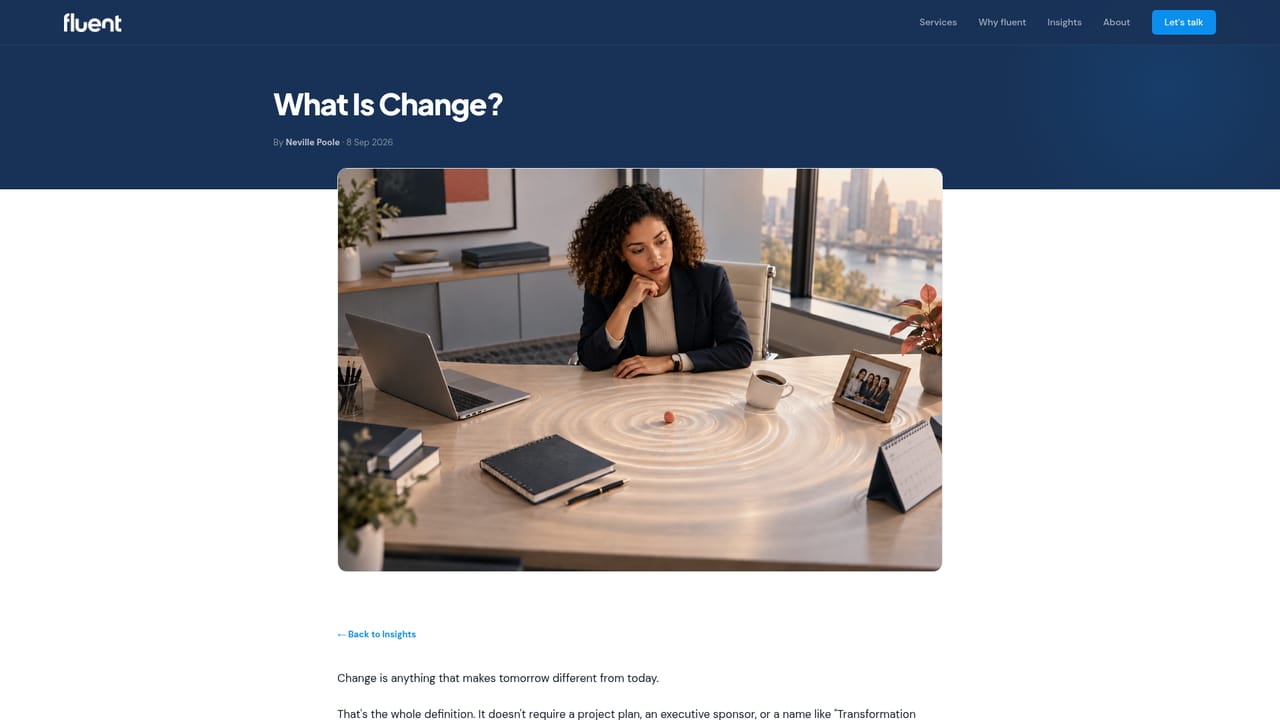
    The insights section carries articles on change, leadership delegation, and executive meeting design. Reading two or three gives a practical feel for the firm's frameworks before any call.
    Fluent — Sample the published thinking
  3. 3Decide which capability fits the problem
    Match the current problem to a capability: product operating model shifts point to Product Management, strategy-to-execution gaps point to Planning, and leadership bench gaps point to Leadership Development.
    Fluent — Decide which capability fits the problem
  4. 4Open a conversation
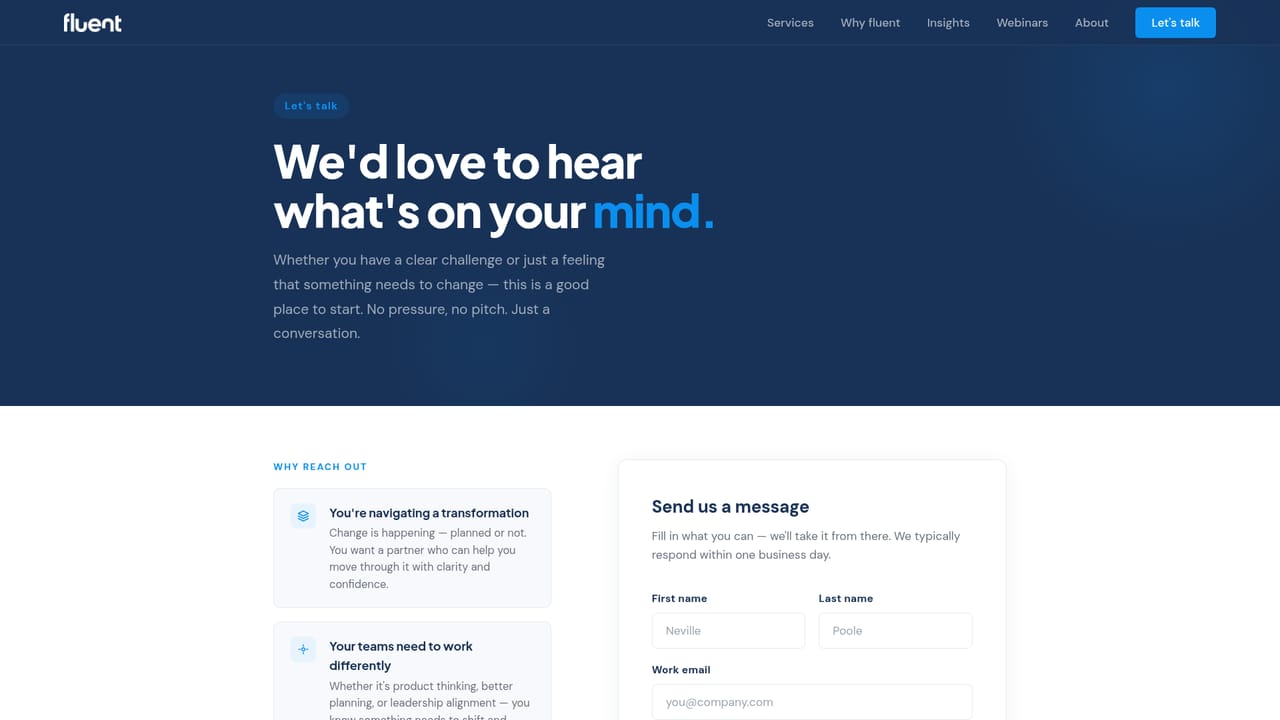
    Use the contact page to describe where the organization is and where it wants to go. Pricing, scope, and engagement length are only established through this conversation.
    Fluent — Open a conversation

Pros and cons

Pros

  • Four clearly defined capability areas that can be bought separately or combinedAI
  • Explicit anti-playbook stance, with co-creation and no hand-off decksAI
  • Client testimonials from senior directors and general managers across PMO, operations, and engineeringAI
  • Stated aim of client independence rather than long-term consultant dependencyAI
  • Free written insights on change, leadership, and meeting design give a sense of the thinking before contactAI

Cons

  • No published pricing, packaging, or engagement minimums anywhere on the siteAI
  • No named consultants, credentials, certifications, or team size to assess seniorityAI
  • No case studies with metrics, only short unattributed-feeling quotesAI
  • Sector and company-size fit is not addressed, so relevance is hard to judge upfrontAI
  • No self-serve option: everything starts with a sales conversationAI

How much does Fluent cost?

Features

Four service lines: Change Enablement using a Change Enablement by Design framework, Product Management covering discovery through delivery, Planning that links stand-ups to long-term vision, and Leadership Development for leading through complexity. Engagements are tailored to client culture and constraints and can be run together or independently.

Learn more

Frequently asked questions about Fluent

  • How do you use Fluent?
    The walkthrough on this page covers 4 steps: 1. Read the four capability pages 2. Sample the published thinking 3. Decide which capability fits the problem 4. Open a conversation.
  • What platforms does Fluent support?
    Fluent is available on Web App.
  • What are the limitations of Fluent?
    No published pricing, packaging, or engagement minimums anywhere on the site. No named consultants, credentials, certifications, or team size to assess seniority. No case studies with metrics, only short unattributed-feeling quotes.

Status

StatusActive
Views0
Outbound clicks0
Added10/21/2026

Platforms

Web App

Pricing

Paid