Free trial
A key is issued on the spot after signing in, so the service can be tested before any paid commitment. No trial length is stated.
Learn moreUnlimited text-to-speech and voice cloning billed per concurrent stream
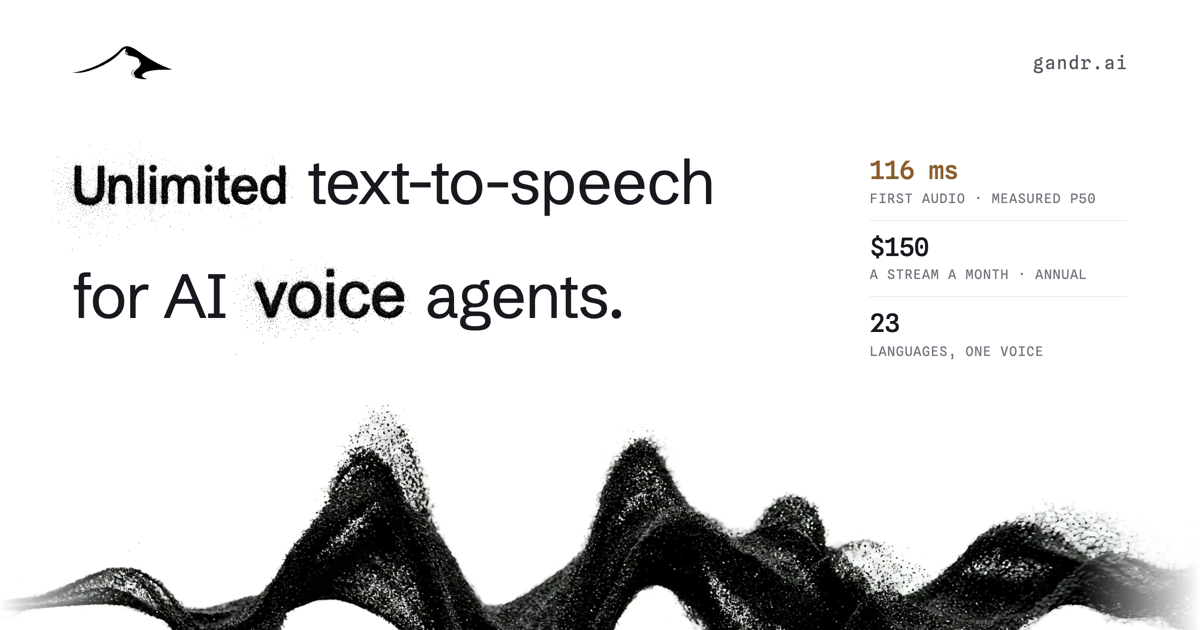
Gandr is a natural text to speech tool. Gandr offers text-to-speech in 23 languages with voice cloning from about ten seconds of audio, billed per concurrent stream rather than per character. Agents connect over WebSocket and narration over HTTP, with published latency benchmarks and a browser console for quick testing.
Gandr is a text-to-speech and voice cloning platform built around an unusual billing model: customers pay for concurrent streams rather than per character or per minute. Once a stream is open, the speech that travels through it is not counted, so a high volume week costs the same as a quiet one. The engine covers 23 languages, and a single voice identity carries across all of them, which matters for anyone producing the same content for several markets. Voice cloning is deliberately lightweight. A reference clip of roughly ten seconds is enough to produce a working clone, with no training job to schedule and no per voice fee. Clones are cached after first use. On the output side, every clip carries an inaudible watermark, and the company states that submitted audio does not enter any training set. Latency figures are published on a dedicated benchmark page: 116 ms p50 for first audio when server side is warm, and 146 ms for the first byte over the open internet. The company argues that tail latency, not the median, is what determines whether a spoken conversation feels natural. The product is aimed at teams embedding speech into software as much as at studios producing audio. Agents connect over WebSocket, while narration and dubbing jobs run over HTTP, and the homepage names LiveKit, Pipecat and Vapi as drop-in environments. Typical uses listed include audiobook narration, dubbing, video, games and voice agents. A browser console lets anyone type a line, pick a voice such as Mia or Lewis, switch language and play the result before committing to an integration. Compared with per character vendors, Gandr suits workloads that are steady or spiky rather than predictable and small: always-on voice agents, long-form narration at scale, multi-language dubbing. Access starts with a key issued on sign in, and pricing moves to a call from 500 lines upward, so very small or highly irregular users may find the model less economical than metered alternatives.
A key is issued on the spot after signing in, so the service can be tested before any paid commitment. No trial length is stated.
Learn moreBilled per concurrent stream at a flat rate, with unlimited speech inside each stream. The homepage does not publish a figure. Requests from 500 lines upward are priced on a call, and a key is issued free on sign in.
Learn moreThe homepage names LiveKit, Pipecat and Vapi as drop-in environments, with agents over WebSocket and narration or dubbing over HTTP.
Learn moreText-to-speech in 23 languages with one voice identity across languages, voice cloning from about ten seconds of audio, streaming over WebSocket for agents, HTTP for narration and dubbing, an inaudible watermark on every clip, no training on submitted audio, and a browser console for typing and previewing lines.
Learn more AI Angels400+ customizable AI girlfriends for NSFW chat, voice calls, and roleplay
 Candy AIExperience the future of companionship with AI friends who chat, role-play, and connect with you on a human level.
 ourdream.aiA vast AI roleplay platform with millions of characters for chat, images, video and voiceAI Angels400+ customizable AI girlfriends for NSFW chat, voice calls, and roleplayCandy AIExperience the future of companionship with AI friends who chat, role-play, and connect with you on a human level.ourdream.aiA vast AI roleplay platform with millions of characters for chat, images, video and voice