Gaslighting Check

Check hard conversations for gaslighting patterns before you reply

Beginner
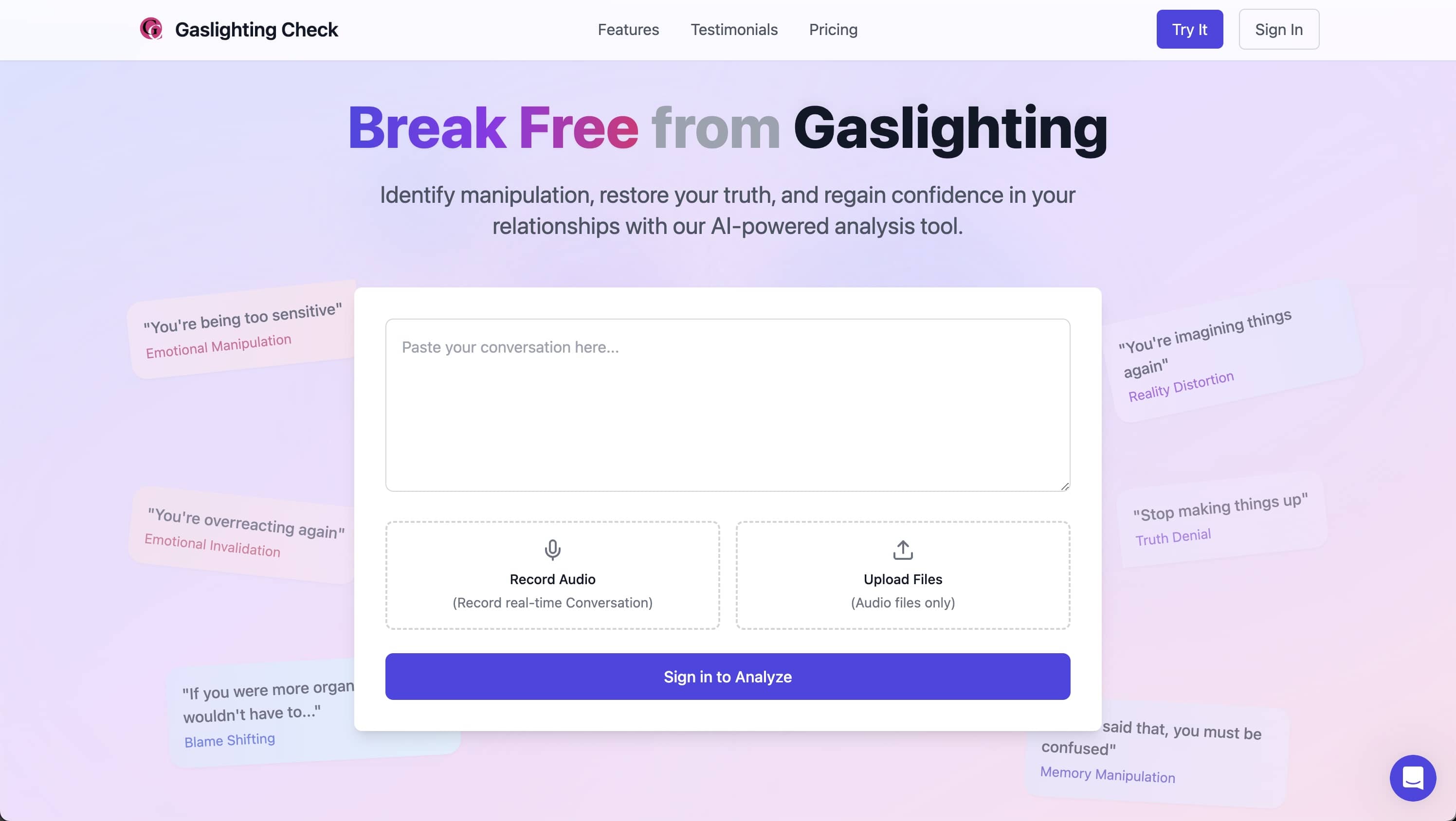
Screenshot of Gaslighting Check, Check hard conversations for gaslighting patterns before you reply

What is Gaslighting Check?

Gaslighting Check is an advice giver tool. An AI checker that reviews pasted conversations, screenshots, audio and transcripts for gaslighting and manipulation tactics, quoting the exact phrases behind each pattern and suggesting a next step. Built for partners, family conflict, workplace situations and no-contact threads, with private local handling until sign-in.

Gaslighting Check is an AI analysis tool built around a narrow, specific question: does this conversation contain recognizable manipulation tactics? You bring the material (pasted text, a screenshot of a message thread, an audio recording, or a transcript file) and the tool returns a review that points to the exact words behind a possible pattern, labels the tactic, and suggests a next step rather than telling you what to do with your relationship. The pattern library is where the product shows its focus. The homepage names specific behaviours: minimization and trivialization, denial of events that happened, blame shifting, smear campaign language, pseudo-apologies ("I am sorry you feel that way"), and manipulative victimism. Results also flag denial, blame and DARVO sequences. The review includes quoted evidence excerpts, so the output is anchored to phrases in the conversation rather than a general verdict. From there the tool routes you toward sorting facts, pausing before replying, drafting a calmer response, or documenting the exchange. The intended audience is people dealing with partners or exes, family members who rewrite events, managers whose instructions and blame keep shifting, and anyone in a no-contact thread who feels pulled back into circular arguments. Each report holds up to 30,000 characters of transcript, and text stays on the device until an account is created. The homepage is careful about limits: single messages cannot establish a pattern or prove intent, and the tool does not diagnose abuse. That framing is the right way to read it. This is not a therapist and not a legal evidence service; it is a structured second opinion for moments when self-doubt makes it hard to see what is in front of you. Compared with generic chat assistants that will happily analyze a conversation, Gaslighting Check wins on curated tactic categories and evidence highlighting, and on the private-by-default handling of sensitive text. Pricing tiers are not published on the homepage, so check the site directly before committing.

How do you use Gaslighting Check?

  1. 1Bring the conversation in
    Paste the exchange into the text box (up to 30,000 characters), or upload a screenshot, an audio file, or a transcript. Include only the portion you want reviewed.
  2. 2Add context before analyzing
    The optional context field is where you note what happened before this exchange and whether it repeats. The tool's own guidance stresses that a single message cannot show a pattern.
  3. 3Run the private analysis
    Submit the check. Your text stays on your device until you create an account, and each report covers one transcript at a time.
  4. 4Read the pattern and the quoted evidence
    Review which tactic was flagged (denial, blame, DARVO, minimization) and read the highlighted phrases that triggered it. Keep the disclaimer in view: the tool cannot establish intent.
  5. 5Choose a next step in the tools dashboard
    Sort facts, hold off on replying, draft a safer response, or save notes so the account of events stays stable. The dashboard holds the working tools for these actions.
  6. 6Take the quiz if you are still unsure
    If you do not yet have a specific conversation to check, the quiz walks through common gaslighting signals and helps you decide whether a review is worth running.

Pros and cons

Pros

  • Names specific tactics such as blame shifting, fauxpologies, DARVO and minimization rather than giving a generic sentiment readAI
  • Highlights quoted evidence from the conversation, so findings can be checked against the actual wordsAI
  • Accepts several input types: pasted text, screenshots, audio recordings and transcript filesAI
  • Text is stored locally until an account is created, which suits the sensitivity of the materialAI
  • Moves past detection into next steps like pausing, drafting a reply, or keeping private documentationAI

Cons

  • The homepage says explicitly that one message cannot establish a pattern or intent, so users may over-read a single reportAI
  • No pricing tiers are shown on the homepage, leaving cost and report limits unclear before sign-upAI
  • An account is required to save text and reports, cutting against the private-first pitchAI
  • Output quality depends on context you type in manually; missing backstory weakens the analysisAI
  • It cannot diagnose abuse or serve as evidence, so anyone in real danger gets no safety routingAI

How much does Gaslighting Check cost?

Features

Checks pasted text, screenshots (JPEG, PNG, WebP), audio recordings or uploads (WAV, MP3, M4A) and transcript files (.txt, .md). Reports cover up to 30,000 characters and highlight exact quoted evidence. Tactic categories include minimization, denial of events, blame shifting, smear campaign language, pseudo-apologies and manipulative victimism, plus denial, blame and DARVO sequences. Follow-up actions cover fact sorting, pausing, reply drafting and private documentation.

Frequently asked questions about Gaslighting Check

  • How do you use Gaslighting Check?
    The walkthrough on this page covers 6 steps: 1. Bring the conversation in 2. Add context before analyzing 3. Run the private analysis 4. Read the pattern and the quoted evidence 5. Choose a next step in the tools dashboard 6. Take the quiz if you are still unsure.
  • What platforms does Gaslighting Check support?
    Gaslighting Check is available on Web App.
  • What are the limitations of Gaslighting Check?
    The homepage says explicitly that one message cannot establish a pattern or intent, so users may over-read a single report. No pricing tiers are shown on the homepage, leaving cost and report limits unclear before sign-up. An account is required to save text and reports, cutting against the private-first pitch.