Support
Support runs through a contact form on the website; no public help centre or documentation portal is listed.
AI palletizing software for robot arms in live warehouse operations
Own Jacobi Robotics? Verify ownership to get a dofollow link

Jacobi Robotics is a productivity tool. Jacobi Robotics sells OmniPalletizer, AI software that drives robot arms to build store-ready mixed-case pallets from live warehouse flow, with simulation-led evaluation and a standardized interface for system integrators.
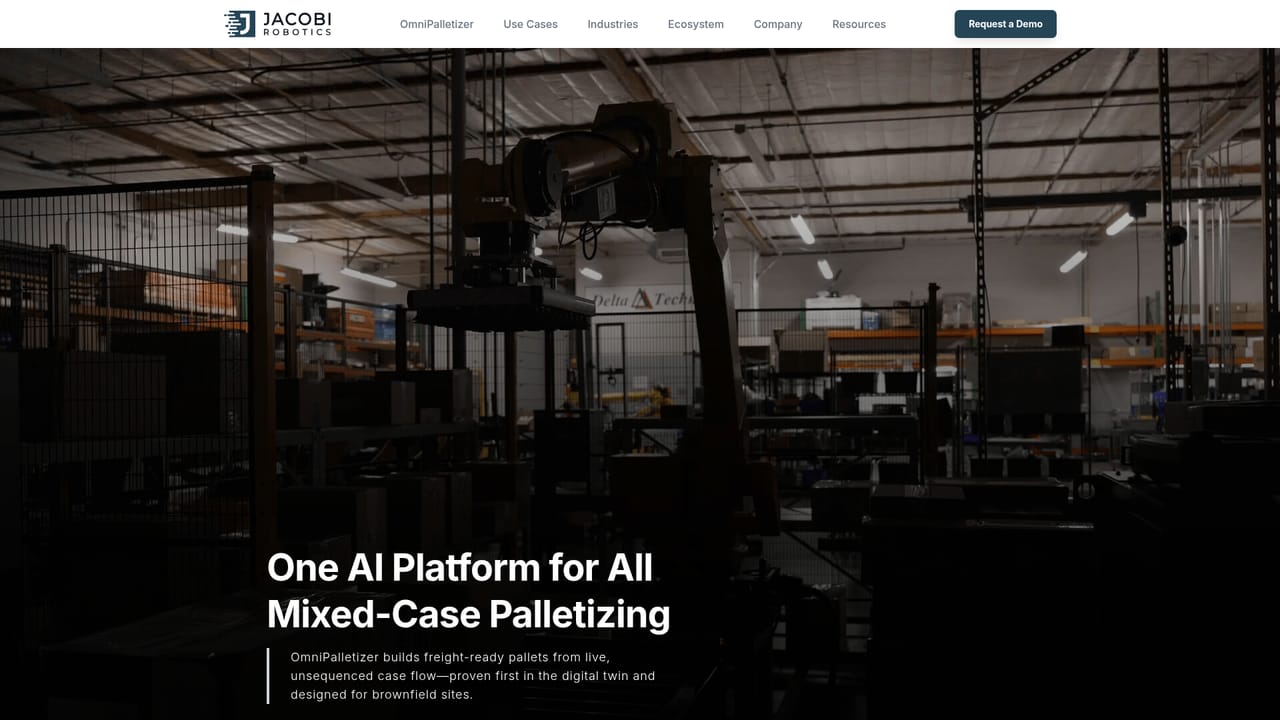
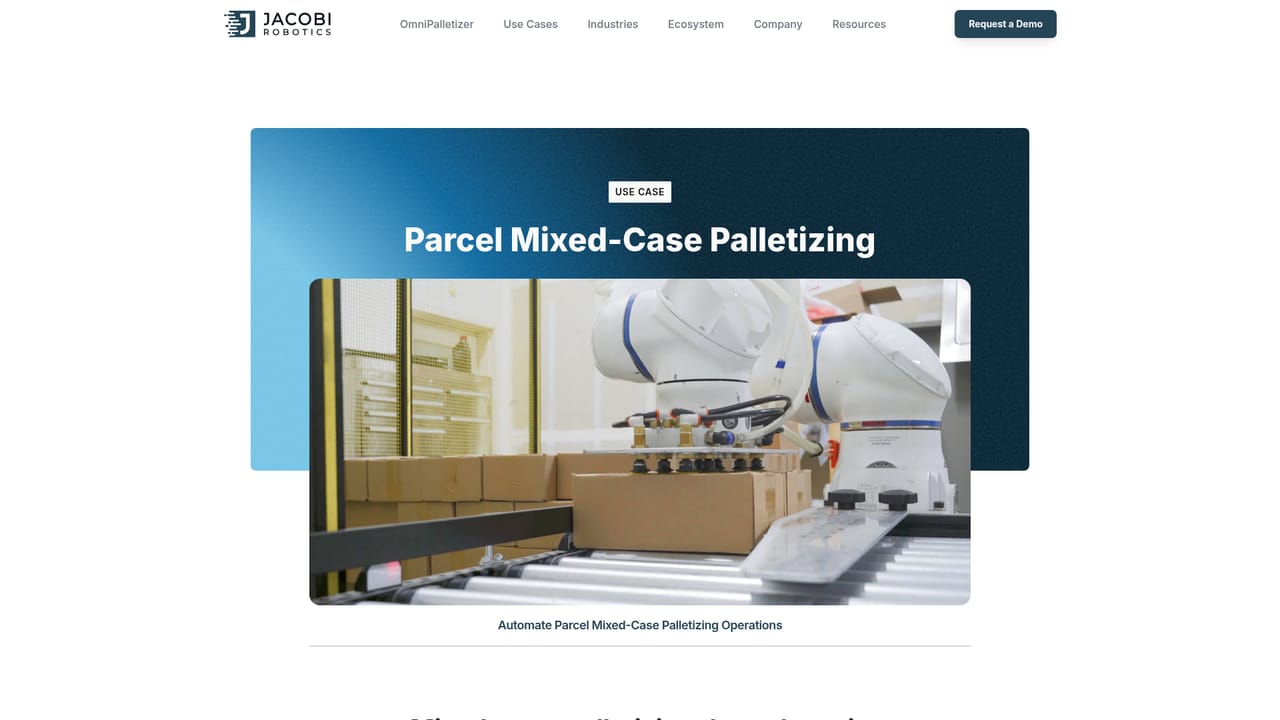
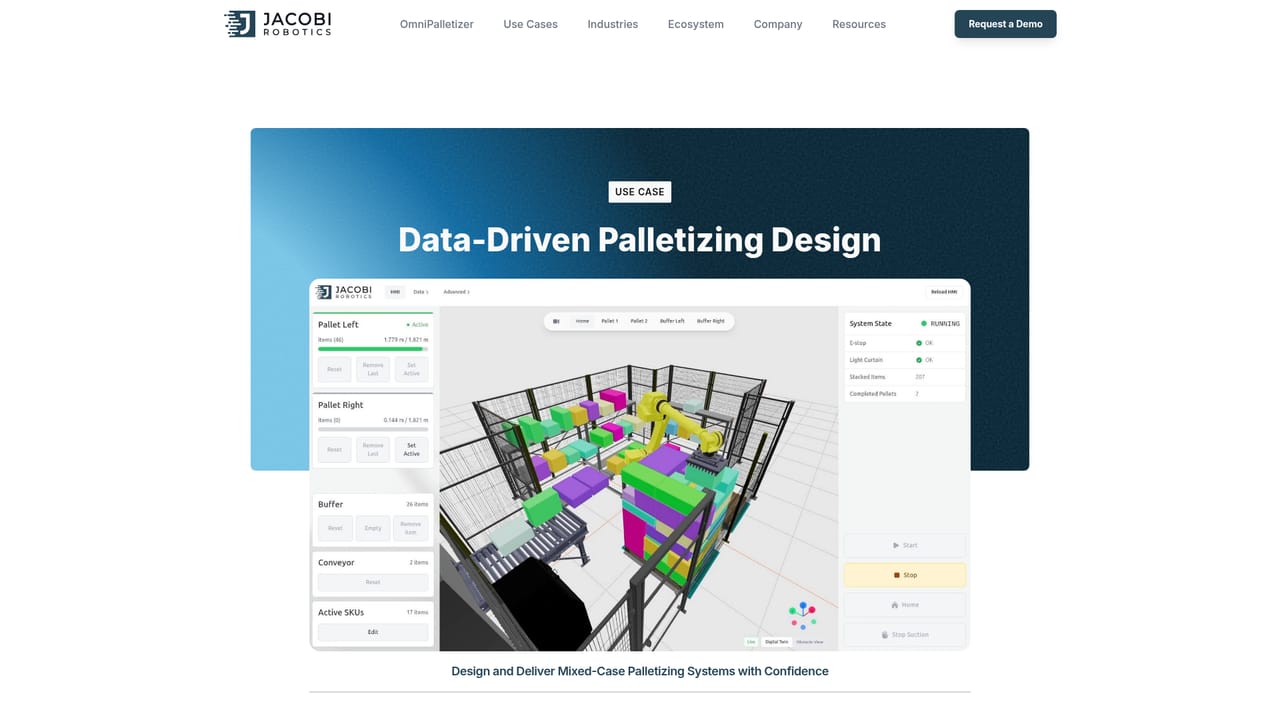
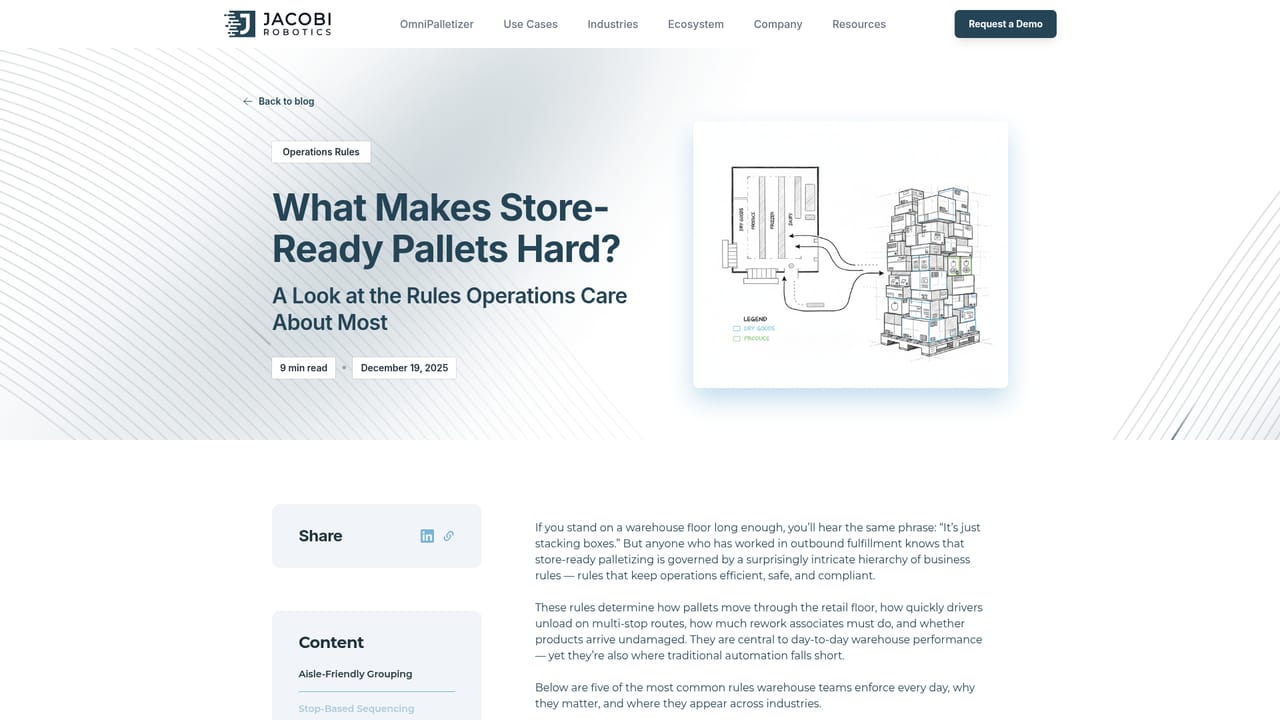
Jacobi Robotics builds software for robot arms, centered on its OmniPalletizer product. The pitch is straightforward: instead of hand-engineering every pallet pattern and motion path, operations teams deploy a system that ingests live mixed-case flow and builds store-ready pallets from it. The company positions the software for retail, grocery, pharma, e-commerce, FMCG and LTL environments, and says it installs into existing lines rather than requiring a rebuilt facility. Over time the system adapts and learns from the pallets it has already built. The practical value sits in the rules it enforces. OmniPalletizer handles case flows coming from pick-to-belt, goods-to-person or AS/RS systems, keeps pace with peak throughput, and applies the constraints warehouse managers actually care about: heavy-to-light stacking, crush limits, aisle-friendly grouping and stop-based sequencing. That last set of details is where most mixed-case palletizing projects stall, because a robot that stacks boxes quickly is useless if the resulting pallet collapses or arrives at the store in the wrong order. Jacobi leads with simulation. Before a customer commits, the company models the deployment against real customer data so stakeholders can see projected throughput, pallet quality and return on investment. The stated goal is that what gets purchased is exactly what will run in the building. For system integrators, the appeal is standardization: one interface across projects and a repeatable, productized path to mixed-case palletizing, including flows that do not depend on upstream sequencing infrastructure. The homepage lists ABB Robotics, Honeywell, DHL, FORTNA and PEAK among the organizations it works with, and press coverage describes an ABB collaboration and a FORTNA expansion into mixed-case palletizing. This is industrial software, not a self-serve tool. Buyers are operations leaders at distributors and retailers, and the integrators who deploy robot cells for them. Pricing is quoted through a contact form, and evaluation runs through simulation and use-case scoping rather than a free signup.

Support runs through a contact form on the website; no public help centre or documentation portal is listed.
Designed to install into existing lines and accept case flow from pick-to-belt, goods-to-person and AS/RS systems. Public partner references include ABB Robotics and FORTNA.
Learn moreOmniPalletizer converts live mixed-case flow into store-ready pallets, supports pick-to-belt, goods-to-person and AS/RS inputs, and enforces heavy-to-light stacking, crush limits, aisle-friendly grouping and stop-based sequencing at peak throughput. Simulation against real customer data projects throughput, pallet quality and ROI before deployment, and the software improves as it accumulates operating experience.
Learn more AI Angels400+ customizable AI girlfriends for NSFW chat, voice calls, and roleplay
 Candy AIExperience the future of companionship with AI friends who chat, role-play, and connect with you on a human level.
 ourdream.aiA vast AI roleplay platform with millions of characters for chat, images, video and voiceAI Angels400+ customizable AI girlfriends for NSFW chat, voice calls, and roleplayCandy AIExperience the future of companionship with AI friends who chat, role-play, and connect with you on a human level.ourdream.aiA vast AI roleplay platform with millions of characters for chat, images, video and voice


