Support
Support runs through the sales and onboarding relationship, starting with a booked walkthrough. No public help centre or documentation portal is referenced on the homepage.
Condition monitoring that catches wind and solar faults before alarms do

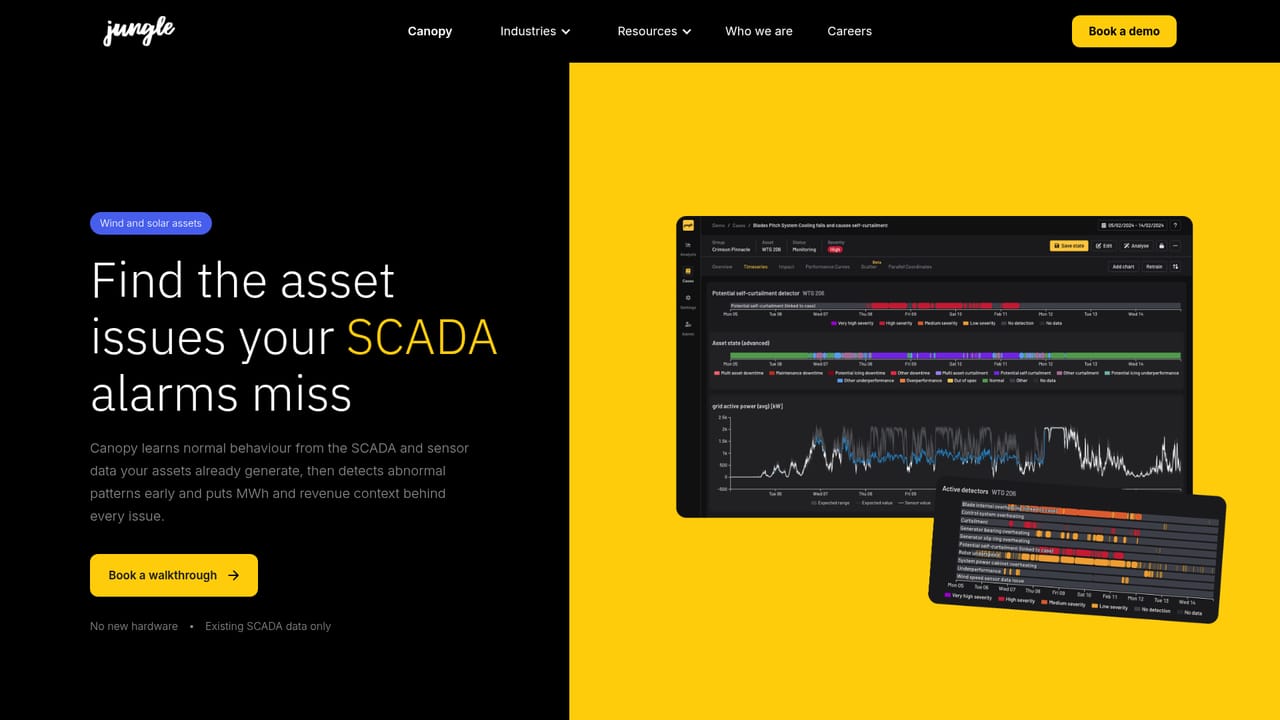
Jungle AI is a pattern recognition tool. Jungle AI's Canopy uses machine learning on existing SCADA data to flag abnormal wind turbine and solar asset behaviour before fixed alarms trigger, delivering prioritised cases with impact and evidence. No new hardware, live in 2 to 3 weeks, aimed at renewable asset managers and operations teams.
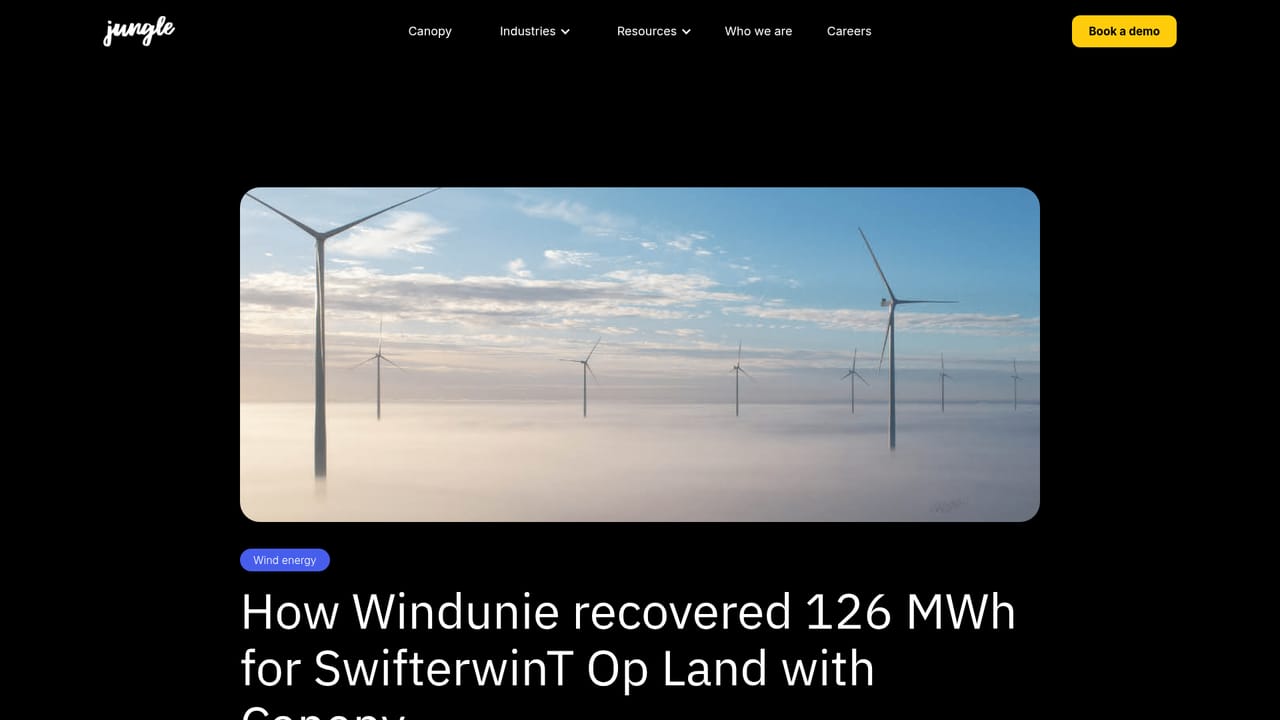
Jungle AI is a renewable energy software company whose main product, Canopy, watches wind turbines and solar farms for signs of trouble that conventional monitoring misses. The premise is simple: most costly failures announce themselves in SCADA and sensor data long before a fixed threshold alarm fires. A bearing starts running slightly hotter than it should for a given wind speed, a pitch system drifts, an inverter quietly self-curtails. Canopy builds a per-asset model of expected behaviour from that asset's own history, then watches for departures from the model. The product splits into two editions, one for wind and one for solar. On the wind side it targets bearing overheating, gearbox and drivetrain abnormalities, hydraulic issues, pitch system deviations, and curtailment or underperformance. On the solar side it covers inverter overheating, inverter self-curtailment, tracker misalignment, string underperformance, and losses from icing, soiling and curtailment. Each flagged behaviour arrives as a case with context, impact and evidence rather than a raw alert, which is the part that matters for a team deciding what to inspect first. Deployment is deliberately light. Jungle states that no new hardware is required, that the system runs on existing SCADA data only, and that customers are live in 2 to 3 weeks. The company reports customers across 12 countries and 4 continents, and its published case work includes a rotor bearing issue at Galp, a hydraulic fault at Ventolines caught months ahead of the threshold alarm, and a pitch behaviour detection at Windunie that recovered 126 MWh. Jungle also quotes an average 1 percent additional AEP and 15 to 25 percent margin improvement as expected returns. This is specialist industrial software, not a general analytics platform. It competes with OEM monitoring suites and independent condition monitoring providers, and it is aimed squarely at asset managers, operations engineers and performance analysts inside wind and solar owners and operators. Smaller portfolios with limited SCADA history have less to work with, and pricing is quoted through a sales conversation rather than published on the site.
Support runs through the sales and onboarding relationship, starting with a booked walkthrough. No public help centre or documentation portal is referenced on the homepage.
The platform runs on existing SCADA data and requires no new hardware, per the homepage. Specific SCADA vendors and systems are not listed.
Canopy builds a per-asset model of expected behaviour from historical sensor data, flags deviations that fixed alarms miss, and packages each finding as a case with context, impact and evidence. Wind coverage includes bearings, gearbox and drivetrain, hydraulics, pitch and curtailment. Solar coverage includes inverter overheating, self-curtailment, tracker misalignment, string underperformance, icing, soiling and curtailment.
Learn more AI Angels400+ customizable AI girlfriends for NSFW chat, voice calls, and roleplay
 Candy AIExperience the future of companionship with AI friends who chat, role-play, and connect with you on a human level.
 ourdream.aiA vast AI roleplay platform with millions of characters for chat, images, video and voiceAI Angels400+ customizable AI girlfriends for NSFW chat, voice calls, and roleplayCandy AIExperience the future of companionship with AI friends who chat, role-play, and connect with you on a human level.ourdream.aiA vast AI roleplay platform with millions of characters for chat, images, video and voice


