Mindreader

Lead scoring and buyer context that tells sales teams who to call and what to say

Beginner
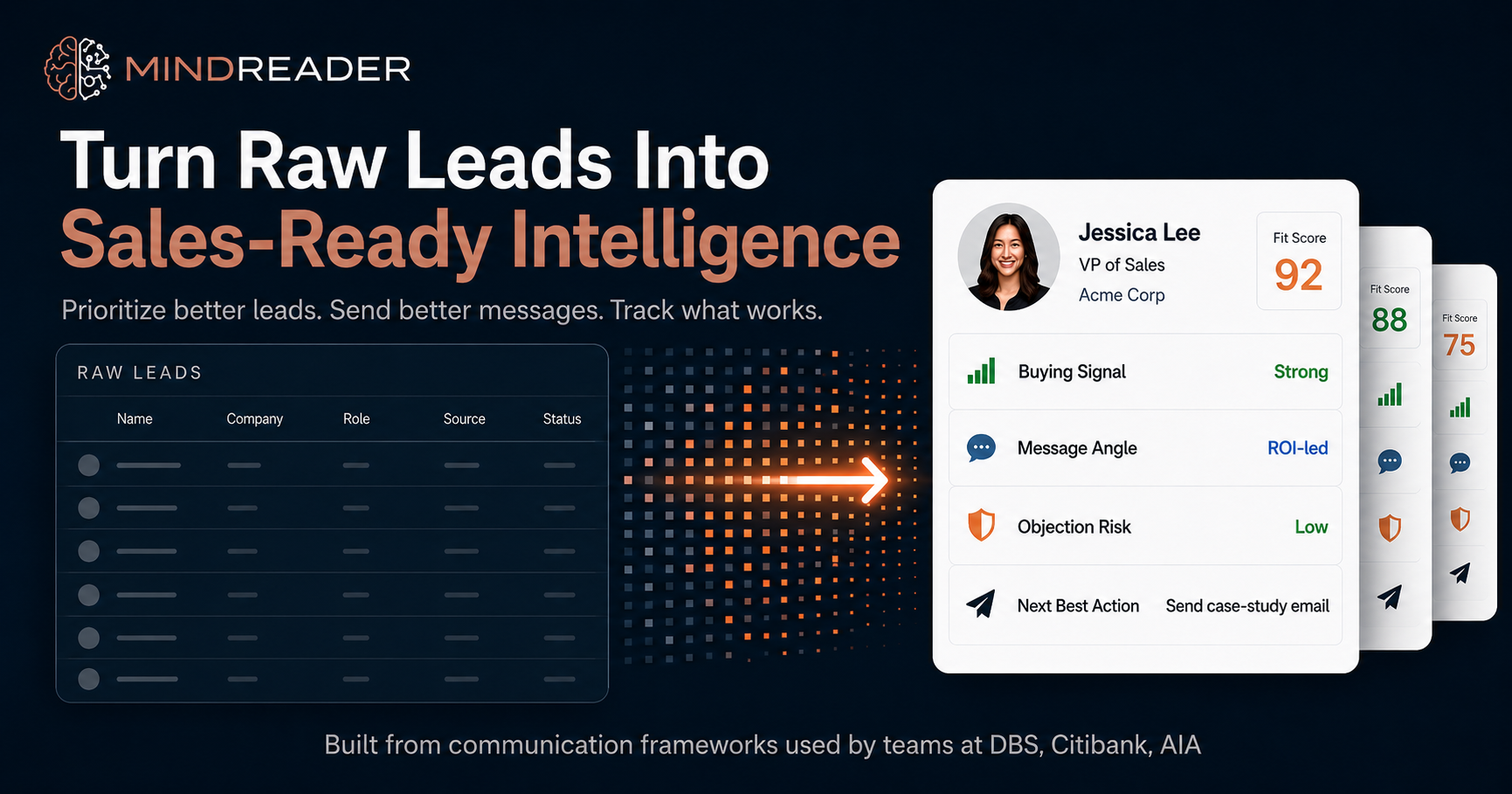
Screenshot of Mindreader, Lead scoring and buyer context that tells sales teams who to call and what to say

What is Mindreader?

Mindreader is a lead generation tool. Mindreader enriches raw sales leads with fit scores, buying signals, message angles, and next-best-action suggestions, built on a personality-based sales training system used with finance, insurance, and property teams. It targets prioritization and communication rather than list volume.

Mindreader is a lead intelligence layer for sales teams. It takes raw lead records and returns a fit score, buying signals, suggested message angles, and a next-best-action recommendation before a setter, agent, or seller makes contact. The pitch is narrow and specific: the product does not replace the CRM, it sits in front of follow-up and answers three questions per lead, which prospects deserve attention first, what framing will land with each one, and what should happen next. The method behind those outputs is a personality-based sales training system rather than a purely statistical model. Mindreader's team says it has trained professionals across finance, insurance, real estate, and enterprise sales, with logos from several insurers and banks on the homepage, and the product packages that field experience into repeatable communication guidance. Blog material on Type A versus Type B buyers, DISC, the Big Five, and attachment styles shows the framework the recommendations draw from. Users describe classifying a client into a type and then adjusting vocabulary, pacing, and presentation format to match. In practice this fits teams that already generate or buy lead lists and find themselves short on prioritization rather than volume. Wealth advisers, property agents, insurance consultants, and B2B sellers are the clearest audience, since the testimonials come from those worlds. The output is meant to be delivered into tools the team already uses, so it behaves more like enrichment data than another dashboard. Enrichment and scoring tools such as Clay or Clearbit focus on firmographics and intent data; Mindreader's differentiator is communication style and message angle, which makes it a complement rather than a direct swap. Access is arranged through a Lead Intelligence Pilot rather than self-serve checkout, and the site does not publish prices, plan tiers, integration specifics, or support terms. Buyers should expect a scoped engagement and ask directly which systems receive the enriched records.

How do you use Mindreader?

  1. 1Review the method and case studies
    Read the case studies page to see how teams applied the framework and what outcomes they reported. This sets expectations before you commit to a pilot conversation.
  2. 2Read the buyer-type primers
    The blog explains how Type A and Type B buyers differ in pacing, vocabulary, and what they want to see before deciding. It is the clearest public explanation of what Mindreader's message angles are built on.
  3. 3Book a Lead Intelligence Pilot
    Access is arranged through a pilot rather than a signup form. Use the booking route on the homepage to scope which lead sources and workflows the enrichment should cover.
  4. 4Connect your lead sources
    During onboarding, provide the lead records you want enriched. Confirm with the team which fields are required and how records are returned to your sales workflow.
  5. 5Work the scored queue
    Setters and sellers pick leads by fit score, read the buying signals and suggested angle, then follow the recommended next action before making contact.
  6. 6Compare notes against real conversations
    Review whether the predicted communication style matched what happened on the call, and feed corrections back so the team's read of each segment sharpens over time.

Pros and cons

Pros

  • Turns a flat lead list into a ranked, annotated queue with a suggested next action per recordAI
  • Message angles are grounded in an established personality framework rather than generic personalizationAI
  • Testimonials come from financial services, insurance, and real estate practitioners with concrete conversion claimsAI
  • Positioned as enrichment that lands in existing sales tools instead of demanding a new workspaceAI
  • The sales training pedigree gives the recommendations a documented method behind themAI

Cons

  • No published pricing, plan tiers, or feature breakdown, so cost and scope only surface in a booked pilotAI
  • Integration page is absent, leaving it unclear which CRMs or sales tools actually receive the enriched dataAI
  • Personality typing as the core signal invites skepticism about accuracy and fairness in segmentationAI
  • Tutorials and help documentation are not exposed publicly, which makes self-evaluation hardAI
  • The homepage testimonials skew toward Asian insurance and property sales, so fit for other markets is unprovenAI

How much does Mindreader cost?

Features

Mindreader enriches lead records with a fit score, buying signals, and conversion angles, then recommends a next-best action for each lead before a setter or seller follows up. Enriched intelligence is delivered into the tools a team already uses. The underlying method is a personality-based sales training system applied across finance, insurance, real estate, and enterprise sales.

Frequently asked questions about Mindreader

  • How do you use Mindreader?
    The walkthrough on this page covers 6 steps: 1. Review the method and case studies 2. Read the buyer-type primers 3. Book a Lead Intelligence Pilot 4. Connect your lead sources 5. Work the scored queue 6. Compare notes against real conversations.
  • What platforms does Mindreader support?
    Mindreader is available on Web App.
  • What are the limitations of Mindreader?
    No published pricing, plan tiers, or feature breakdown, so cost and scope only surface in a booked pilot. Integration page is absent, leaving it unclear which CRMs or sales tools actually receive the enriched data. Personality typing as the core signal invites skepticism about accuracy and fairness in segmentation.

Status

StatusActive
Views0
Outbound clicks0
Added10/21/2026

Platforms

Web App

Pricing

Paid