Minds

Synthetic audiences for fast, repeatable market research

Intermediate API
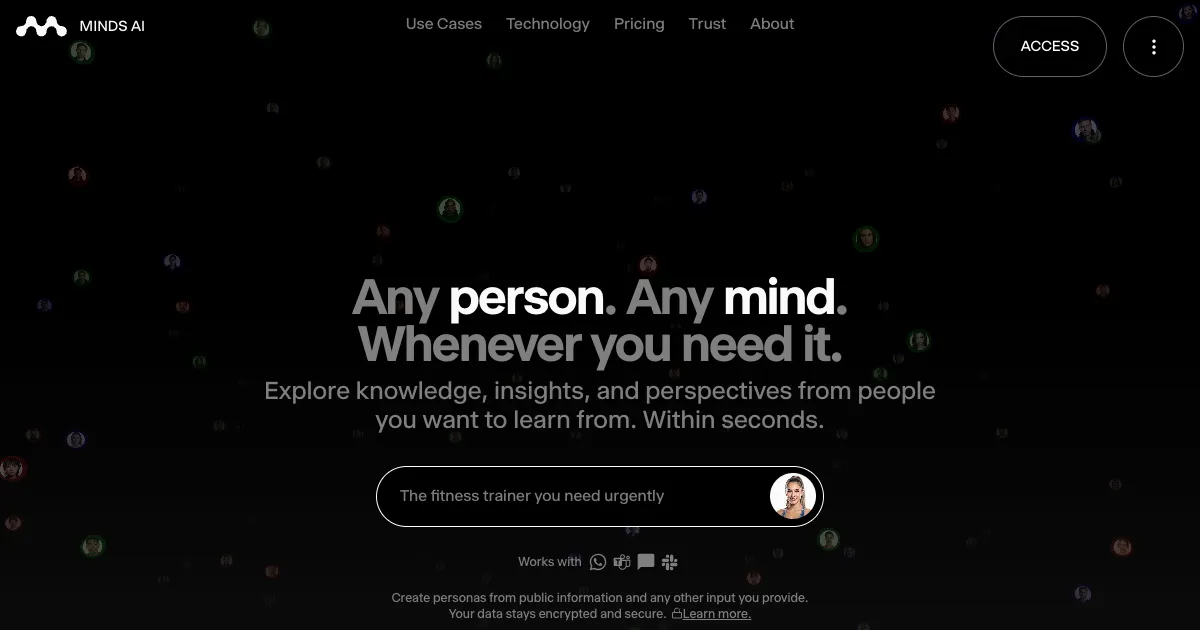
Screenshot of Minds, Synthetic audiences for fast, repeatable market research

What is Minds?

Minds creates reusable synthetic audiences from a brief, file or link and runs message tests, concept comparisons, pricing probes and structured studies against them in minutes. Minds PRISM source modelling underpins the simulations, with per-persona profiles and results traceable to individual responses.

Minds builds synthetic audiences that stand in for real target groups during research. A user supplies a brief, a file or a link, and the platform identifies the audience dimensions that matter for the question at hand, then assembles a reusable panel of simulated respondents with an explicit profile for each individual Mind. Segment allocation is set precisely, so a study can mirror the weighting of a real population rather than a loose approximation of one. The product covers a wide range of research jobs. A team can test a single message, compare competing concepts, probe pricing reactions, or run a fully structured study with the same underlying audience. Simple questions are quick to set up, while decisions that need more rigor expose more control over how the study is framed. Results remain traceable back to the individual responses and the reasoning behind them, which matters when a synthetic finding has to survive scrutiny from stakeholders. Beneath the surface, Minds PRISM source modelling anchors the simulations. The site cites audience examples such as U.S. Gen Z (7,983 data points), European fast food consumers (7,426 data points) and global health care workers (6,871 data points), which signals how granular the underlying panels can get. Customers shown on the homepage span consumer brands, agencies, research institutes and publishers, and there are dedicated entry points for brands, agencies and research partners. Minds sits in an unusual spot in the AI tool landscape. It is not a chatbot that answers questions and not a survey fielding service; it is closer to a simulation layer that sits in front of a research question. That makes it a fit for marketing and product teams that need directional insight in minutes, and for research organizations that want to test hypotheses before committing budget to fieldwork. Teams expecting it to replace statistically validated primary research outright should read the published validation work first.

How do you use Minds?

  1. 1Review the fit for your team type
    Check the brand, agency or research partner pages to see which use cases Minds positions itself for before starting a study.
  2. 2Start from a brief, file or link
    Paste a research brief or supply supporting material. Minds identifies the audience dimensions that matter and proposes how to structure the panel.
  3. 3Build and save the audience
    Set the segment allocation and review the explicit profile for each Mind, then save the audience so it can be reused for later questions.
  4. 4Run a test or a full study
    Start with a quick message or concept test, or move into a structured study with more control when the decision needs it.
  5. 5Trace results back to responses
    Open the findings and follow each result down to the individual responses and reasoning behind it before sharing with stakeholders.
  6. 6Optional: browse the marketplace
    Look at the marketplace for prebuilt audiences or configurations rather than constructing every panel from scratch.

Pros and cons

Pros

  • Audiences are reusable across studies, so a segment only has to be built onceAI
  • Every individual Mind carries an explicit profile, which makes segment composition auditableAI
  • Simple tests start fast while structured studies expose deeper setup controlsAI
  • Results stay linked to the underlying responses and reasoning, supporting reviewAI
  • Source modelling via Minds PRISM and published validation studies back the approachAI

Cons

  • No pricing is published on the homepage, so budget planning requires a sales conversationAI
  • Synthetic results still need to be read as directional; the homepage does not claim substitutes for fielded researchAI
  • Heavier structured studies carry a real learning curve in setupAI
  • The value depends on how well the audience dimensions match the real population being modelledAI
  • No public self-serve signup path is described; onboarding appears to go through salesAI

How much does Minds cost?

Integrations

A broad integration library is documented, including Google Drive, OneDrive, Google Sheets, Slack, Jira, Linear, Figma, Looker Studio, n8n and embed widgets, plus connections to Claude, ChatGPT, Gemini, Cursor and OpenRouter for model access.

Learn more

Features

Audience construction from a brief, file or link, with defensible dimensions identified automatically and exact segment allocation. Reusable audiences with explicit profiles per Mind. Support for message tests, concept comparisons, pricing probes and structured studies. Results stay connected to the responses and reasoning behind them. Powered by Minds PRISM source modelling, with dedicated paths for brands, agencies and research partners.

Learn more

Frequently asked questions about Minds

  • Does Minds have an API?
    Yes, Minds offers an API.
  • How do you use Minds?
    The walkthrough on this page covers 6 steps: 1. Review the fit for your team type 2. Start from a brief, file or link 3. Build and save the audience 4. Run a test or a full study 5. Trace results back to responses 6. Optional: browse the marketplace.
  • What platforms does Minds support?
    Minds is available on Web App and Browser extension.
  • What does Minds integrate with?
    A broad integration library is documented, including Google Drive, OneDrive, Google Sheets, Slack, Jira, Linear, Figma, Looker Studio, n8n and embed widgets, plus connections to Claude, ChatGPT, Gemini, Cursor and OpenRouter for model access.
  • What are the limitations of Minds?
    No pricing is published on the homepage, so budget planning requires a sales conversation. Synthetic results still need to be read as directional; the homepage does not claim substitutes for fielded research. Heavier structured studies carry a real learning curve in setup.

Status

StatusActive
Views0
Outbound clicks0
Added10/21/2026

Platforms

Web AppBrowser extension

Pricing

Free TrialPaid