Optimus by Iacon Autonomics

An autonomous RL engineer that trains agents, LLMs and robot policies

Advanced
Screenshot of Optimus by Iacon Autonomics, An autonomous RL engineer that trains agents, LLMs and robot policies

What is Optimus by Iacon Autonomics?

Optimus by Iacon Autonomics is a research tool. Optimus from Iacon Autonomics is an autonomous reinforcement learning engineer. Given an agent or model and a goal, it researches methods, runs experiments and trains LLMs, agents and robot policies, with desktop apps for Mac, Windows and Linux.

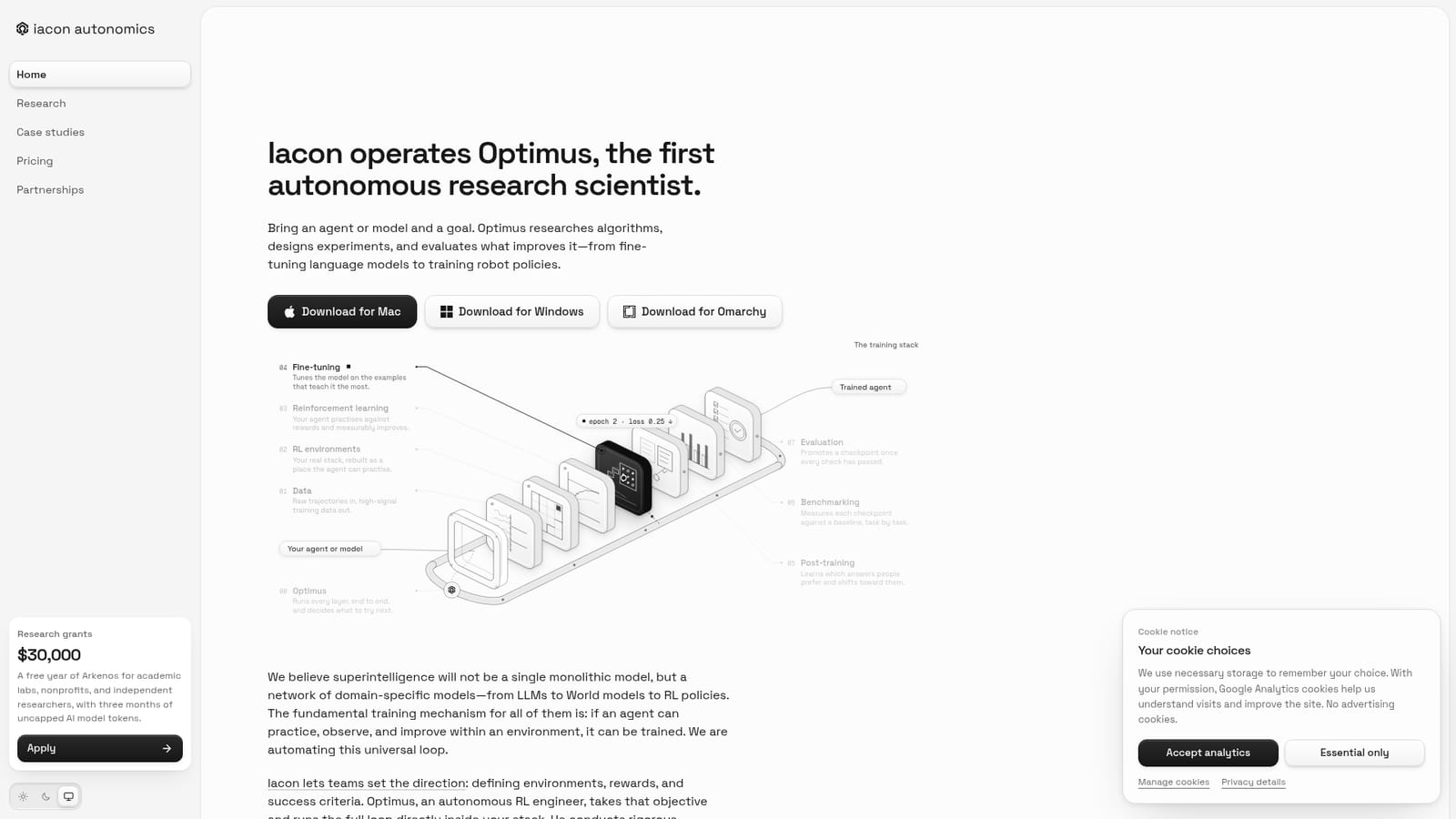
Optimus, operated by Iacon Autonomics, is an autonomous reinforcement learning engineer. A team supplies an agent or model together with a goal, and Optimus researches algorithms, designs experiments, runs them and evaluates which changes actually improve the result. The stated scope runs from fine-tuning language models to training robot policies, and the company also names diffusion models, NPCs, biological systems and custom policies as targets. The product is organized as a training stack that Optimus operates end to end. It starts with data, turning raw trajectories into higher-signal training sets. It then rebuilds the customer's real environment as an RL environment where the agent can practise, applies reinforcement learning against rewards, fine-tunes on the most instructive examples, and runs post-training to shift outputs toward preferred answers. Benchmarking compares each checkpoint with a baseline task by task, and evaluation promotes a checkpoint only after every check has passed. Optimus also decides what to try next across those layers. In practice, humans keep control of direction: they define the environments, rewards and success criteria, while Optimus runs the loop inside the customer's own stack. It can implement published state-of-the-art methods or synthesize new ones. Desktop downloads are offered for Mac (Apple Silicon), Windows (x64) and Linux (x64 AppImage). The site presents case studies with Resemble AI (an investigative-agent benchmark called DetectBench), Google DeepMind (teaching Gemma to paint through code) and an independent MuJoCo project for a Franka Panda picking task. Several research groups and companies are listed as users, and a partnership program invites compute, simulator and data providers to integrate with the stack. Among alternatives, Optimus sits closer to an automated research engineer than to a training library or hosted fine-tuning service. It suits teams that already have a defined environment and reward and want the experimentation loop itself delegated, rather than people looking for a one-click model customization tool.

How do you use Optimus by Iacon Autonomics?

  1. 1Install the desktop app
    Download the Mac (Apple Silicon), Windows x64 or Linux x64 AppImage build from the homepage and install it on the machine that can reach your training stack.
    Optimus by Iacon Autonomics — Install the desktop app
  2. 2Review a comparable case study
    Read the DeepMind, Resemble AI or MuJoCo case study to see how goals, evaluation and successive agent revisions are structured.
    Optimus by Iacon Autonomics — Review a comparable case study
  3. 3Bring your agent or model
    Connect the agent or model you want improved, whether a language model, robot policy or custom policy, so Optimus can work inside your stack.
  4. 4Define environments, rewards and success criteria
    Specify the environment the agent practises in, the reward signal and the checks that define success. Optimus uses these to plan experiments.
  5. 5Review benchmarked checkpoints
    Compare each checkpoint against the baseline task by task and use the trained agent once every evaluation check has passed.

Pros and cons

Pros

  • Covers the whole training loop: data, RL environments, fine-tuning, post-training, benchmarking and evaluationAI
  • Humans set environments, rewards and success criteria while Optimus runs the experimentationAI
  • Works across LLMs, diffusion models, robotics, NPCs and custom policiesAI
  • Checkpoints are benchmarked against a baseline and promoted only after every check passesAI
  • Public case studies with Google DeepMind, Resemble AI and a MuJoCo robot task show concrete useAI

Cons

  • Pricing is not published on the homepage, so cost cannot be judged before contactAI
  • Requires a well-defined environment, reward and success criteria from the user, which is real upfront workAI
  • Aimed at ML teams and researchers, so it is a poor fit for non-technical usersAI
  • No integrations, API or documentation are described, leaving compatibility with existing stacks unclearAI
  • Autonomous experiment design may be harder to audit than a manually run training pipelineAI

How much does Optimus by Iacon Autonomics cost?

Integrations

The homepage describes running inside the customer's own stack and partnering with compute, simulator and data providers, but names no specific integrations.

Learn more

Features

Autonomous algorithm research, experiment design and evaluation. Covers data curation from raw trajectories, RL environments, reinforcement learning, fine-tuning, post-training, benchmarking against baselines and checkpoint promotion, for LLMs, diffusion models, robotics and custom policies.

Learn more

Frequently asked questions about Optimus by Iacon Autonomics

  • How do you use Optimus by Iacon Autonomics?
    The walkthrough on this page covers 5 steps: 1. Install the desktop app 2. Review a comparable case study 3. Bring your agent or model 4. Define environments, rewards and success criteria 5. Review benchmarked checkpoints.
  • What platforms does Optimus by Iacon Autonomics support?
    Optimus by Iacon Autonomics is available on MacOS, Windows and Linux.
  • What does Optimus by Iacon Autonomics integrate with?
    The homepage describes running inside the customer's own stack and partnering with compute, simulator and data providers, but names no specific integrations.
  • What are the limitations of Optimus by Iacon Autonomics?
    Pricing is not published on the homepage, so cost cannot be judged before contact. Requires a well-defined environment, reward and success criteria from the user, which is real upfront work. Aimed at ML teams and researchers, so it is a poor fit for non-technical users.

Status

StatusActive
Views0
Outbound clicks0
Added10/18/2026

Platforms

MacOSWindowsLinux

Pricing

Paid