GPTProto

One pay-per-token API for 200+ chat, image and video models

Intermediate API
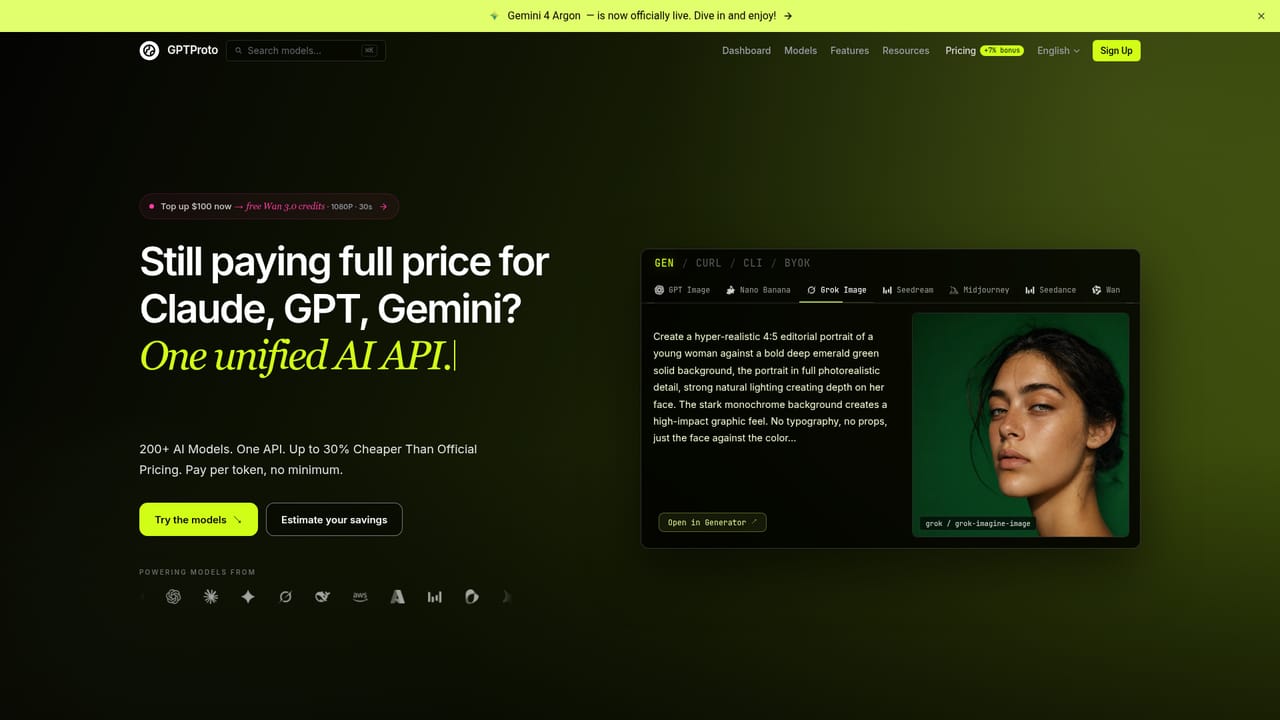
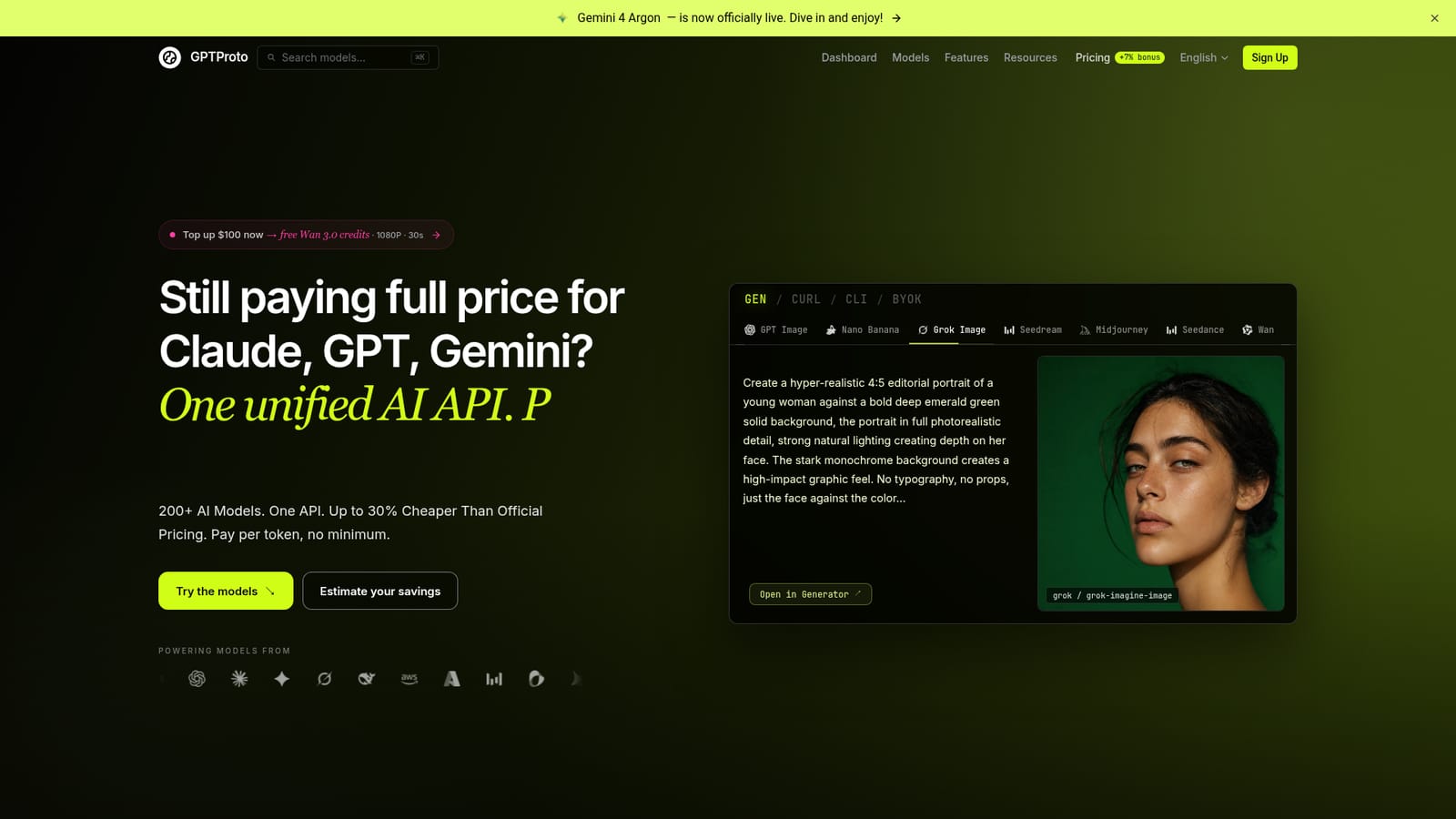
Screenshot of GPTProto, One pay-per-token API for 200+ chat, image and video models

What is GPTProto?

GPTProto is a unified API gateway giving access to 200+ chat, image and video models from OpenAI, Claude, Gemini, Grok and others, billed per token with no minimum and advertised discounts against official and OpenRouter prices.

GPTProto is an API aggregator that puts more than 200 AI models behind a single endpoint and a single account. The catalog spans text models from OpenAI, Claude, Gemini, Grok, DeepSeek, GLM, Kimi, Qwen, MiniMax and Hunyuan, plus image and video generators such as GPT Image, Nano Banana, Seedream, Midjourney, Seedance and Wan. Billing is per token with no minimum, and the site claims prices up to 30% below official provider rates, with a comparison column against OpenRouter as well. The service is aimed at developers and teams that call several model vendors and want one key, one invoice and one integration. The homepage groups models by use case, including benchmarks, roleplay, AI agents, image generation, video generation, content production, customer service, data extraction and business analytics. Each group is a table listing GPTProto's input and output price per million tokens, the discount against official pricing and OpenRouter, context window size, and a link to the model page. Cache-read prices are shown where a model supports them, and image models are priced per image. In practice a user creates an API key from the dashboard, picks a model from its page and sends requests through an OpenAI-compatible interface. The homepage mentions curl and CLI access, bring-your-own-key, routing and failover, and compatibility with coding agents and chat front ends such as Claude Code, Codex, Cline, Kilo Code, SillyTavern and Janitor AI. A browser-based generator lets people try an image model with a prompt before writing any code, and a savings calculator estimates the difference from paying providers directly. Among alternatives, GPTProto sits closest to OpenRouter and to buying credits from each lab separately. Its pitch is price and breadth rather than a proprietary model or workflow layer, so it suits cost-sensitive production workloads, agent pipelines and experiments across vendors. Teams that need a direct contract with a single provider may still prefer going to the source.

How do you use GPTProto?

  1. 1Create an account and API key
    Sign up, then open the dashboard API key page and generate a key for your requests.
    GPTProto — Create an account and API key
  2. 2Pick a model and compare prices
    Browse the use-case tables on the homepage and compare input, output and cache-read prices, context size and discounts before choosing.
    GPTProto — Pick a model and compare prices
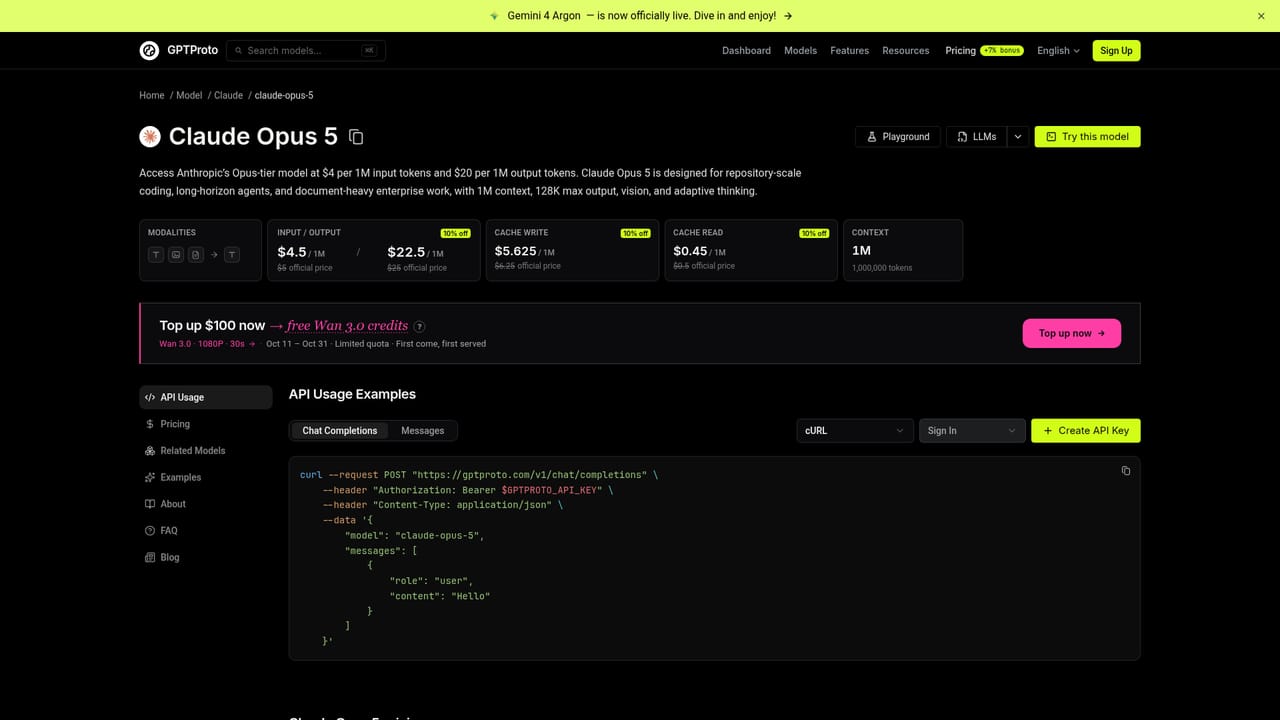
  3. 3Open a model page
    Select a model such as Claude Opus 5 to see its details and request format before wiring it into code.
    GPTProto — Open a model page
  4. 4Send a first request
    Point an OpenAI-compatible client or curl at GPTProto with your key and the chosen model name, then check the response and token usage.
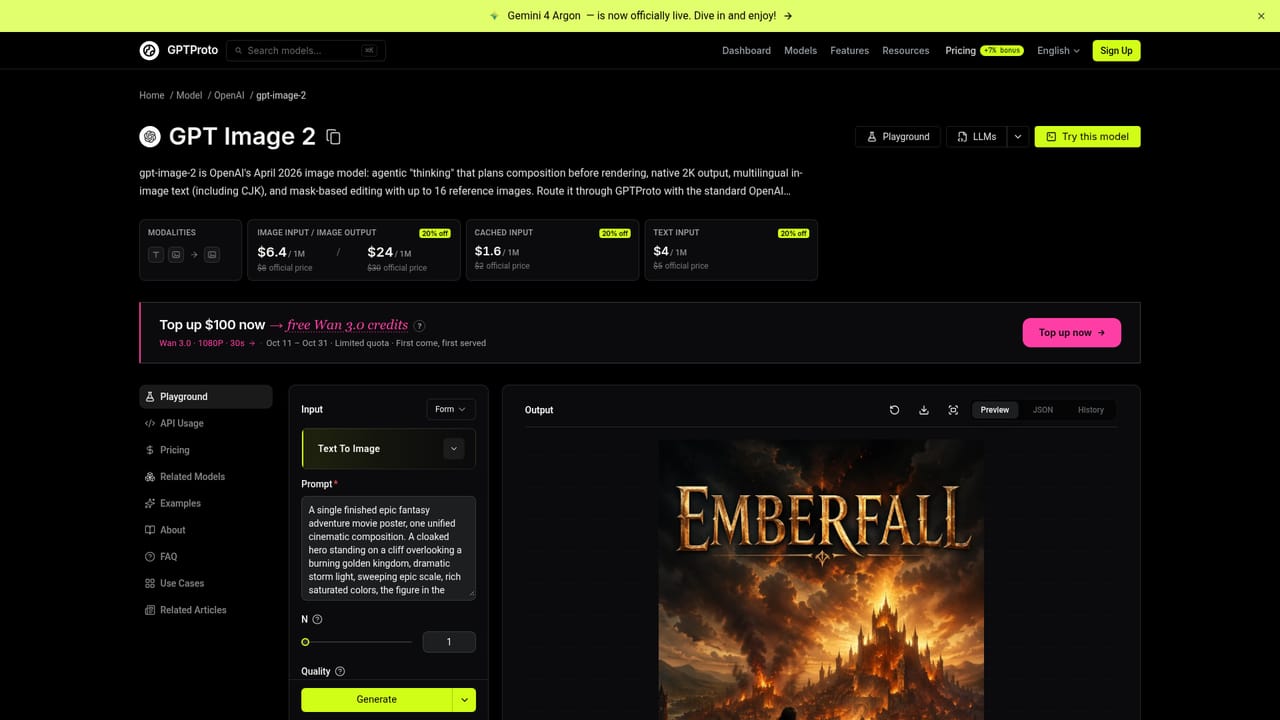
  5. 5Try image generation in the browser
    Use the generator with a model such as GPT Image 2 to test a prompt without writing code.
    GPTProto — Try image generation in the browser

Pros and cons

Pros

  • Single key and account reach 200+ models across text, image and video vendorsAI
  • Pay per token with no minimum, so small experiments cost little to startAI
  • Pricing tables show discounts against both official rates and OpenRouter per modelAI
  • Works with coding agents and chat front ends such as Claude Code, Cline and SillyTavernAI
  • Browser generator and savings calculator let buyers test models and estimate costs firstAI

Cons

  • Discounts vary by model and range from 5% to 43%, so savings on some models are smallAI
  • Headline claims differ across the page (up to 30% versus up to 80%), which makes real savings hard to judgeAI
  • Reselling third-party models adds an intermediary between you and the original providerAI
  • Homepage does not describe support channels, SLAs or uptime guarantees in detailAI

How much does GPTProto cost?

Pricing

Pay-as-you-go per token with no minimum. Each model lists input and output prices per 1M tokens (for example Claude Sonnet 5 at $1.80 / $9.00), with cache-read rates where offered. Image models such as GPT Image 2 are priced per image ($6.40).

Learn more

Integrations

Lists compatibility with Claude Code, Codex, Antigravity, OpenCode, OpenClaw, Cline, Kilo Code, SillyTavern, Janitor AI, HammerAI, Chub AI and Manus, and offers models from OpenAI, Claude, Gemini, Grok and DeepSeek.

Features

Unified API to 200+ models, per-token billing, OpenAI-compatible interface, cache-read pricing, routing and failover, bring-your-own-key, curl and CLI access, browser image generator, savings calculator and price comparisons against official and OpenRouter rates.

Frequently asked questions about GPTProto

  • How much does GPTProto cost?
    Pay-as-you-go per token with no minimum. Each model lists input and output prices per 1M tokens (for example Claude Sonnet 5 at $1.80 / $9.00), with cache-read rates where offered. Image models such as GPT Image 2 are priced per image ($6.40).
  • Does GPTProto have an API?
    Yes, GPTProto offers an API.
  • How do you use GPTProto?
    The walkthrough on this page covers 5 steps: 1. Create an account and API key 2. Pick a model and compare prices 3. Open a model page 4. Send a first request 5. Try image generation in the browser.
  • What platforms does GPTProto support?
    GPTProto is available on Web App.
  • What does GPTProto integrate with?
    Lists compatibility with Claude Code, Codex, Antigravity, OpenCode, OpenClaw, Cline, Kilo Code, SillyTavern, Janitor AI, HammerAI, Chub AI and Manus, and offers models from OpenAI, Claude, Gemini, Grok and DeepSeek.
  • What are the limitations of GPTProto?
    Discounts vary by model and range from 5% to 43%, so savings on some models are small. Headline claims differ across the page (up to 30% versus up to 80%), which makes real savings hard to judge. Reselling third-party models adds an intermediary between you and the original provider.

Status

StatusActive
Views0
Outbound clicks0
Added10/18/2026

Platforms

Web App

Pricing

Paid