Similarix

Semantic search and deduplication for image assets in S3 buckets

Intermediate API
Screenshot of Similarix, Semantic search and deduplication for image assets in S3 buckets

What is Similarix?

Similarix is a semantic search layer for image assets stored in S3. It indexes bucket contents read-only, then supports text queries and image-to-image matching, duplicate detection and API access, with in-house models and support for 133 languages. Plans are tiered by the number of files processed per month.

Similarix adds an AI indexing layer on top of object storage so that image libraries become searchable by meaning rather than by filename. S3 itself has no real search capability, and Similarix is built explicitly around that gap: it reads your buckets, builds indexes from the visual and textual content of each asset, and returns matches for natural language queries or for a sample image you supply. Access to the originals stays read-only, so the tool never modifies or deletes the files sitting in your storage. In practice a team points Similarix at one or more S3 collections (or uploads files directly through the interface or the Upload API, for those who would rather not configure a bucket first). Indexing runs asynchronously and finishes in roughly a minute or two for small collections, stretching to a few hours for libraries holding thousands of files. A dashboard notification confirms when the index is ready. From that point, users search by text or by example image, review near duplicates and exact duplicates, and call the same capability through the API, which is included on the Pro tier. The product targets developers and operations teams who already keep media in S3 (product photography, field imagery, internal archives) and want retrieval without migrating to a dedicated digital asset management system. That positioning matters when weighing alternatives: where a DAM typically owns your files and bundles metadata workflows, branding tools and review cycles, Similarix deliberately stays thin and leaves storage where it is. Coverage currently centers on image formats, with PDFs, documents and spreadsheets promised for a later release. Text queries work across 133 languages, and the underlying models are developed in-house, so there is no dependency on external providers. Billing scales with the number of assets processed and stored per month, and the headline plans list fixed processing allowances that buyers should compare against their real library size. Larger operations can request custom models trained on their own assets and redistribution rights under an enterprise agreement.

How do you use Similarix?

  1. 1Create a Similarix account
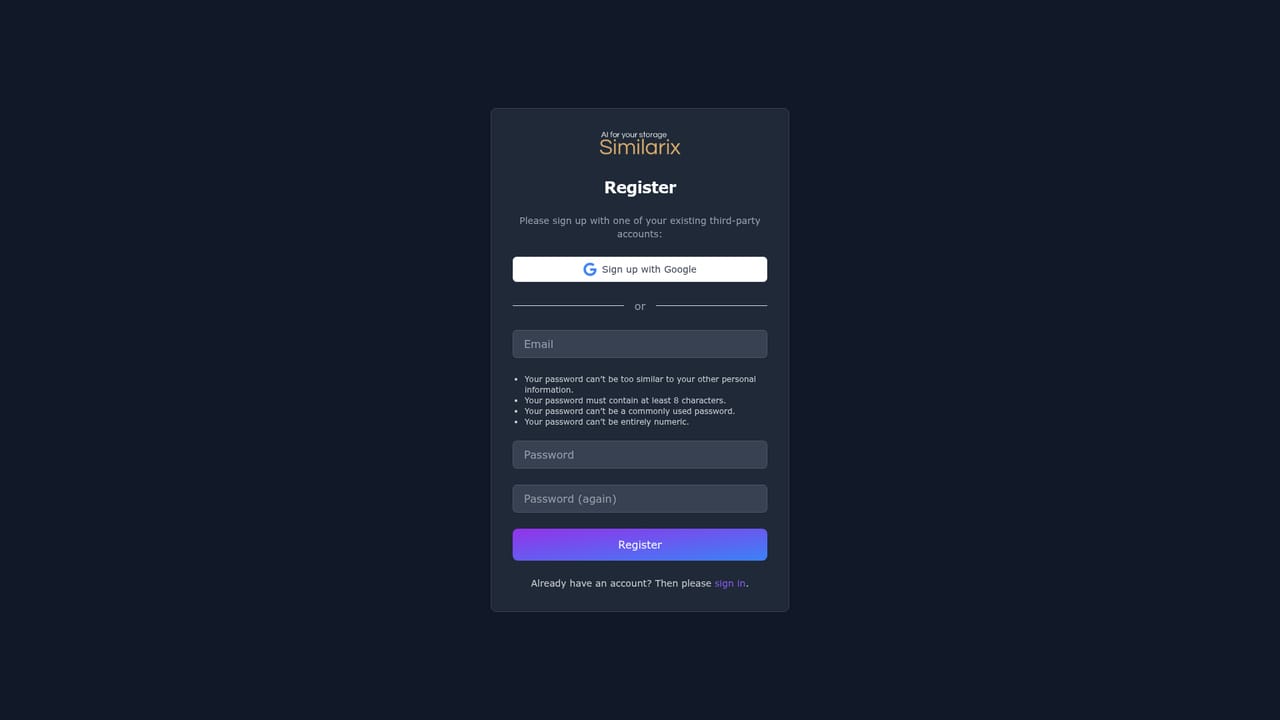
    Sign up with the registration form to get access to the dashboard and the Similarix Cloud storage option. No payment details are needed to explore the interface.
    Similarix — Create a Similarix account
  2. 2Connect storage or upload files
    Add an S3 collection for indexing, or skip bucket setup entirely and push images through the web uploader or the Upload API. Similarix only reads the originals.
  3. 3Wait for indexing to complete
    Processing takes a minute or two for small sets and a few hours for large libraries. The dashboard notifies you when the index is built and content becomes searchable.
  4. 4Search by text or by example image
    Enter a description in any of the 133 supported languages, or use an existing image as the query to surface visually similar assets. Duplicate detection runs alongside.
  5. 5Pick a plan when you are ready to scale
    Choose Basic or Pro at checkout depending on how many files you process, or contact support for an enterprise agreement with custom models and SLA terms.
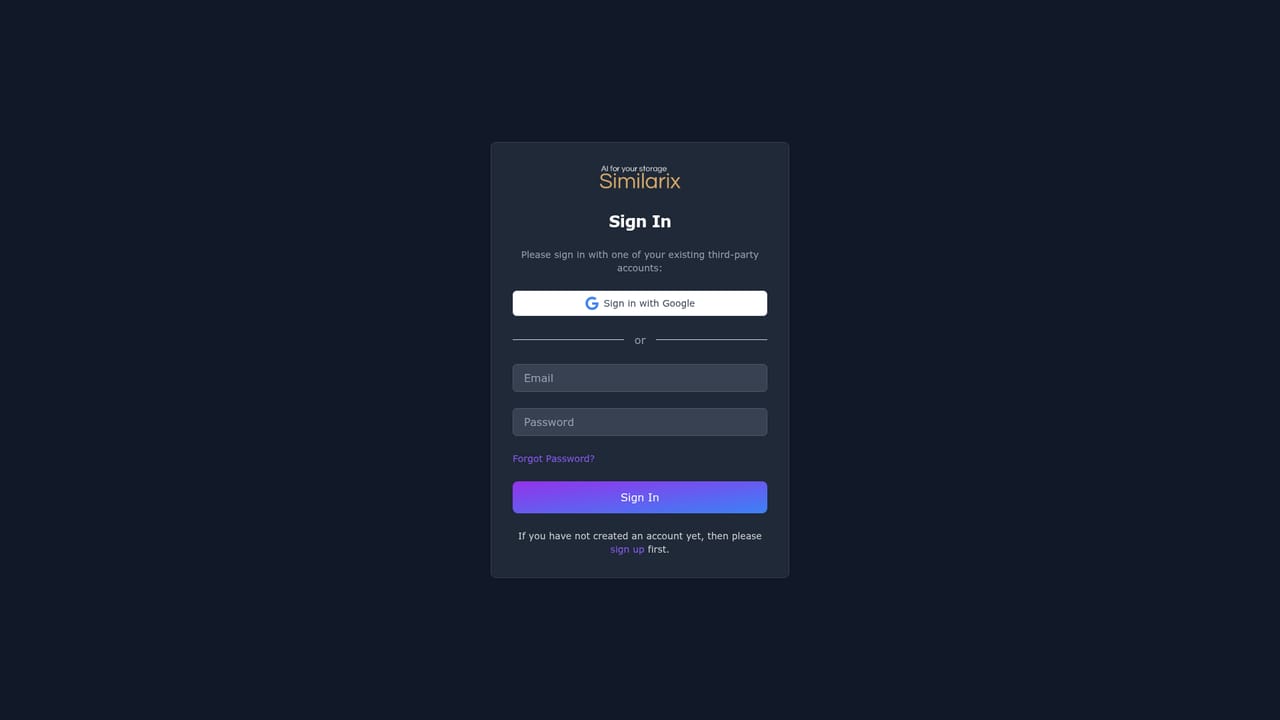
    Similarix — Pick a plan when you are ready to scale

Pros and cons

Pros

  • Semantic matching finds assets by meaning and by visual similarity, not just by filename or exact keywordsAI
  • Read-only access to originals keeps stored files untouched during indexing and searchAI
  • Indexes can be built quickly, from a couple of minutes on small collections to a few hours for thousands of filesAI
  • In-house and open-source models mean no reliance on OpenAI, Claude or Mistral for core inferenceAI
  • The API is included on the Pro plan and has documented responses around 200 ms, suitable for production useAI

Cons

  • Current coverage is limited to image formats, with PDFs, documents and sheets only promised for the futureAI
  • Plan allowances (1,000 and 10,000 files) are small for teams with large media libraries, and enterprise pricing is quote onlyAI
  • Cancelling and later resubscribing requires full reindexing and can lose custom tagging settingsAI
  • No free trial is advertised and prices are listed in euros, which adds friction for some buyersAI
  • Outside integrations are thin: S3 is the core connector, a Google Drive connector is still awaited and the CLI is not yet releasedAI

How much does Similarix cost?

Pricing

Three tiers. Basic costs 12 EUR per month with 1,000 files processed and dashboard access. Pro costs 29 EUR per month with 10,000 files plus API and CLI access. Enterprise is quote based, covering up to 1 billion files, custom ML models and six months of premium support. Annual billing saves 30 percent, and billing follows assets processed and stored each month.

Learn more

Support

Support runs through email: support@similarix.com for technical and billing questions, and hello@similarix.com for onboarding, which is offered on Pro plans. Enterprise agreements add six months of premium support.

Integrations

S3 buckets are the primary connection, with a dashboard, a production-grade Image Search API on Pro and an Upload API. A CLI and a Google Drive connector are described as forthcoming rather than shipped.

Features

Semantic search over S3 collections by text or by example image, exact and near duplicate detection, read-only access to originals, support for 133 languages, dashboard and API access, optional uploads without S3 setup, free Similarix Cloud managed storage on all plans, and in-house models with no third-party AI dependencies.

Frequently asked questions about Similarix

  • How much does Similarix cost?
    Three tiers. Basic costs 12 EUR per month with 1,000 files processed and dashboard access. Pro costs 29 EUR per month with 10,000 files plus API and CLI access. Enterprise is quote based, covering up to 1 billion files, custom ML models and six months of premium support. Annual billing saves 30 percent, and billing follows assets processed and stored each month.
  • Does Similarix have an API?
    Yes, Similarix offers an API.
  • How do you use Similarix?
    The walkthrough on this page covers 5 steps: 1. Create a Similarix account 2. Connect storage or upload files 3. Wait for indexing to complete 4. Search by text or by example image 5. Pick a plan when you are ready to scale.
  • What platforms does Similarix support?
    Similarix is available on Web App.
  • What does Similarix integrate with?
    S3 buckets are the primary connection, with a dashboard, a production-grade Image Search API on Pro and an Upload API. A CLI and a Google Drive connector are described as forthcoming rather than shipped.
  • What are the limitations of Similarix?
    Current coverage is limited to image formats, with PDFs, documents and sheets only promised for the future. Plan allowances (1,000 and 10,000 files) are small for teams with large media libraries, and enterprise pricing is quote only. Cancelling and later resubscribing requires full reindexing and can lose custom tagging settings.

Status

StatusActive
Views0
Outbound clicks0
Added10/21/2026

Platforms

Web App

Pricing

PaidSubscription