Support
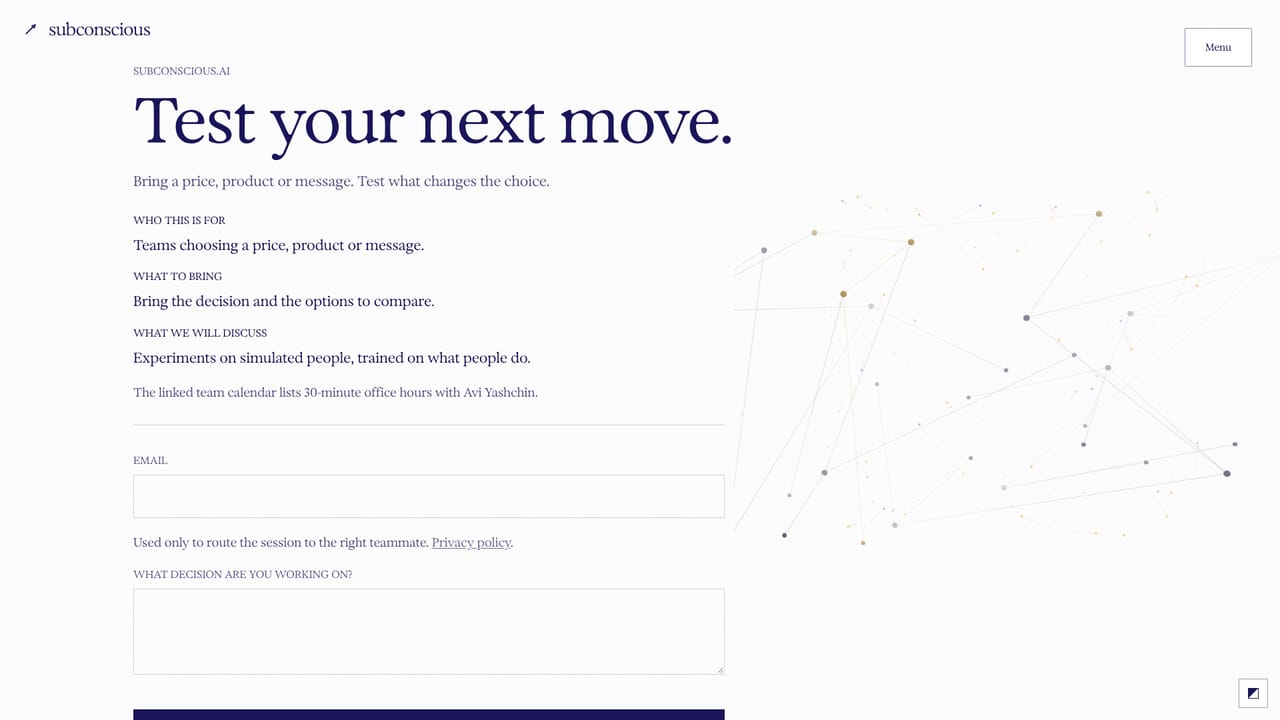
Support runs through a decision review booked with the team. Research is carried out by PhD scientists on staff, with scientific advisors retained separately.
Learn moreRun price, product and message decisions as controlled experiments before you commit.
Own Subconscious AI? Verify ownership to get a dofollow link

Subconscious AI is an election simulation tool. A market simulation platform that treats pricing, product and messaging decisions as controlled experiments on modeled buyers. Study designs include discrete choice with price, MaxDiff, shelf and volumetric simulations, each paired with stated assumptions and validation against human studies.
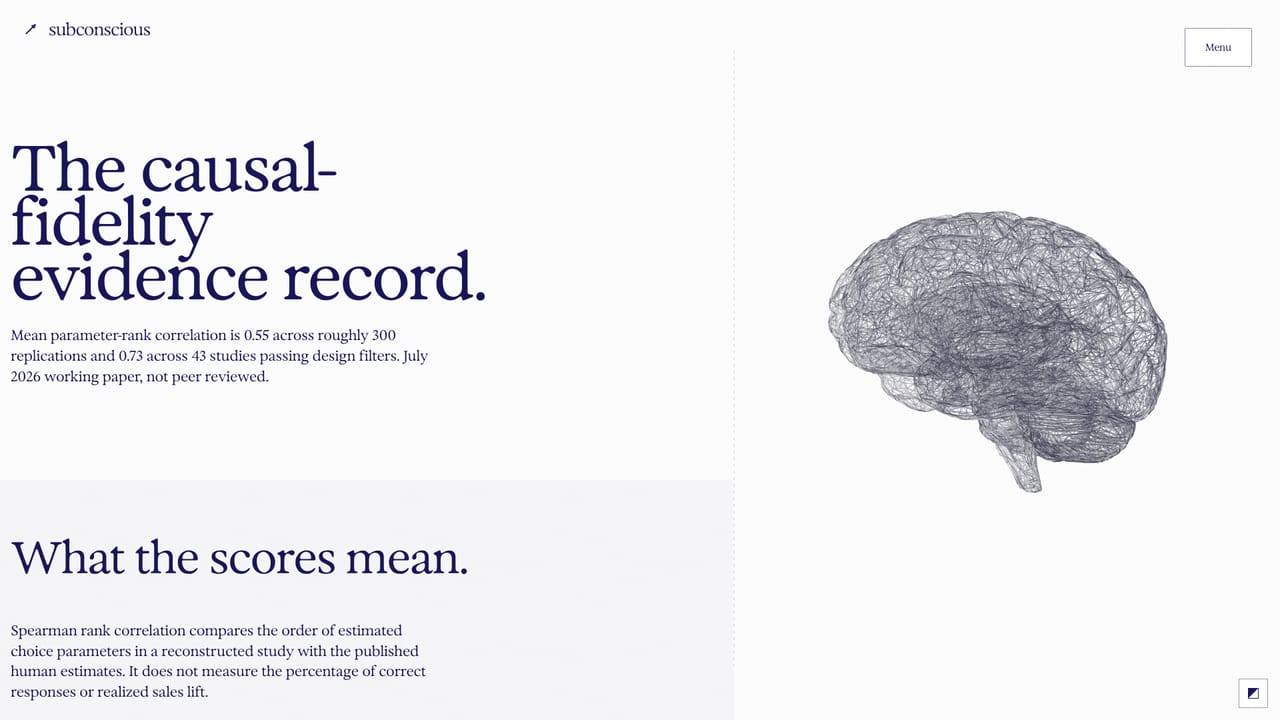
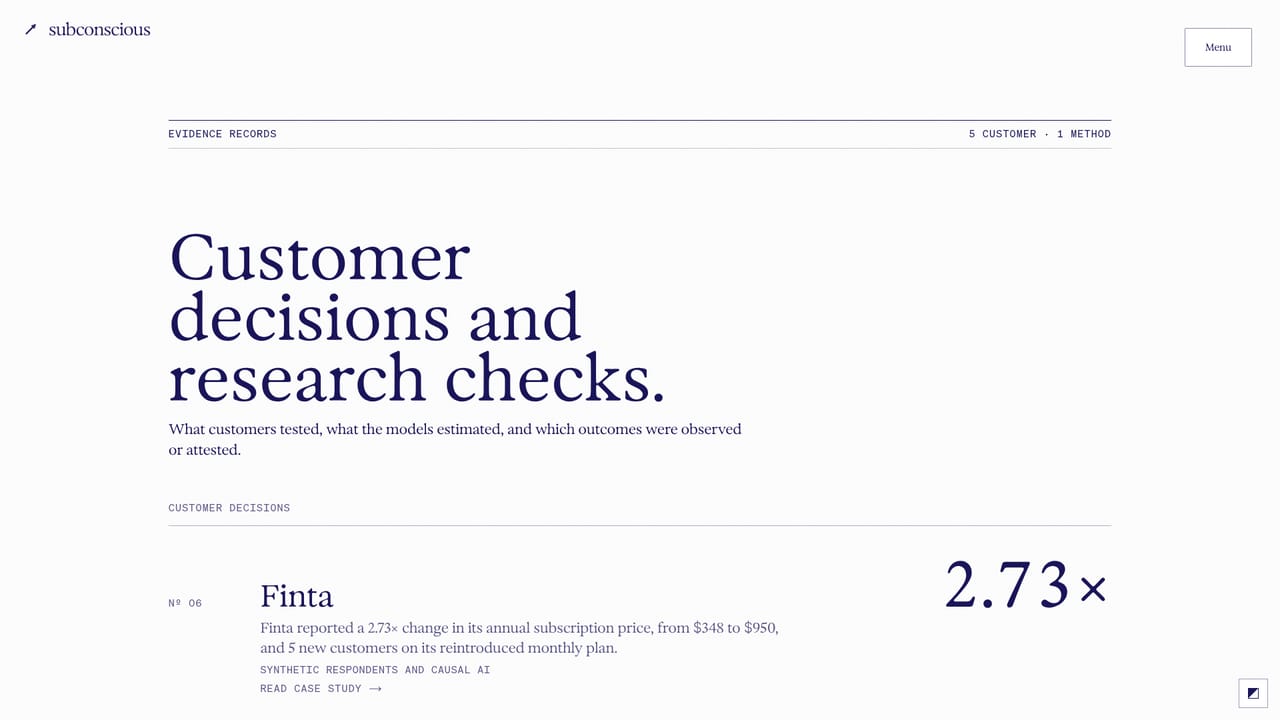
Subconscious AI is a market simulation platform built around a single premise: that a business decision can be tested on a modeled market before money is spent on it. The company starts with a simulator for business decisions, using causal experiments to check how a market responds before capital is committed. Buyers are represented individually, each one carrying its own reasons to choose, so the output is not a single demand curve but a population of simulated customers making a choice among your offer, a competitor's offer, or no purchase at all. The product maps a business question onto a study design. Pricing questions run as discrete choice experiments with price, producing stated willingness to pay, modeled demand and pricing scenarios. Feature and claim questions use MaxDiff or best-worst ranking. Product and pack questions use build-your-own plus adaptive choice. Shelf arguments for retailers use a category shelf simulation. Volume questions use volumetric choice, and competitive scenarios use a market simulator fitted on the model. Each design lists its modeled outputs alongside the assumptions it depends on, which keeps the limits of a study visible rather than buried. The workflow follows a fixed loop: randomize an action, estimate its effect and interval, validate against the relevant human comparison, then update the design when evidence changes. Validation is the part the company invests in publicly. A working paper reports Spearman rank correlation of estimated choice parameters at 0.55 across roughly 300 replications and 0.73 across 43 design-filtered studies, and that paper is explicitly not peer reviewed. Published customer work includes Mintel comparing modeled preferences against human conjoint results, Finta adjusting pricing after survey insights, and New Age Floral deriving a modeled price from five iterative experiments. This is aimed at pricing teams, product marketers, insights and research groups, and consultants who already run conjoint or concept testing and want faster iteration between rounds. It is a research instrument, not a self-serve survey widget. Buyers comparing it to traditional panel-based conjoint vendors should weigh speed and iteration cost against the fact that Subconscious outputs are modeled estimates that still require external evidence before a real commitment.
Support runs through a decision review booked with the team. Research is carried out by PhD scientists on staff, with scientific advisors retained separately.
Learn moreStudy designs include discrete choice with price for willingness to pay and demand scenarios, MaxDiff for ranking features and claims, build-your-own with adaptive choice for product and pack configuration, category shelf simulation for retail pitches, volumetric choice for quantities and repeat purchase, concept tests with complete ranking, preference-based segmentation, and a market simulator for competitor scenarios.
 AI Angels400+ customizable AI girlfriends for NSFW chat, voice calls, and roleplay
 Candy AIExperience the future of companionship with AI friends who chat, role-play, and connect with you on a human level.
 ourdream.aiA vast AI roleplay platform with millions of characters for chat, images, video and voiceAI Angels400+ customizable AI girlfriends for NSFW chat, voice calls, and roleplayCandy AIExperience the future of companionship with AI friends who chat, role-play, and connect with you on a human level.ourdream.aiA vast AI roleplay platform with millions of characters for chat, images, video and voice