
Supermemory

Persistent memory layer that lets AI agents keep learning across sessions

Advanced API
Screenshot of Supermemory, Persistent memory layer that lets AI agents keep learning across sessions

What is Supermemory?

Supermemory is a memory and continual learning layer for AI agents. It ingests files, chats and URLs, stores extracted learnings in a vector graph database, and injects the relevant ones into an agent's context at query time. It is offered through an API, MCP connections to ChatGPT and Claude, and plugins for Cursor, Claude Code and Hermes.

Supermemory is infrastructure for giving AI agents long term memory. Raw inputs such as files, chats, URLs and other raw data are fed into a model the company calls learner-1, which extracts, merges, infers and forgets information before writing it to a vector graph database. Relevant memories are then pulled back into an agent's context window in real time, so the agent can carry prior knowledge into a new task without retraining the underlying model. The design goal is portability. Memory sits outside the model providers, so a user's or tenant's accumulated context follows them across models and harnesses. The vendor positions this against simply stuffing documents into a context window, publishing internal runs that show token cost growing more slowly than markdown based memory as a corpus scales from a few hundred to nearly ten thousand files. Public benchmark claims cover LongMemEval, LoCoMo and ConvoMem, and an independent SWE-ContextBench evaluation is cited for software task resolution. In practice the product reaches users in three ways: a direct API for teams building their own agents, MCP based connections to assistants such as ChatGPT and Claude, and plugins for coding tools like Cursor, Claude Code and Hermes. A console handles account and project setup. The company says the system serves over 100k organizations and processes more than a trillion tokens per month, with recall latencies in the low hundreds of milliseconds per query. Supermemory competes with agent memory libraries such as Mem0, and its differentiators are the graph based storage, a time aware forgetting mechanism, self hosted deployment, and compliance coverage. Teams with strict data residency needs can run it in their own data center, inside a VPC, or air gapped. Free, Pro and Max tiers ship standard PDF extraction, while Scale and Enterprise add OCR plus descriptions of figures and diagrams. Whoever picks it up should expect to wire an API or MCP endpoint rather than click through a finished consumer app.

How do you use Supermemory?

  1. 1Create an account in the console
    Sign in at the supermemory console to generate the credentials your agents will use. This is also where projects and memory stores are managed.
    Supermemory — Create an account in the console
  2. 2Read the core concepts
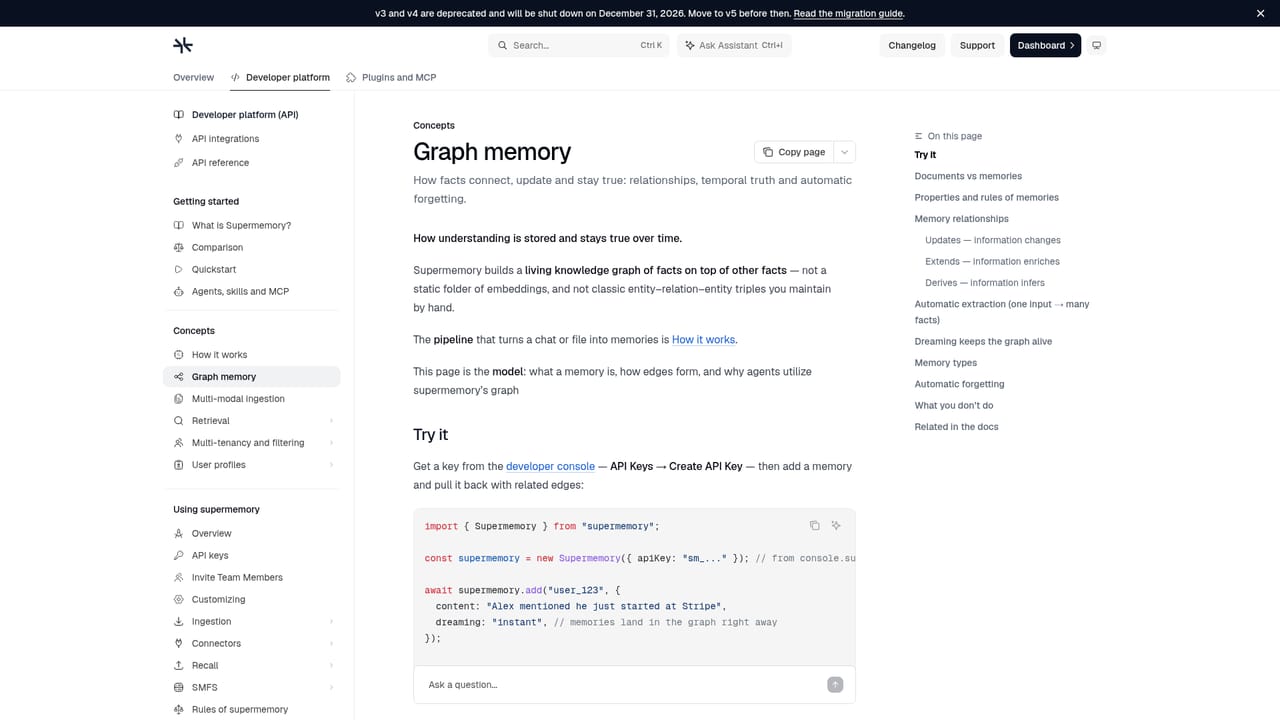
    Skim the content types and graph memory pages to understand what supermemory accepts as input and how extracted memories are linked and aged out.
    Supermemory — Read the core concepts
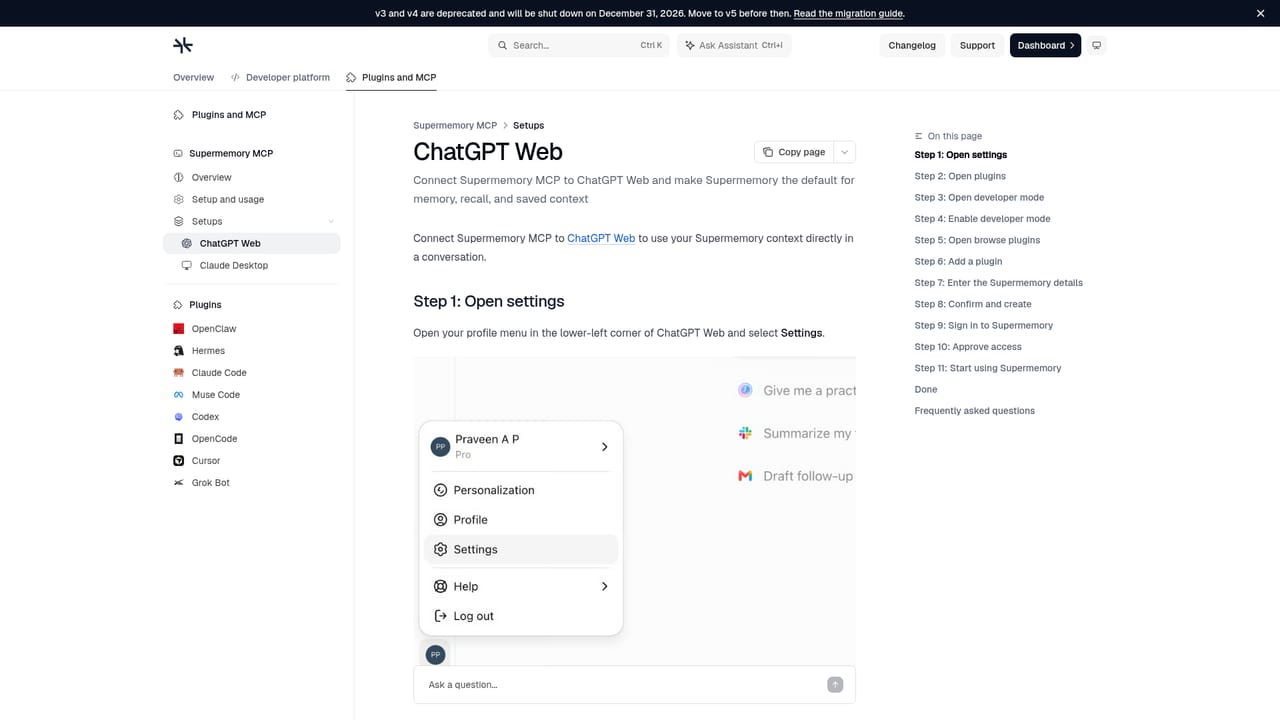
  3. 3Connect an assistant over MCP
    Follow the ChatGPT web or Claude Desktop guide to point the assistant at your supermemory endpoint. After setup, the assistant can read and write memories during a chat.
    Supermemory — Connect an assistant over MCP
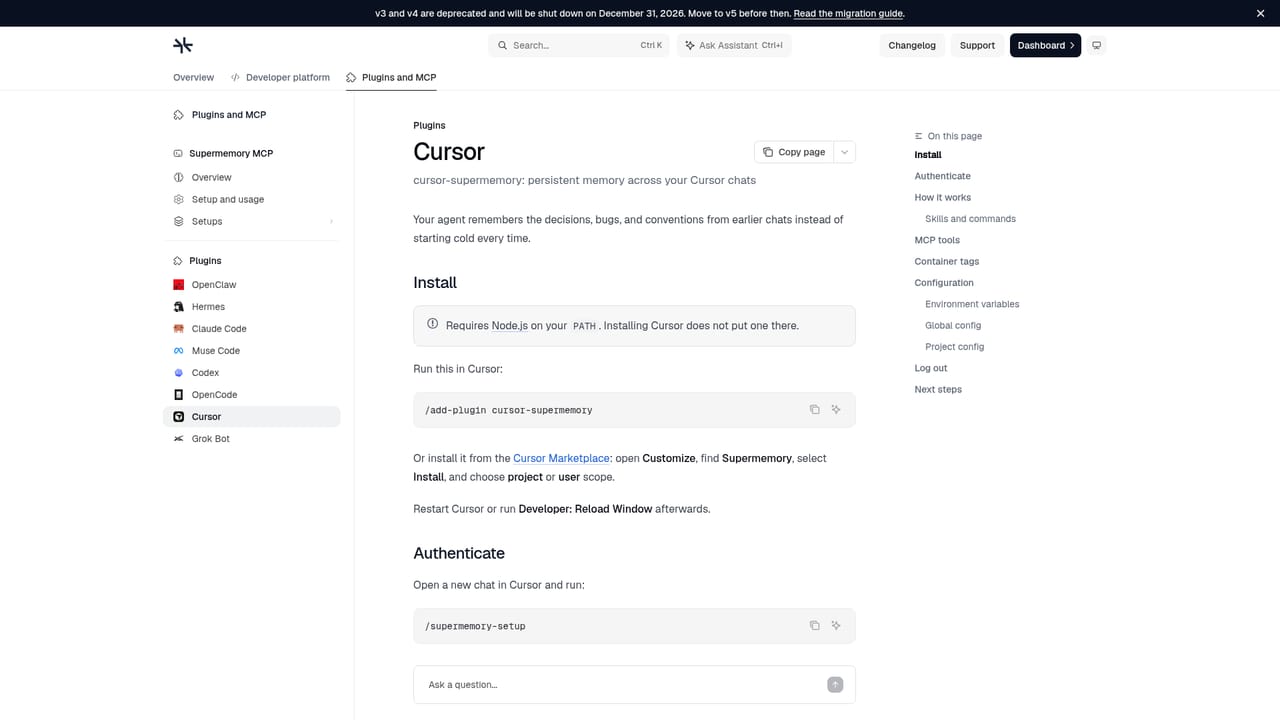
  4. 4Plug memory into your coding tool
    Install the Cursor or Claude Code integration so project context and past decisions are recalled automatically while you work.
    Supermemory — Plug memory into your coding tool
  5. 5Evaluate self hosting if data cannot leave
    Review the self hosting overview to see requirements for running the stack inside your own VPC, data center or an air gapped environment.

Pros and cons

Pros

  • Memory lives outside the model provider, so context carries across models and harnessesAI
  • Graph based storage with time awareness and a forget mechanism, not just a flat vector storeAI
  • Reaches common assistants and coding tools through MCP and ready pluginsAI
  • Self hosting options include VPC, on premise data center and air gapped deploymentsAI
  • SOC 2, HIPAA and GDPR coverage with contracts and DPA availableAI

Cons

  • No public price list on the homepage, so budgeting requires a sales conversationAI
  • Benchmark and token cost claims come largely from the vendor's own research runsAI
  • Advanced PDF extraction with OCR and figure descriptions is held back for Scale and EnterpriseAI
  • Setup is developer oriented: API keys, MCP config or plugin wiring rather than a finished appAI

How much does Supermemory cost?

Pricing

The site names Free, Pro, Max, Scale and Enterprise tiers but does not publish prices or quotas. Free, Pro and Max include standard PDF extraction, while Scale and Enterprise add OCR and descriptions of figures and diagrams. Enterprise buyers can request deployment options and contracts directly.

Learn more

Support

Support runs through the console and published docs, a trust center for compliance questions, and a sales calendar for deployment and enterprise requirements. Documentation covers concepts, integrations and self hosting.

Learn more

Integrations

Documented connections cover ChatGPT on the web, Claude Desktop, Cursor, Hermes and Claude Code, plus a general MCP endpoint for other harnesses. A REST style API supports custom agent builds, and self hosting is documented for private environments.

Learn more

Features

A learner-1 model extracts, merges, infers and forgets across user, task and tenant context, writing to a vector graph database with time awareness. Memories are injected into an agent's context in real time through an API, MCP or plugins. The system supports advanced document extraction at higher tiers and can be deployed in a VPC, a private data center or air gapped.

Learn more

Frequently asked questions about Supermemory

  • How much does Supermemory cost?
    The site names Free, Pro, Max, Scale and Enterprise tiers but does not publish prices or quotas. Free, Pro and Max include standard PDF extraction, while Scale and Enterprise add OCR and descriptions of figures and diagrams. Enterprise buyers can request deployment options and contracts directly.
  • Does Supermemory have an API?
    Yes, Supermemory offers an API.
  • How do you use Supermemory?
    The walkthrough on this page covers 5 steps: 1. Create an account in the console 2. Read the core concepts 3. Connect an assistant over MCP 4. Plug memory into your coding tool 5. Evaluate self hosting if data cannot leave.
  • What platforms does Supermemory support?
    Supermemory is available on Web App and Browser extension.
  • What does Supermemory integrate with?
    Documented connections cover ChatGPT on the web, Claude Desktop, Cursor, Hermes and Claude Code, plus a general MCP endpoint for other harnesses. A REST style API supports custom agent builds, and self hosting is documented for private environments.
  • What are the limitations of Supermemory?
    No public price list on the homepage, so budgeting requires a sales conversation. Benchmark and token cost claims come largely from the vendor's own research runs. Advanced PDF extraction with OCR and figure descriptions is held back for Scale and Enterprise.

Status

StatusActive
Views0
Outbound clicks0
Added10/22/2026

Platforms

Web AppBrowser extension

Pricing

FreemiumPaidSubscription