TextLayer AI

Senior AI product execution for PE firms and portfolio companies

Advanced
Screenshot of TextLayer AI, Senior AI product execution for PE firms and portfolio companies

What is TextLayer AI?

TextLayer AI is an AI project builder tool. TextLayer is a senior AI product studio for PE firms and their portfolio companies. It scopes, builds and ships approved AI initiatives into production, then transfers capability to internal teams.

TextLayer is an AI product studio aimed at private equity sponsors and the companies in their portfolios. It does not sell a self-serve software product. Instead, a senior team takes an approved AI priority and carries it through scoping, engineering, production launch and handover. The pitch on the site is narrower than the usual agency claim: once a budget line for AI is signed off, the result depends almost entirely on how well the work is executed, and TextLayer positions its experience as the difference between a demo and something that survives contact with real users. The engagement model is a four stage cycle. Align sets the trajectory by defining the path to value, narrowing scope and surfacing the decisions that matter. Build happens in testable increments with evaluation, observability and controls baked in. Grow uses production evidence to refine the product, the customer experience and the unit economics. Transfer leaves the portfolio company able to operate and extend what was built, so capability stays in house rather than walking out with the consultants. The site grounds its case in a worked example rather than a feature list. A small number of scoping decisions, in TextLayer's telling, cut a workflow from three years to three months of data preparation, reduced cost per workbook run from $15 to $0.50, and brought time to result from 15 minutes down to 2. It also cites KPMG research stating that only 8% of organizations report established ROI from AI, which is the problem the service exists to address. That makes TextLayer relevant to investment and operating teams rather than individual builders. A solo founder looking for a generative text tool is in the wrong place. A portfolio company with an approved AI initiative, an internal engineering team that needs reinforcement, and a mandate to show returns has a much clearer fit. The published insights, including a test of TypeSafe AI's Jev decision models, signal that the firm stays close to current model capabilities. Hg Capital is named as a trusted partner. Pricing is not published.

How do you use TextLayer AI?

  1. 1Review how TextLayer runs engagements
    Read the services page to understand the Align, Build, Grow and Transfer sequence and decide which stage your team is at.
    TextLayer AI — Review how TextLayer runs engagements
  2. 2Check the published insights
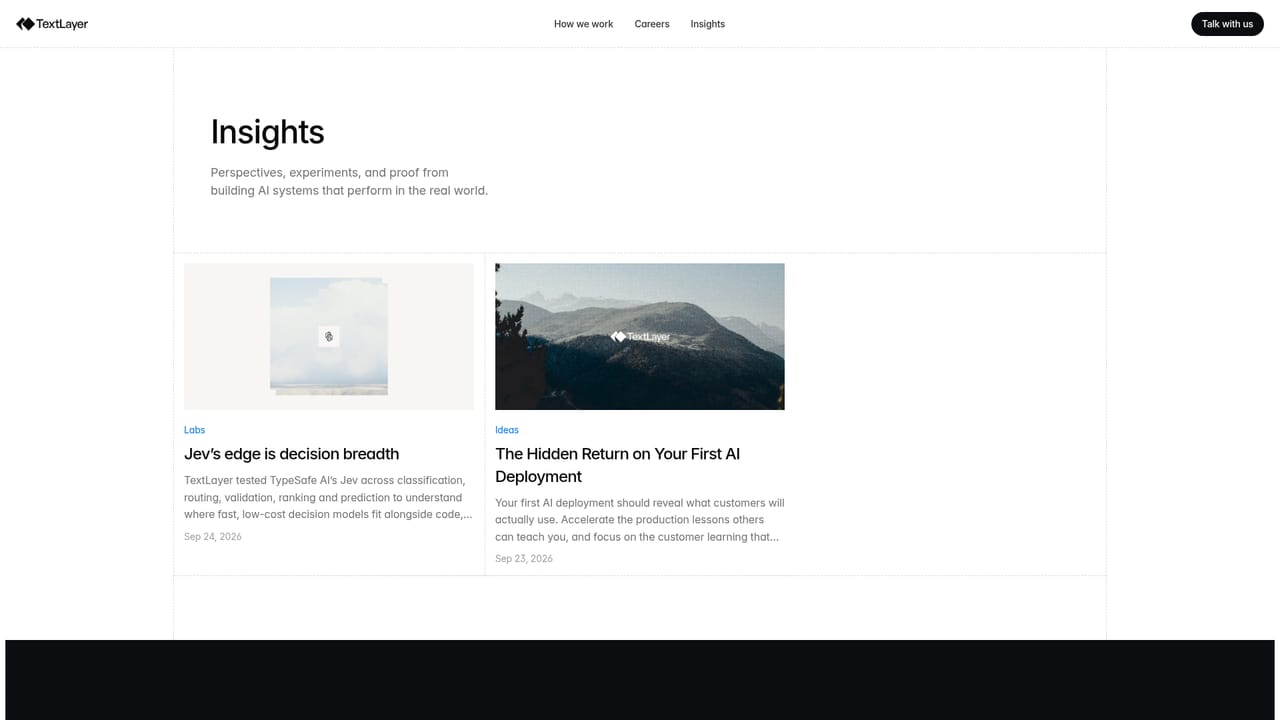
    The insights section shows how the team reasons about production AI, decision models and early deployment returns. Use it to judge whether the thinking matches your problem.
    TextLayer AI — Check the published insights
  3. 3Read the decision model lab note
    The Jev write up covers classification, routing, validation, ranking and prediction tests, useful if your priority involves fast, low cost decisioning.
    TextLayer AI — Read the decision model lab note
  4. 4Read the first deployment note
    This piece frames what a first AI deployment should teach you about customer behavior before you commit to a larger build.
    TextLayer AI — Read the first deployment note
  5. 5Open a scoping conversation
    Use the contact page to describe the AI priority, the portfolio context and any internal engineering capacity you already have.

Pros and cons

Pros

  • Works from an already approved AI priority, so engagements start with a clear business mandate instead of open ended explorationAI
  • Four stage model (Align, Build, Grow, Transfer) includes a handover step, which reduces dependence on outside help after launchAI
  • Build phase explicitly covers evaluation, observability and controls, which are the parts most likely to fail in productionAI
  • Published case example shows concrete shifts in cost, speed and scope resulting from narrowing the problemAI
  • Team is positioned as senior and stays accountable through launch and real world use, not just deliveryAI

Cons

  • No published pricing, packaging or engagement minimums, so budgeting requires a sales conversationAI
  • Not a software product: there is no free tier, trial or self-serve signup for individuals to evaluateAI
  • Scope is limited to PE sponsors and portfolio companies, which excludes most startups and solo buildersAI
  • Site publishes no case studies with named clients beyond a partner mention, so outcomes are hard to verify independentlyAI
  • No technical documentation or API surface is described, which matters if you need to assess fit before committingAI

How much does TextLayer AI cost?

Features

Engagements follow four stages: Align (define the path to value, narrow scope, surface critical decisions), Build (ship in testable increments with evaluation, observability and controls), Grow (use production evidence to improve product, customer experience and economics) and Transfer (leave the internal team able to operate and extend the work).

Learn more

Frequently asked questions about TextLayer AI

  • How do you use TextLayer AI?
    The walkthrough on this page covers 5 steps: 1. Review how TextLayer runs engagements 2. Check the published insights 3. Read the decision model lab note 4. Read the first deployment note 5. Open a scoping conversation.
  • What platforms does TextLayer AI support?
    TextLayer AI is available on Web App.
  • What are the limitations of TextLayer AI?
    No published pricing, packaging or engagement minimums, so budgeting requires a sales conversation. Not a software product: there is no free tier, trial or self-serve signup for individuals to evaluate. Scope is limited to PE sponsors and portfolio companies, which excludes most startups and solo builders.

Status

StatusActive
Views0
Outbound clicks0
Added10/21/2026

Platforms

Web App

Pricing

Paid