TokenPricing

A searchable catalog of LLM API token prices, normalized to dollars per million tokens.

Beginner
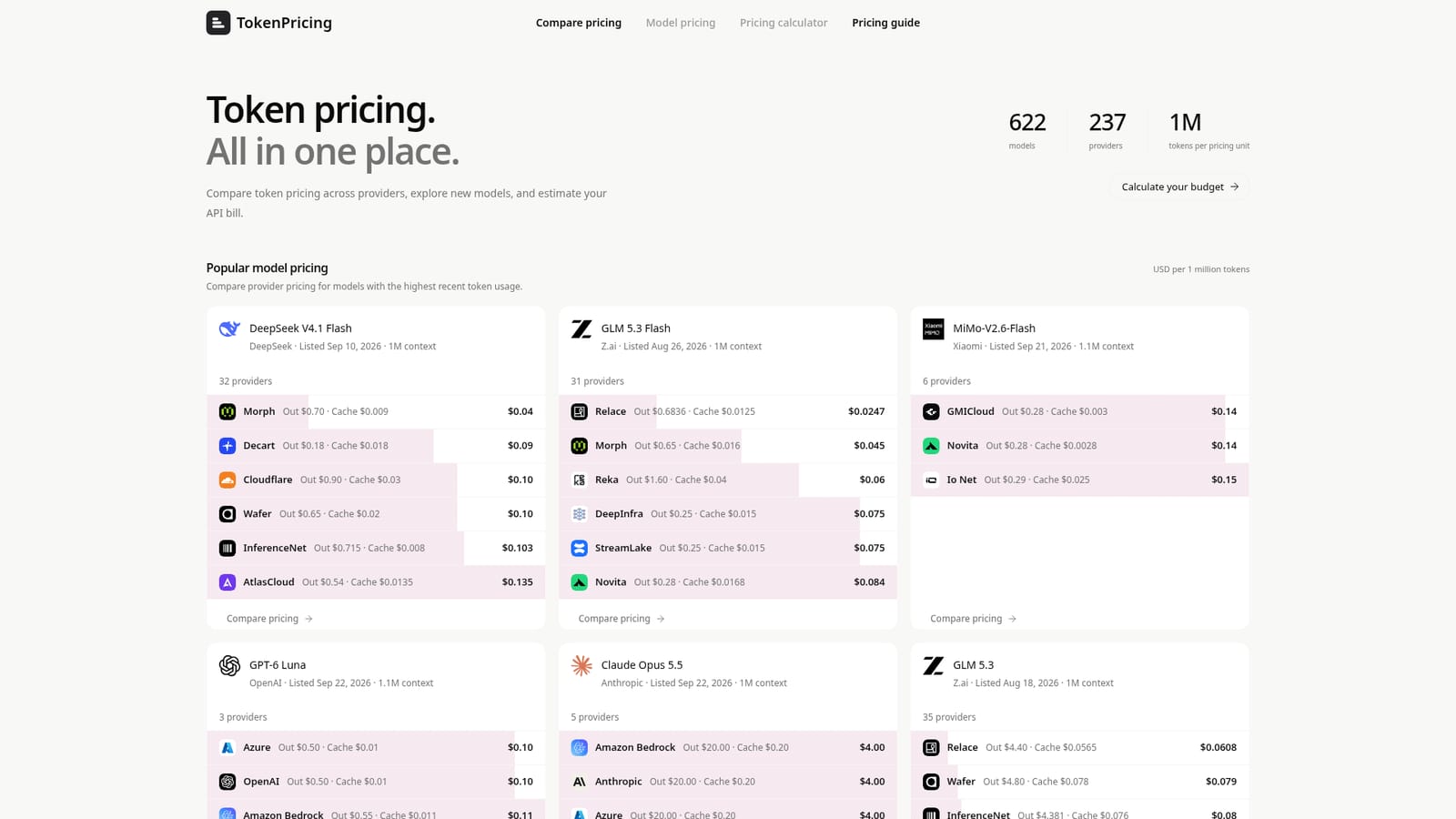
Screenshot of TokenPricing, A searchable catalog of LLM API token prices, normalized to dollars per million tokens

What is TokenPricing?

TokenPricing is a free, independent catalog that normalizes LLM API token pricing from hundreds of providers into dollars per 1 million tokens, with a built in cost calculator and no account required.

TokenPricing is a reference site for comparing what large language model APIs actually cost. Instead of visiting dozens of provider pages and converting between different billing units, every listed rate on the site is normalized to US dollars per 1 million tokens, covering input, output and cached token pricing side by side. The homepage tracks hundreds of models and providers, with counts shown directly on the page, and surfaces newly listed models alongside the most actively compared ones. The tool is built for anyone who has to budget or architect around LLM usage: developers choosing between hosting options for an open model, founders estimating the monthly cost of a product feature, and technical buyers comparing a model's official API price against third party or cloud marketplace resale pricing. No account or sign in is required to browse the catalog or run estimates, which lowers the barrier for a quick price check during technical planning. In practice, a visitor lands on a table of models with listing date, context window size and the number of provider offers available, then drills into an individual model page to see every provider's input, output and cached rate ranked side by side. A dedicated calculator page converts expected token volume into a projected bill for a chosen model and provider combination, making it possible to sanity check a cost estimate before writing integration code. Among alternatives such as manually compiled spreadsheets, scattered provider pricing pages, or pricing calculators bundled inside a single vendor's console, TokenPricing positions itself as an independent, provider agnostic layer that spans the wider market rather than one vendor's lineup. Its value is strongest for cost comparison and discovery rather than live usage tracking or billing reconciliation, which would require integrating with actual API accounts.

How do you use TokenPricing?

  1. 1Scan the popular models section
    On the homepage, review the list of models with the highest recent token usage to get a quick sense of current market rates across providers.
    TokenPricing — Scan the popular models section
  2. 2Search or filter the full pricing table
    Use the model and provider search on the homepage comparison table to narrow results by time range, model name or provider.
  3. 3Open a model page to compare providers
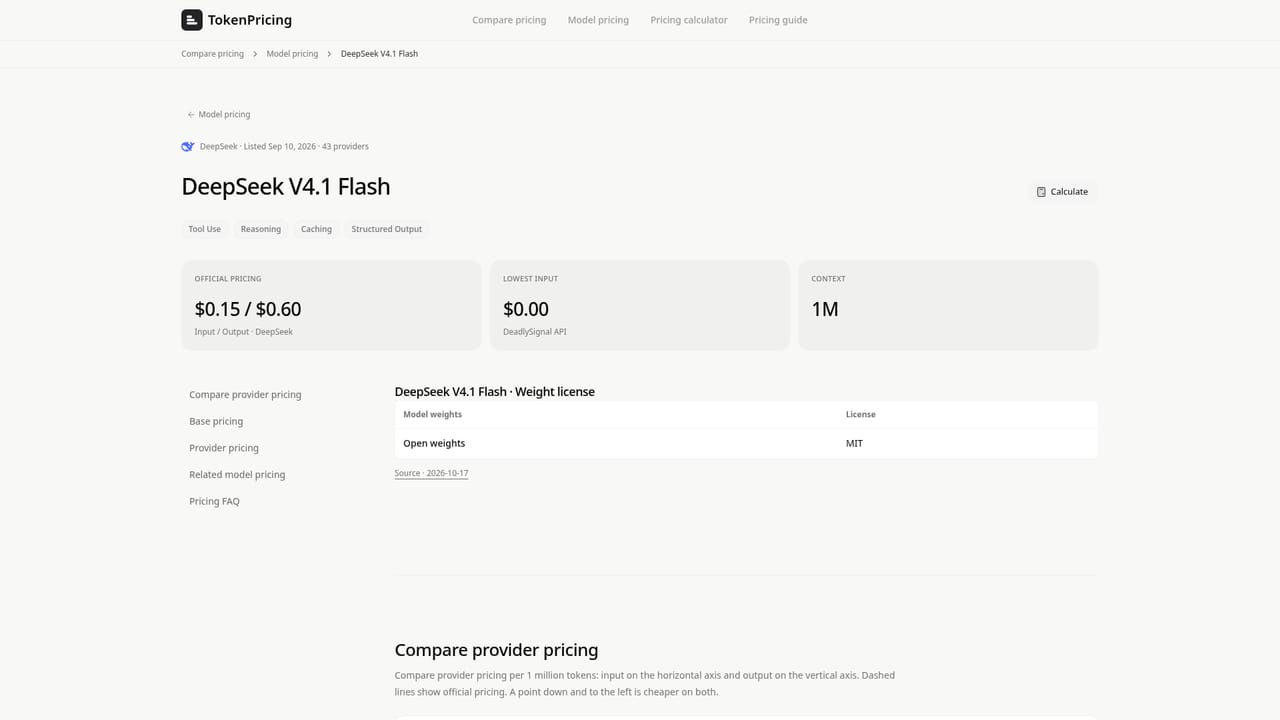
    Click into a specific model, such as DeepSeek V4.1 Flash, to see every provider's input, output and cached pricing ranked side by side.
    TokenPricing — Open a model page to compare providers
  4. 4Run a cost estimate
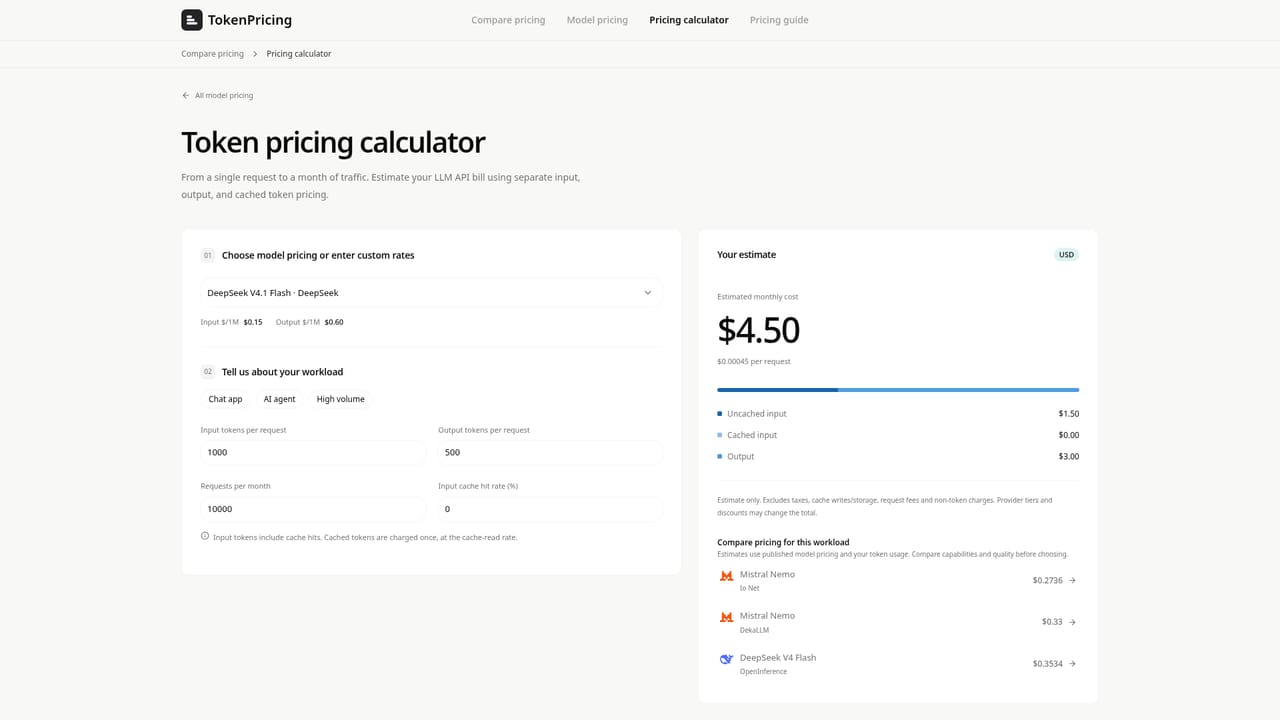
    Go to the calculator, pick a model and provider combination, and enter expected token volume to project what an API bill would look like.
    TokenPricing — Run a cost estimate
  5. 5Check context window and cache pricing before choosing
    Before committing to a provider, confirm the model's context window size and cached token rate, since these vary even for the same underlying model.

Pros and cons

Pros

  • Normalizes every provider's pricing to the same dollars per 1 million tokens unit for direct comparisonAI
  • Covers a large number of models and providers in one searchable tableAI
  • Includes a calculator to estimate API costs before committing to a providerAI
  • No account or sign in required to browse pricing or use the calculatorAI
  • Surfaces newly listed models alongside the most actively compared onesAI

Cons

  • Homepage content does not state how often pricing data is refreshed or verified against provider sourcesAI
  • No stated support channel, documentation hub or contact method for reporting pricing errorsAI
  • No mention of an API or export option for pulling pricing data into other tools or spreadsheetsAI
  • Focused purely on token pricing, so it does not track actual usage, invoices or spend against a real accountAI
  • No information provided about team or enterprise features beyond the free public comparison toolAI

How much does TokenPricing cost?

Features

Live catalog of LLM models and providers with pricing normalized to dollars per 1 million tokens, a popular models view, a searchable and filterable comparison table showing context window and offer counts, individual model pages ranking every provider, and a calculator for estimating API costs.

Learn more

Frequently asked questions about TokenPricing

  • How do you use TokenPricing?
    The walkthrough on this page covers 5 steps: 1. Scan the popular models section 2. Search or filter the full pricing table 3. Open a model page to compare providers 4. Run a cost estimate 5. Check context window and cache pricing before choosing.
  • What platforms does TokenPricing support?
    TokenPricing is available on Web App.
  • What are the limitations of TokenPricing?
    Homepage content does not state how often pricing data is refreshed or verified against provider sources. No stated support channel, documentation hub or contact method for reporting pricing errors. No mention of an API or export option for pulling pricing data into other tools or spreadsheets.

Status

StatusActive
Views0
Outbound clicks0
Added10/17/2026

Platforms

Web App

Pricing

Free