Unify

Continual learning infrastructure that trains your agent's model on every interaction

Advanced
Screenshot of Unify, Continual learning infrastructure that trains your agent's model on every interaction

What is Unify?

Unify is a developer tool. Unify sells continual learning for AI agents: every user interaction trains the model behind your agent, with the stated goal of rising quality and falling latency and cost. It targets engineering teams running agents in production, and its public research argues that harness memory alone cannot replace a model that learns.

Unify is infrastructure for teams that want the model behind their AI agent to improve after deployment rather than stay frozen at the version they shipped. The company's core argument is that a static model wrapped in a harness, which writes notes to a scratchpad and rereads them on each task, is a limited design. Unify instead closes the loop: every user interaction feeds back into training the model that drives the agent, so quality is meant to climb while latency and cost fall. The team frames the resulting asset as a flywheel that the customer owns. The audience is AI engineering and product teams running agents in production, not individuals looking for a chat interface. Those teams already have an agent and a harness; Unify positions itself as the layer that makes the underlying model learnable, which means the people adopting it are expected to reason about training loops, evaluation and deployment tradeoffs. In practice the pitch rests on continual learning as a discipline. Unify has published research writing on the subject, including work on Continual-ARC and on why prompt scaffolding and memory alone do not substitute for a model that updates. The homepage does not detail the product surface, the SDK, the supported model families or the deployment model, so anyone evaluating it should treat the blog as the primary technical evidence and ask directly about integration effort. Where it fits among alternatives is the interesting part. Most LLM comparison shopping in 2026 is about picking a frozen model per task or per price point. Unify argues that choice matters less than whether the chosen model keeps absorbing signal from your own users. That makes it a complement to model routing and evaluation tooling rather than a drop-in replacement, and a competitor to managed fine tuning services only insofar as those also promise ongoing adaptation. Buyers who cannot commit to a feedback pipeline, or who operate in settings where training on user data is restricted, will find less to gain.

How do you use Unify?

  1. 1Read the core argument first
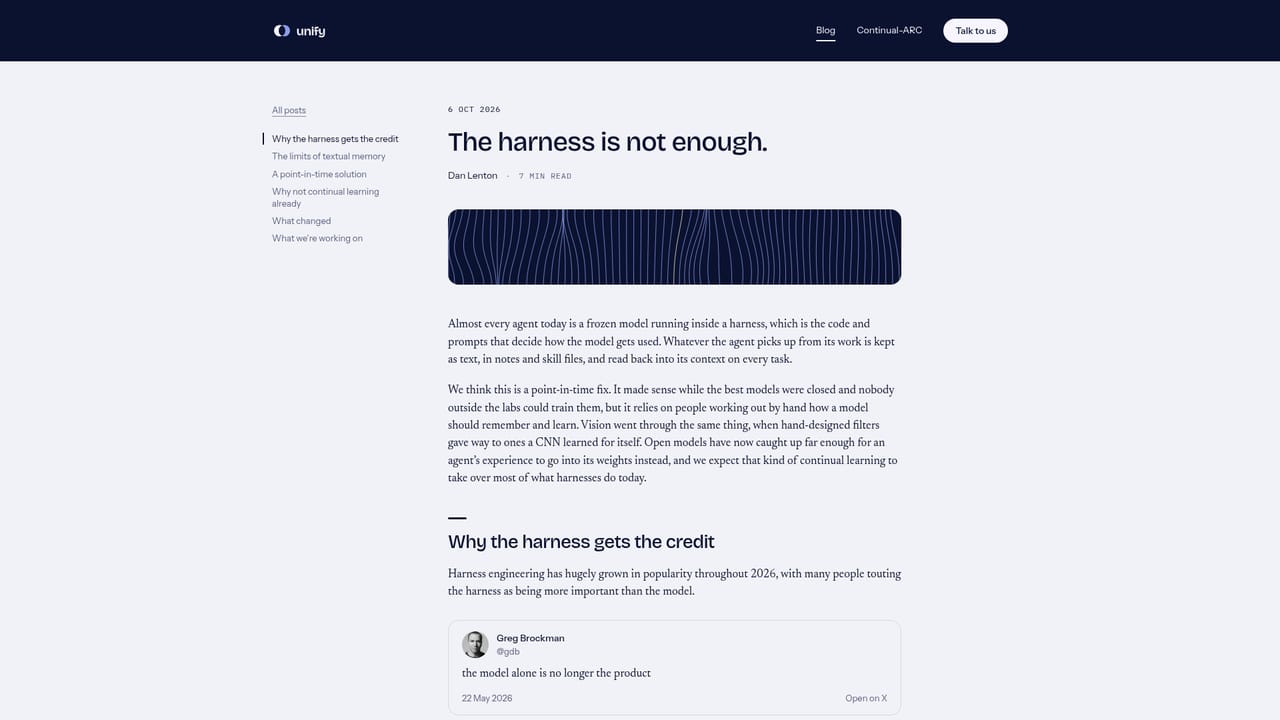
    Start with the post on why the harness is not enough. It explains the difference between an agent that writes notes and rereads them and a model that actually updates, which is the premise for everything else.
    Unify — Read the core argument first
  2. 2Review the continual learning research
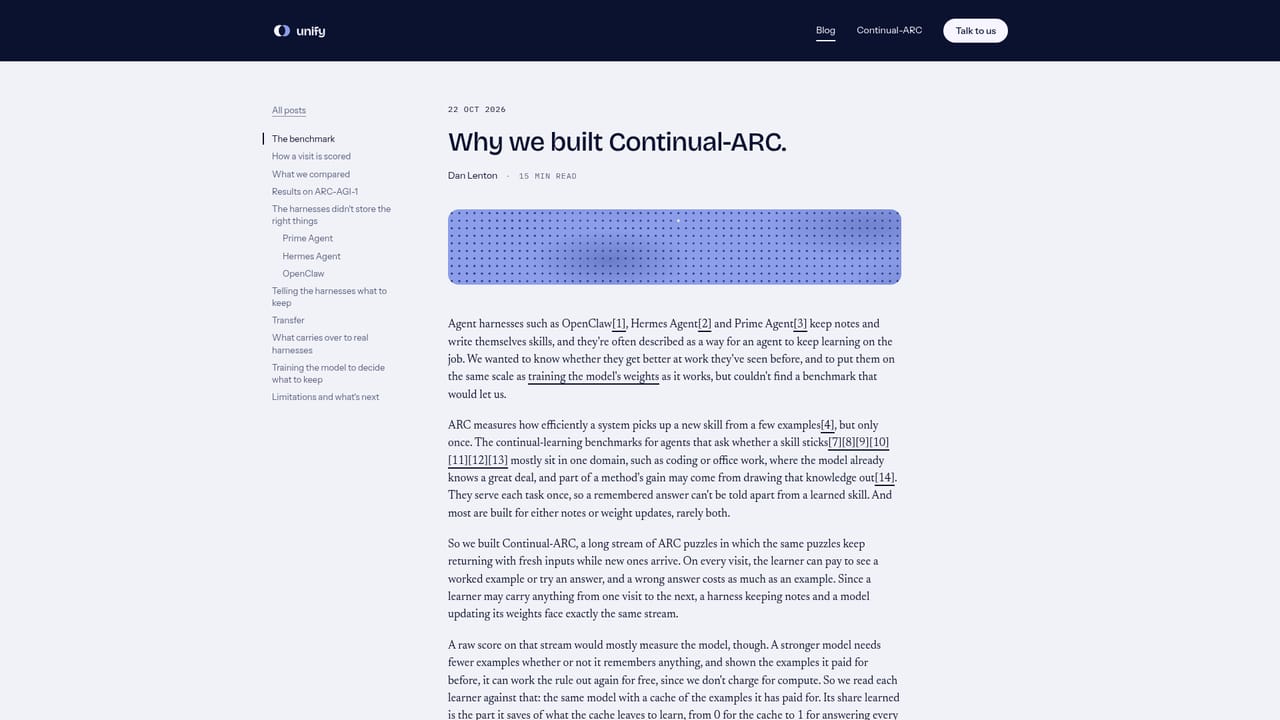
    The Continual-ARC writeup goes deeper into method. Read it before talking to the team so your questions are about training loops and evaluation rather than definitions.
    Unify — Review the continual learning research
  3. 3Scan the blog for current direction
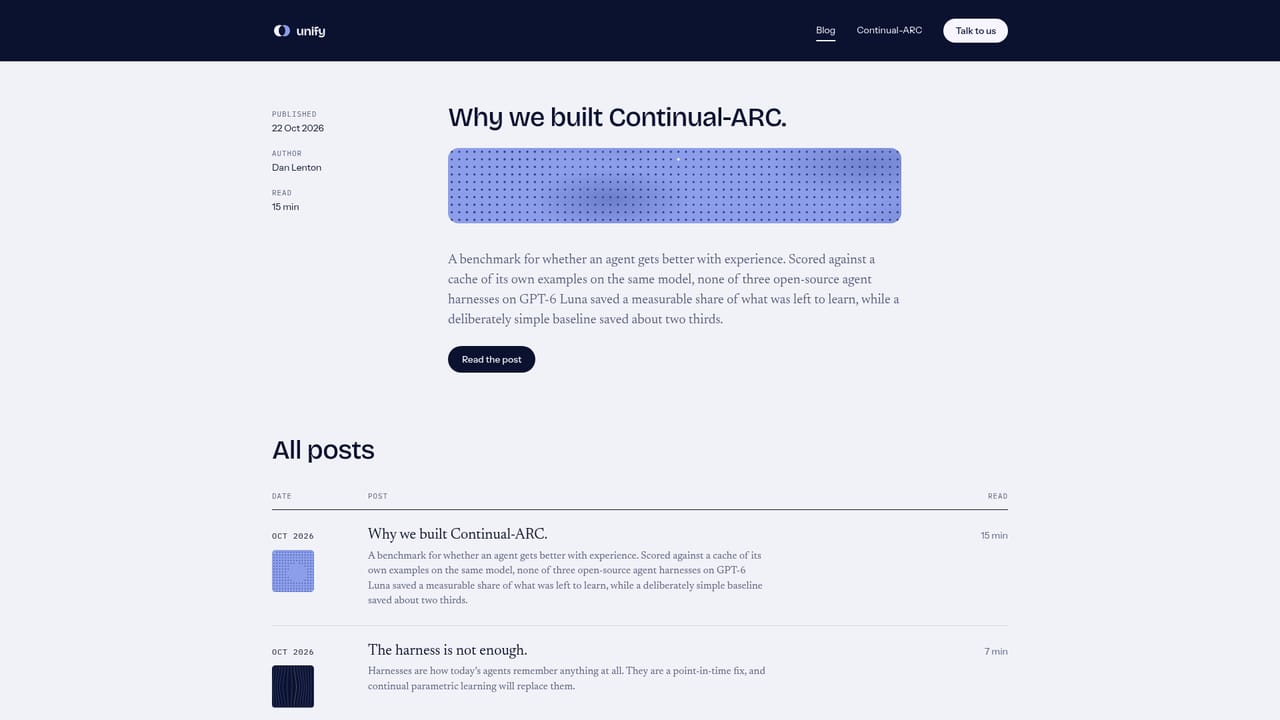
    The blog index shows how recent the published work is and what the team is currently focused on. It is the best proxy for roadmap until you speak with them.
    Unify — Scan the blog for current direction
  4. 4Map your agent's feedback loop
    Before any integration, identify which user interactions carry usable signal and how you would capture them. Unify's value depends on that pipeline existing on your side.
  5. 5Scope a pilot with the team
    Contact Unify to agree a baseline metric, a training cadence and success criteria. Because no pricing is published, the pilot is also where commercial terms get settled.

Pros and cons

Pros

  • Clear technical thesis: the model, not just the surrounding harness, should keep learning from real usageAI
  • Positions the trained model and its feedback loop as an asset the customer owns rather than rentsAI
  • Public research writing on continual learning gives buyers something concrete to evaluate before committingAI
  • Backed by a long list of named investors and technical advisors, which reduces early vendor riskAI
  • Frames improvement in three dimensions at once (quality, latency, cost) instead of accuracy aloneAI

Cons

  • The homepage is almost entirely positioning and investor logos; product mechanics, SDK and supported models are not describedAI
  • No published pricing, no self-serve signup path and no stated free tier, so evaluation starts with a sales conversationAI
  • Continual learning on user interactions raises data governance and privacy questions the site does not addressAI
  • Little third-party benchmark evidence yet; the case rests largely on the company's own blog postsAI
  • Value depends on having production traffic and a feedback loop, so small teams or prototypes will see little benefitAI

How much does Unify cost?

Features

The homepage describes a continual learning layer: interactions with your agent train the model behind it, with the claimed result of improving quality while reducing latency and cost. Supporting material includes published research on Continual-ARC and a post arguing that harness-based memory is insufficient. Specific product features, SDK surface and supported models are not listed on the homepage.

Learn more

Frequently asked questions about Unify

  • How do you use Unify?
    The walkthrough on this page covers 5 steps: 1. Read the core argument first 2. Review the continual learning research 3. Scan the blog for current direction 4. Map your agent's feedback loop 5. Scope a pilot with the team.
  • What platforms does Unify support?
    Unify is available on Web App.
  • What are the limitations of Unify?
    The homepage is almost entirely positioning and investor logos; product mechanics, SDK and supported models are not described. No published pricing, no self-serve signup path and no stated free tier, so evaluation starts with a sales conversation. Continual learning on user interactions raises data governance and privacy questions the site does not address.

Status

StatusActive
Views0
Outbound clicks0
Added10/21/2026

Platforms

Web App

Pricing

Paid