Zep

Unified context layer for enterprise AI agents

Advanced API
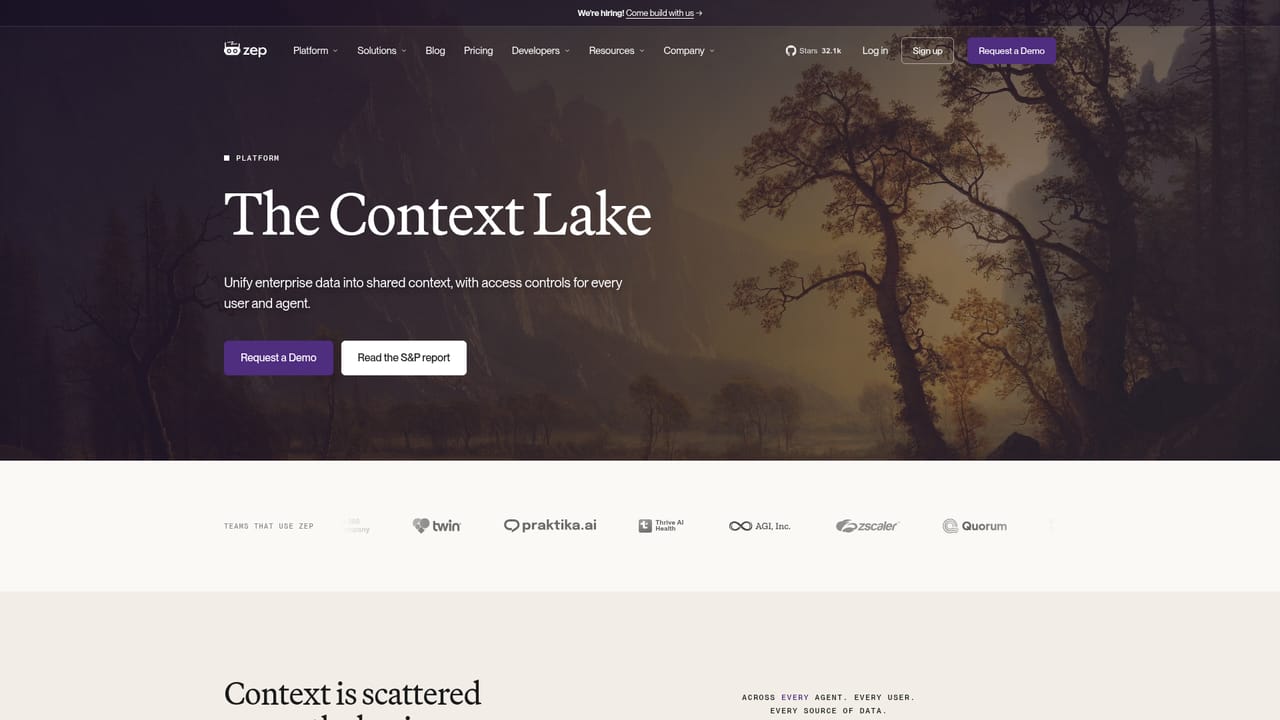
Screenshot of Zep, Unified context layer for enterprise AI agents

What is Zep?

Zep is a developer tool. Zep unifies business data, documents, and conversations into governed Context Graphs that AI agents query for task-specific facts. It combines temporal memory, sub-200ms retrieval, and policy-based access control, with cloud, BYOK, and VPC deployment options.

Zep is a context infrastructure layer built for teams running AI agents in production. It ingests business data, documents, and conversations, then compiles them into a Context Graph for each user, customer, account, or domain. Instead of pulling whole records through tool calls, an agent asks Zep for the facts a task depends on and receives a compact, policy-filtered response in a single call. The company says this cuts token use by around 90 percent compared with tool calling. The system is aimed at engineering and platform teams that need agents to act on accurate, current knowledge across an organization. Facts inside a graph are dated and updated as source data changes, and each fact retains a link back to where it came from, so an answer can be audited to its origin. A Context Lake holds many graphs at once, managed as one system, and retrieval stays under 200 milliseconds according to the vendor regardless of graph count or size. On the published LoCoMo and LongMemEval benchmarks, Zep reports 94.7 percent and 90.2 percent accuracy respectively with context sizes in the low thousands of tokens. Governance sits in the data layer rather than the application. Attribute-based access control determines which context an agent may retrieve, retention policies expire data on a schedule, legal holds block deletion, and request logs record every access decision. Deployments come in three forms: a managed cloud service, a cloud option where the customer supplies encryption keys, and a bring-your-own-cloud setup inside a customer VPC. Zep competes in the agent memory and retrieval space, where alternatives tend to be either vector stores with limited structure or tool-calling pipelines that pass entire records. Its differentiator is the temporal graph plus built-in policy enforcement. Pricing details are not spelled out on the homepage; enterprise plans and a demo request are the stated routes, with a self-serve start also offered.

How do you use Zep?

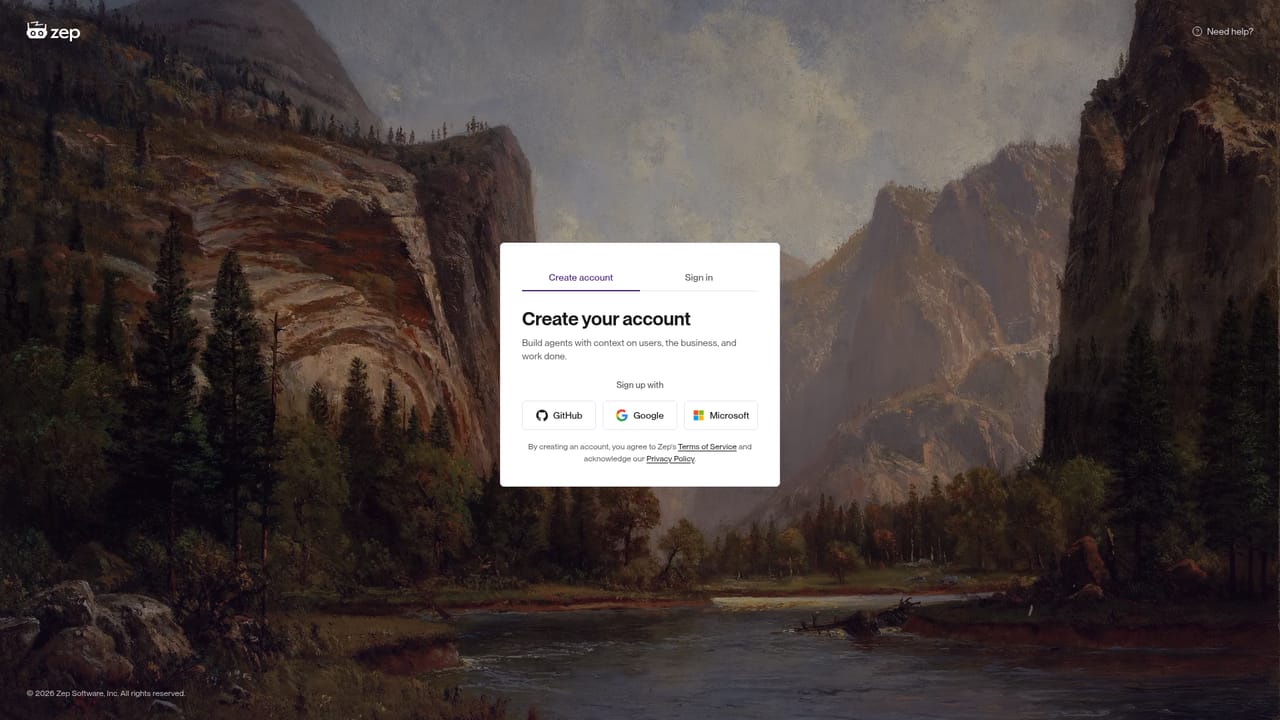
  1. 1Create a Zep account
    Register through the Zep app to get access to a project and API credentials. The signup flow is the entry point for the managed cloud service.
    Zep — Create a Zep account
  2. 2Send data into Zep
    Ingest business records, documents, and conversation episodes. Each record keeps a link to its source so facts can later be traced back.
  3. 3Build a Context Graph per subject
    Zep compiles ingested data into a graph for each user, account, or domain, with dated facts that update as source data changes.
    Zep — Build a Context Graph per subject
  4. 4Set access and retention policies
    Define attribute-based rules for what each agent may retrieve, and configure retention schedules and legal holds where compliance requires them.
  5. 5Retrieve context from your agent
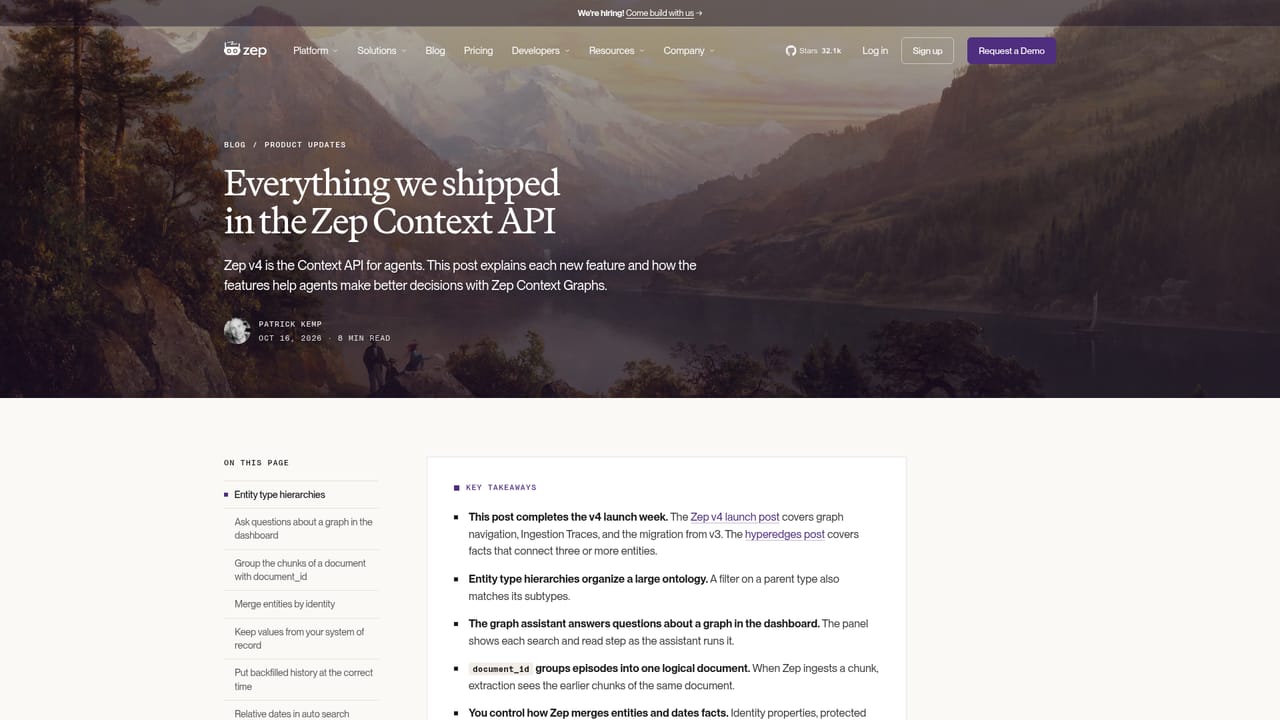
    Call the context API so the agent receives only the filtered facts a task depends on, in one request. Review the Context API release notes for the current version.
    Zep — Retrieve context from your agent
  6. 6Monitor usage and latency
    Use the analytics view to watch ingestion volume, graph creation, retrieval latency, and error rates across projects.

Pros and cons

Pros

  • Temporal Context Graphs track how facts change over time and keep each fact linked to its source for auditingAI
  • Retrieval reported under 200ms at 10K to 100M graphs, so latency does not degrade with scaleAI
  • Access and retention policies enforced in the data layer, with logs for every request and access decisionAI
  • Claimed 90 percent reduction in token use by returning only task-relevant facts instead of full recordsAI
  • Deployment flexibility across managed cloud, customer-managed keys, and inside a customer VPCAI

Cons

  • Homepage does not publish any price points, so budgeting requires a sales conversation or a check of the pricing pageAI
  • No self-serve free tier or trial terms are stated on the homepageAI
  • Benchmark results come from Zep's own published research, and no independent replication is referencedAI
  • The platform is built for production agent engineering, which puts it out of reach for non-technical usersAI
  • Integration coverage is not itemized on the homepage, leaving connector breadth unclear before a demoAI

How much does Zep cost?

Pricing

The homepage does not list prices. It points to a pricing page and to enterprise plans, and offers a demo request alongside a self-serve start. Cloud, cloud with customer-managed keys, and bring-your-own-cloud deployments are the stated options, with BYOC handled through sales.

Learn more

Features

Core features include a Context Lake holding many Context Graphs as one managed system, temporal facts dated and updated over time, source tracing for every fact, attribute-based access control, retention policies with legal hold, audit and API logs, sub-200ms retrieval at scale, and a monitoring dashboard for ingestion, latency, and errors.

Learn more

Frequently asked questions about Zep

  • How much does Zep cost?
    The homepage does not list prices. It points to a pricing page and to enterprise plans, and offers a demo request alongside a self-serve start. Cloud, cloud with customer-managed keys, and bring-your-own-cloud deployments are the stated options, with BYOC handled through sales.
  • Does Zep have an API?
    Yes, Zep offers an API.
  • How do you use Zep?
    The walkthrough on this page covers 6 steps: 1. Create a Zep account 2. Send data into Zep 3. Build a Context Graph per subject 4. Set access and retention policies 5. Retrieve context from your agent 6. Monitor usage and latency.
  • What platforms does Zep support?
    Zep is available on Web App.
  • What are the limitations of Zep?
    Homepage does not publish any price points, so budgeting requires a sales conversation or a check of the pricing page. No self-serve free tier or trial terms are stated on the homepage. Benchmark results come from Zep's own published research, and no independent replication is referenced.

Status

StatusActive
Views0
Outbound clicks0
Added10/21/2026

Platforms

Web App

Pricing

FreemiumPaid