Support
Above investigators triage and verify every finding before it reaches the customer team, and cases are shared through Slack, Teams, email, Jira and ServiceNow so security, HR and legal read the same report.
AI insider risk investigation across SaaS, endpoints, identity and AI agents
Own Above Security? Verify ownership to get a dofollow link

Above Security is a content detector tool. Above Security runs a fleet of AI agents that investigate insider risk across SaaS, endpoints, identity and AI tools, then delivers verified cases with evidence to security, HR and legal teams.
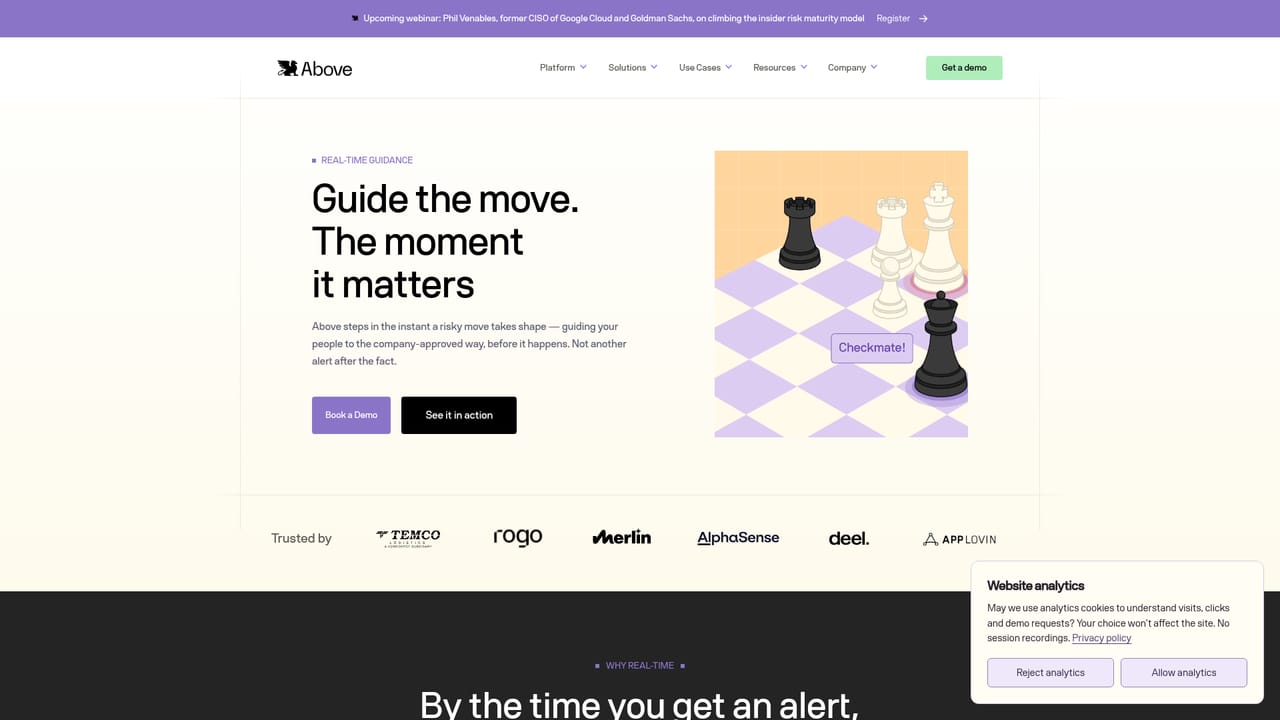
Above Security is an insider risk platform built around the idea that insider threat is a narrative rather than a single alert. Instead of stacking detectors that each emit their own suspicious activity signals, Above collects telemetry from browsers, endpoint tools, email and collaboration suites, identity providers, AI assistants and systems of record, then assembles those fragments into one investigation with evidence attached. A fleet of specialized AI agents handles the reasoning: dedicated agents cover shadow AI and shadow IT, data exfiltration, flight risk, inappropriate use and communications sentiment. Findings are streamed to the security team only after Above investigators have triaged and verified them. The product suits security operations and insider risk teams at organizations large enough to run SaaS, identity, endpoint and AI tooling side by side, including CISOs who need defensible case files rather than raw anomaly lists. In practice a finding arrives as a human-readable case with an activity timeline, the permissions and conversation context behind it, and a report that security, HR and legal can all read. Cases and findings push out to CrowdStrike Falcon Next-Gen SIEM, Splunk, Microsoft Sentinel, Elastic, Jira, ServiceNow, Slack, Teams and email. Above also maps business and shadow processes by watching real activity rather than policy documents, so an unsanctioned workflow stands out without a prewritten baseline. A second layer runs in the moment. Real-time guidance appears inside email, SaaS and AI tools when a risky action is forming (a customer list heading to a personal drive, for example) and offers the company-approved alternative with a short explanation, rather than blocking the work. Above positions itself against detection-only insider risk tools and UEBA suites, arguing that investigation quality, not alert volume, is the differentiator. The trade-off is that value depends on broad data coverage, so buyers should expect a deployment spanning many systems before the picture becomes complete. Pricing is not published on the homepage; the path to evaluation is a demo request.
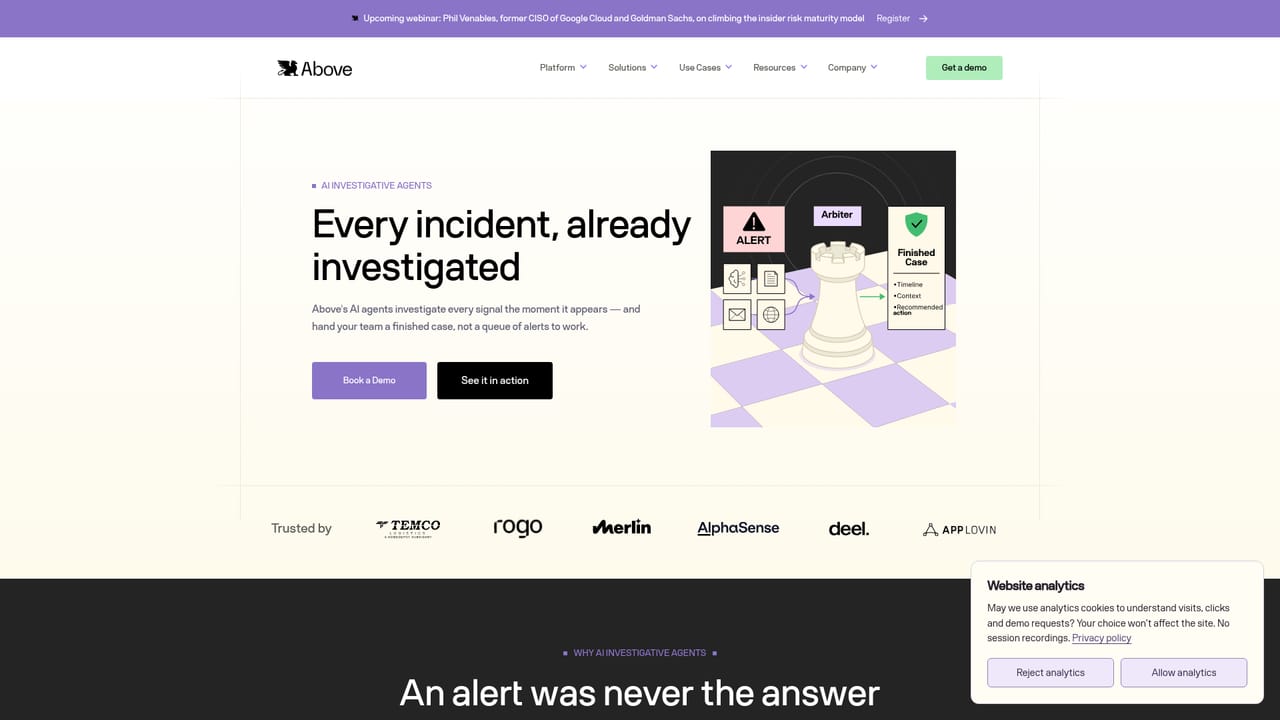
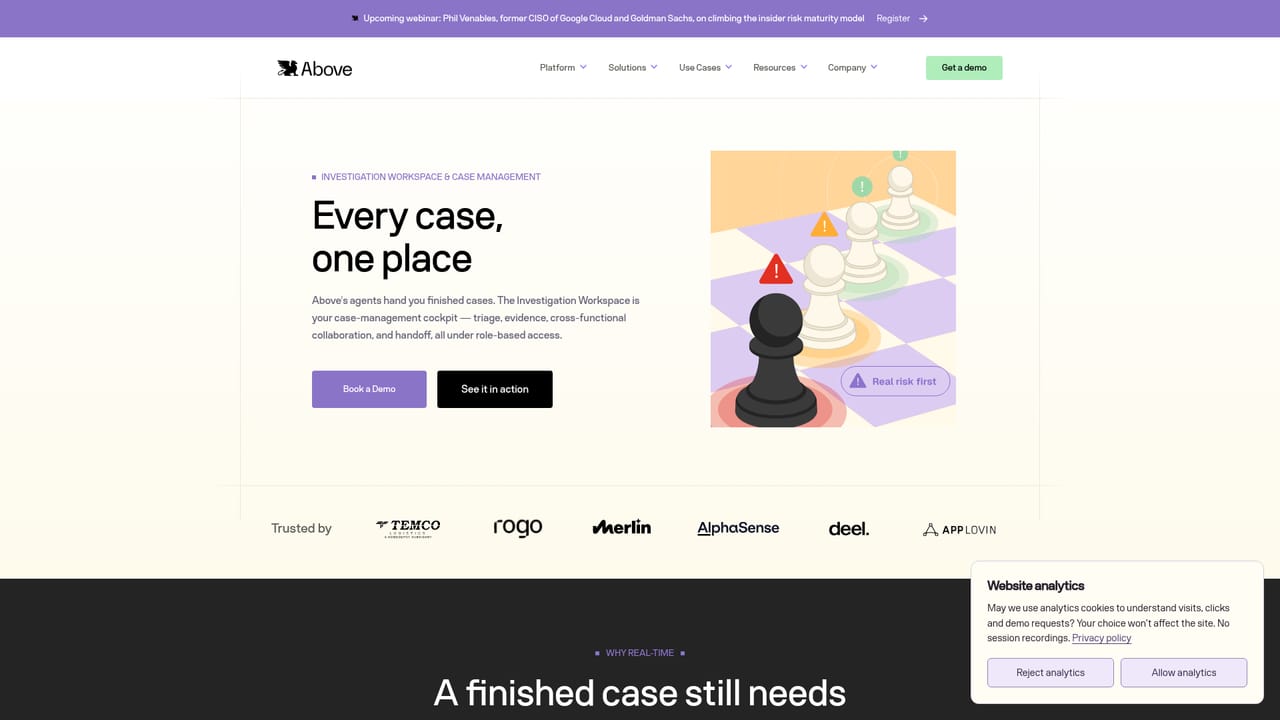
Above investigators triage and verify every finding before it reaches the customer team, and cases are shared through Slack, Teams, email, Jira and ServiceNow so security, HR and legal read the same report.
Browser, endpoint (CrowdStrike Falcon, Defender, SentinelOne, Cortex XDR), identity and SaaS (Okta, Entra ID, Google Workspace), email and collaboration (Gmail, Outlook, Slack, Teams), AI agents (Claude, ChatGPT, Copilot), and SIEM, ticketing and chat outputs.
Learn moreSpecialized AI agents for shadow AI and IT, data exfiltration, flight risk, inappropriate use and communications sentiment; behavioral modeling that mines business and shadow processes; full-session visibility across browsers, endpoints, identity, email, SaaS and AI agents; investigation workspace with case management and activity timelines; real-time guidance inside everyday tools; findings streamed to SIEM and ticketing systems; managed triage by Above investigators.
Learn more AI Angels400+ customizable AI girlfriends for NSFW chat, voice calls, and roleplay
 Candy AIExperience the future of companionship with AI friends who chat, role-play, and connect with you on a human level.
 ourdream.aiA vast AI roleplay platform with millions of characters for chat, images, video and voiceAI Angels400+ customizable AI girlfriends for NSFW chat, voice calls, and roleplayCandy AIExperience the future of companionship with AI friends who chat, role-play, and connect with you on a human level.ourdream.aiA vast AI roleplay platform with millions of characters for chat, images, video and voice


