AI Video Editor

Edit real video clips with plain-language prompts and AI models

Beginner
Screenshot of AI Video Editor, Edit real video clips with plain-language prompts and AI models

What is AI Video Editor?

AI Video Editor is a generative video tool that edits real video clips with plain-language prompts and AI models. AI Video Editor is a web workspace for editing uploaded clips with text prompts: remove objects or watermarks, recolor products and restyle footage.

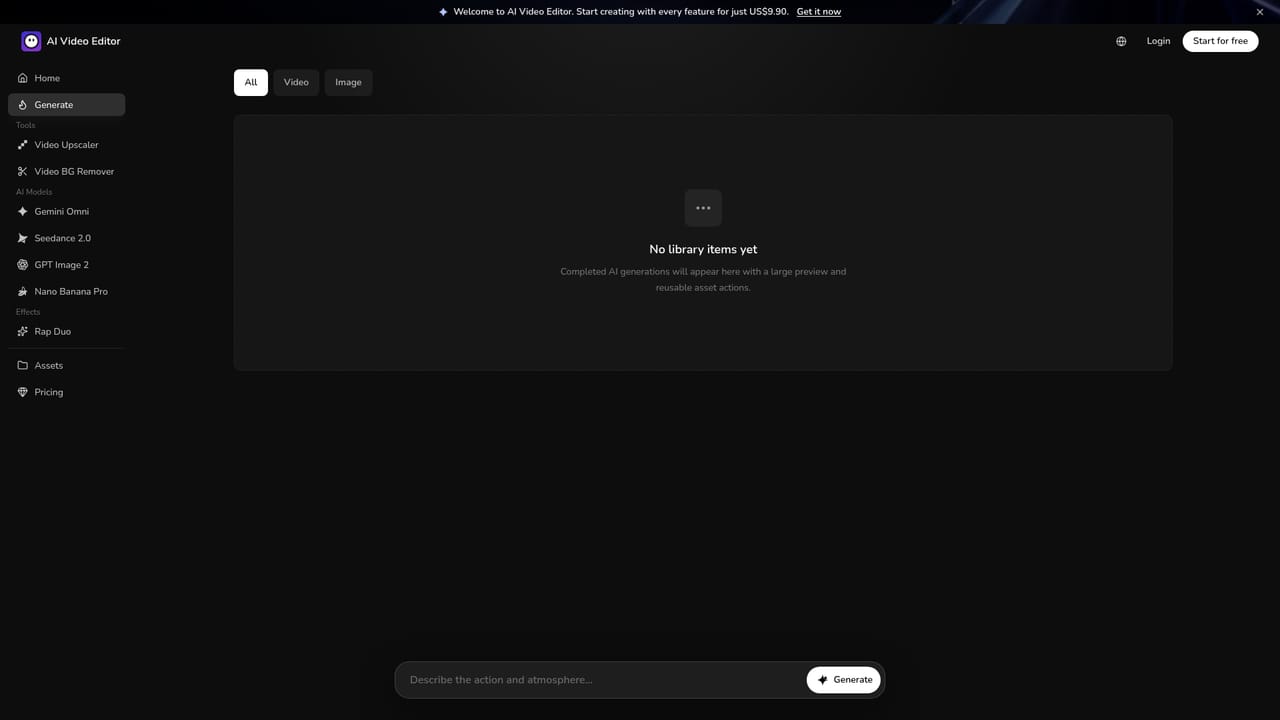
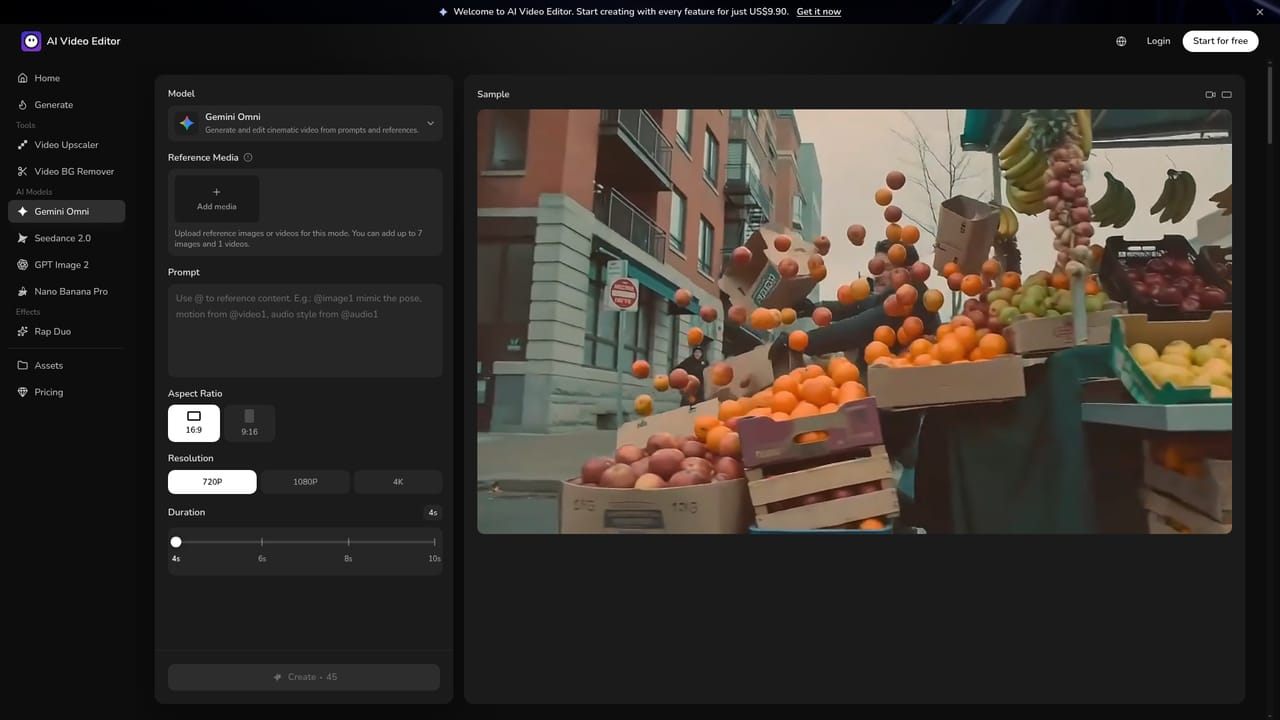
AI Video Editor is a browser-based workspace for changing existing footage with written instructions. A user uploads a clip, describes the change, and the tool applies it while trying to hold the rest of the shot steady: camera movement, lighting, framing and subject continuity. Typical jobs include removing a watermark or a distracting object, recoloring a product, swapping one item for another, restyling a scene into a cinematic, anime or commercial look, and changing details such as weather or setting. The prompt box accepts references with an @ syntax, so a source video, a reference image or an audio clip can be attached and pointed to inside the instruction. Beyond editing, the same workspace offers several third-party image and video models, including Gemini Omni, Seedance 2.0, GPT Image 2 and Nano Banana Pro, each with its own page. Controls such as edit mode, duration, source media, first and last frames and reference limits are exposed per model. Finished results are saved to a library where they can be compared, reused as references and carried into the next prompt. The audience is mostly marketing and production work: growth marketers refreshing paid creative, creative teams doing look development, ecommerce teams who need extra colorways without another shoot, and creators repairing footage after the shoot is over. The site itself cautions that object removal depends on a clear subject and a background that can be reconstructed, and that chaotic motion or tiny details may take several attempts. Compared with timeline editors, this is a generation-first tool: there is no manual cutting or layering described, and results depend on prompt quality and the chosen model. It sits closer to prompt-driven video-to-video tools and multi-model aggregators than to traditional editing software. Access runs on credits, with sign-in granting a starter allotment, failed generations being refunded, and commercial use of outputs reserved for paid users.
How do you use AI Video Editor?

  1. 1Open the generator and sign in
    Go to the generator page and sign in. New accounts receive a starting credit balance, enough for a short test edit.
    AI Video Editor — Open the generator and sign in
  2. 2Upload a source clip
    Add the best available footage. Clips with a visible subject and moderate camera movement give the model a better starting point.
  3. 3Describe the exact change
    Write one clear instruction, such as removing a watermark or recoloring a product, and state what must stay unchanged, like framing and lighting.
  4. 4Add references and pick a model
    Use @ to attach reference images, video or audio, then choose a supported model such as Gemini Omni for editing.
    AI Video Editor — Add references and pick a model
  5. 5Review, refine and reuse
    Compare the result in the library, adjust the prompt or reference if needed, and reuse the best output in the next pass.

Pros and cons

Pros

  • Prompt-based edits cover object removal, watermark removal, product recolors and style changes without reshootingAI
  • The @ syntax lets video, image and audio references steer an editAI
  • Several image and video models share one workspace, with model-specific controls shown clearlyAI
  • Finished outputs are saved to a library for comparison and reuse in later promptsAI
  • Failed generations automatically return the credits used for that attemptAI

Cons

  • Object removal can need several attempts when motion is complex, occlusion is heavy or details are tinyAI
  • Results depend on source clip quality, so chaotic camera movement gives weaker editsAI
  • No manual timeline, cutting or layering is described, so it will not replace a traditional editorAI
  • Credit-based use means iterating on prompts consumes credits, and commercial use is limited to paid usersAI

How much does AI Video Editor cost?

Free trial

Signing in grants 25 credits, enough to edit one 4-second video with Seedance 2 Mini.

Learn more

Pricing

Pricing amounts are not stated on the homepage. Access runs on credits: signing in grants 25 credits, enough for a 4-second edit with Seedance 2 Mini. Paid users may use outputs commercially.

Learn more

Support

The homepage has an FAQ covering edits, references, credits and ownership. No support channel is listed.

Integrations

No third-party app integrations are listed. The workspace bundles models such as Gemini Omni, Seedance 2.0, GPT Image 2 and Nano Banana Pro.

Features

Prompt-based clip editing (restyle, object and watermark removal, product recolor, scene changes), @ references for video, image and audio, multiple image and video models, first and last frame control, and a saved asset library.

Frequently asked questions about AI Video Editor

  • How much does AI Video Editor cost?
    Pricing amounts are not stated on the homepage. Access runs on credits: signing in grants 25 credits, enough for a 4-second edit with Seedance 2 Mini. Paid users may use outputs commercially.
  • Does AI Video Editor offer a free trial?
    Signing in grants 25 credits, enough to edit one 4-second video with Seedance 2 Mini.
  • How do you use AI Video Editor?
    The walkthrough on this page covers 5 steps: 1. Open the generator and sign in 2. Upload a source clip 3. Describe the exact change 4. Add references and pick a model 5. Review, refine and reuse.
  • What platforms does AI Video Editor support?
    AI Video Editor is available on Web App.
  • What does AI Video Editor integrate with?
    No third-party app integrations are listed. The workspace bundles models such as Gemini Omni, Seedance 2.0, GPT Image 2 and Nano Banana Pro.
  • What are the limitations of AI Video Editor?
    Object removal can need several attempts when motion is complex, occlusion is heavy or details are tiny. Results depend on source clip quality, so chaotic camera movement gives weaker edits. No manual timeline, cutting or layering is described, so it will not replace a traditional editor.

Status

StatusActive
Views0
Outbound clicks0
Added10/18/2026

Platforms

Web App

Pricing

FreemiumPaid