Aria Networks

Microsecond telemetry and an intelligent Network OS for AI clusters

Advanced
Screenshot of Aria Networks, Microsecond telemetry and an intelligent Network OS for AI clusters

What is Aria Networks?

Aria Networks is a pattern recognition tool. Aria Networks combines purpose-built 800G switches, microsecond-level telemetry and an intelligent Network OS to diagnose congestion, optics and host problems across AI training and inference clusters, with investigations run by both human operators and autonomous agents.

Aria Networks is a network observability and hardware company aimed squarely at the operators of AI compute clusters. Rather than selling a software overlay that sits on top of whatever switches happen to be installed, Aria starts at the silicon: its own switches are designed from the ASIC up to capture telemetry that conventional networking gear was not built to expose. That telemetry then feeds an intelligent Network OS which correlates signals across three layers at once, network state (traffic behaviour, congestion, protocol health, optics) and host systems (GPU state, NIC counters, firmware, system details) and the workloads themselves, meaning training and inference metrics pulled from the ML toolchain. The pitch is resolution. Aria claims 100 to 10,000 times the telemetry resolution of competitors, and argues that the difference matters when a stalled job in a large cluster can come from a marginal optic, a silent firmware mismatch or a congested link rather than an obvious failure. By holding all of those signals in a single context instead of isolated dashboards, the platform is positioned to point at a root cause rather than a symptom. The interface is built for two audiences simultaneously: people who ask questions in natural language, and automated agents that act on the same telemetry and reasoning without waiting for a human to start an investigation. The product is clearly not for small teams or general IT. It is for organisations running GPU-dense infrastructure at scale, where fabric cost is measured in millions and utilisation directly determines whether expensive compute earns its keep. Aria frames the economics around model flop utilisation and token efficiency, with a calculator that estimates how small an MFU improvement is needed to recover the network's five year cost. Anyone evaluating it will be comparing against established switch vendors plus a separate observability stack, and should expect a hardware-led procurement rather than a self-serve signup.

How do you use Aria Networks?

  1. 1Review the product and hardware lineup
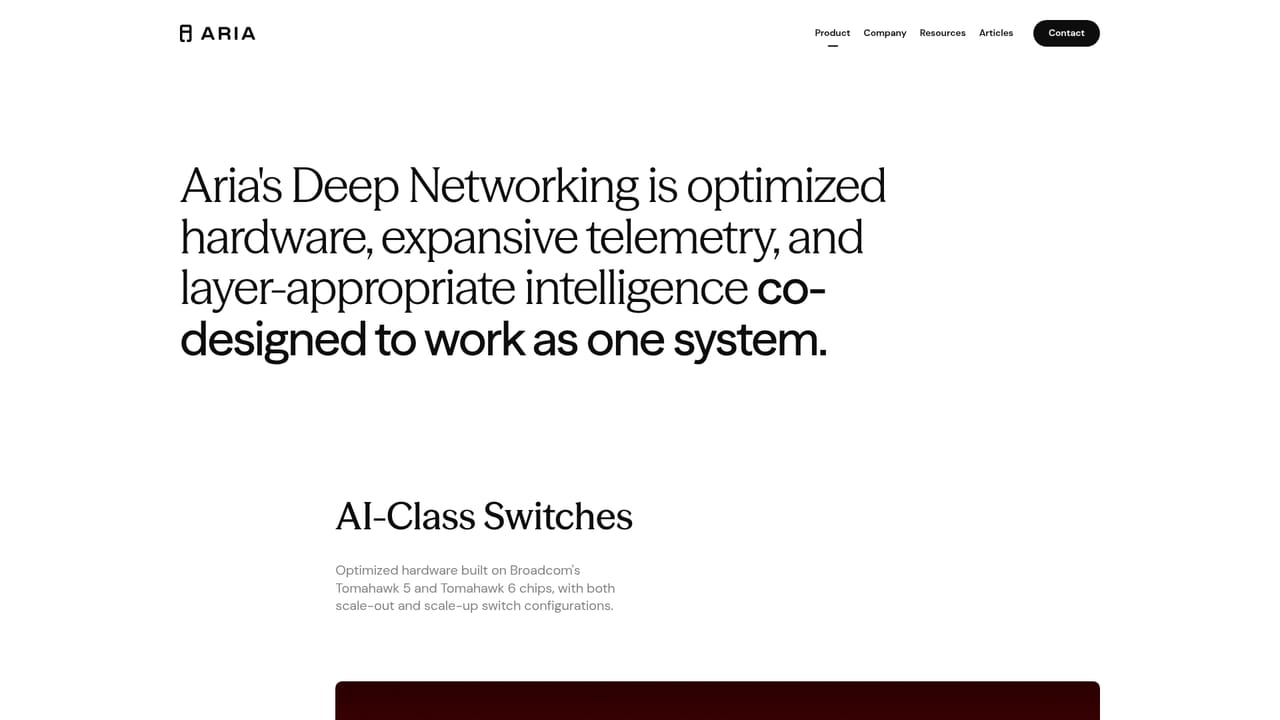
    Start on the product page to understand the switch models and the software layer, since the telemetry capability is tied to Aria's own hardware.
    Aria Networks — Review the product and hardware lineup
  2. 2Map your cluster's layers
    Identify which network, host and workload signals you currently collect and where they live, so you can judge what the unified context would replace.
  3. 3Read the resources library
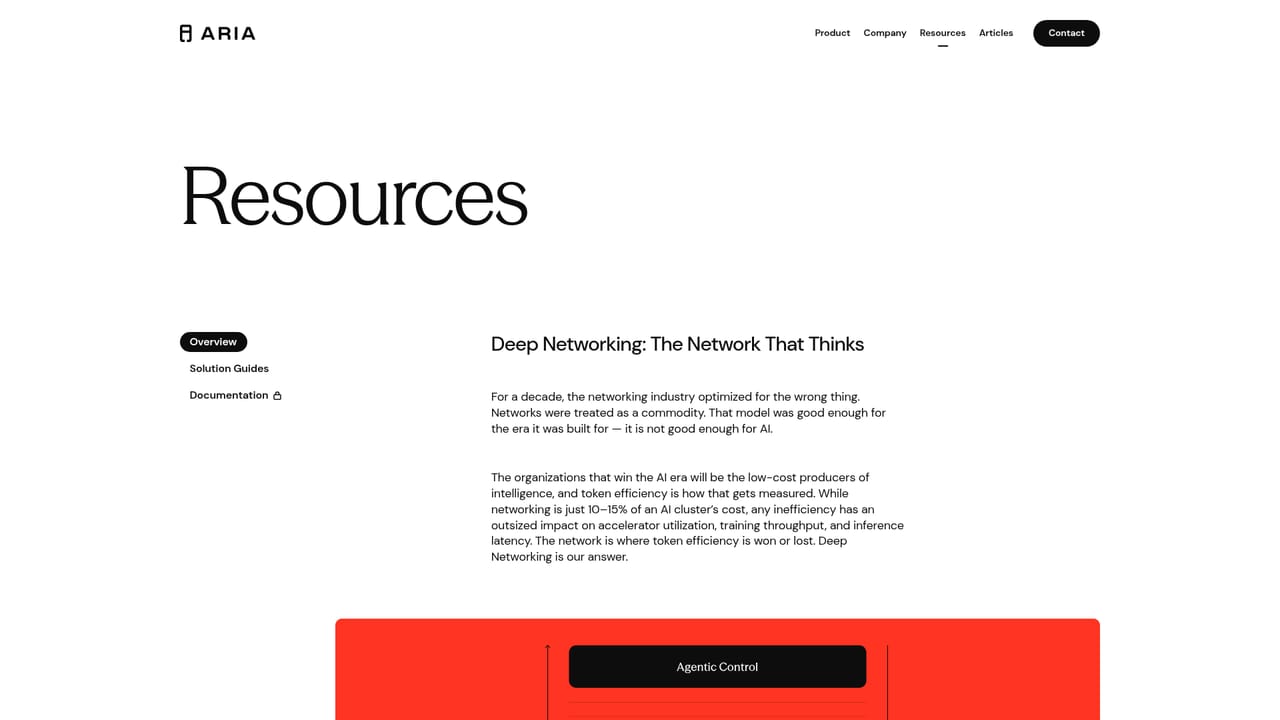
    Work through published material on telemetry and network intelligence to see how the three signal layers are correlated in practice.
    Aria Networks — Read the resources library
  4. 4Run the economics estimate
    Use the homepage calculator to model MFU improvement and token efficiency against network cost and see what gain is needed to recoup the spend.
    Aria Networks — Run the economics estimate
  5. 5Contact sales for a scoped evaluation
    Reach the sales team by email to discuss switch configuration, deployment scope and pricing for your cluster size.

Pros and cons

Pros

  • Telemetry spans network, host and workload layers in one correlated context rather than separate toolsAI
  • Hardware is designed from the ASIC up specifically to expose signals standard switches do notAI
  • Claimed 100 to 10,000x resolution advantage over competing monitoring approachesAI
  • Built for agent-driven investigation as well as human querying, which suits large always-on clustersAI
  • Economics framed around MFU and token efficiency, giving a concrete way to judge returnAI

Cons

  • Deep telemetry depends on Aria's own switches, so existing hardware cannot be monitored to the same depthAI
  • No public pricing, tiers or free tier are stated, making budgetary comparison difficult before a sales conversationAI
  • Requires advanced networking and ML infrastructure expertise to deploy and interpretAI
  • The economic case rests on MFU gains that will vary widely by cluster and workloadAI
  • Little public detail on third-party tooling integration or how it coexists with incumbent monitoring stacksAI

How much does Aria Networks cost?

Features

Unified telemetry context covering network behaviour, congestion, protocol health, optics and state, correlated with host signals such as GPU state, NIC counters and firmware, plus training and inference metrics from the ML toolchain. The intelligent Network OS supports both direct human queries and autonomous agents running continuous investigations at scale, backed by purpose-built switches engineered for high-resolution capture.

Learn more

Frequently asked questions about Aria Networks

  • How do you use Aria Networks?
    The walkthrough on this page covers 5 steps: 1. Review the product and hardware lineup 2. Map your cluster's layers 3. Read the resources library 4. Run the economics estimate 5. Contact sales for a scoped evaluation.
  • What platforms does Aria Networks support?
    Aria Networks is available on Web App.
  • What are the limitations of Aria Networks?
    Deep telemetry depends on Aria's own switches, so existing hardware cannot be monitored to the same depth. No public pricing, tiers or free tier are stated, making budgetary comparison difficult before a sales conversation. Requires advanced networking and ML infrastructure expertise to deploy and interpret.

Status

StatusActive
Views0
Outbound clicks0
Added10/22/2026

Platforms

Web App

Pricing

Paid