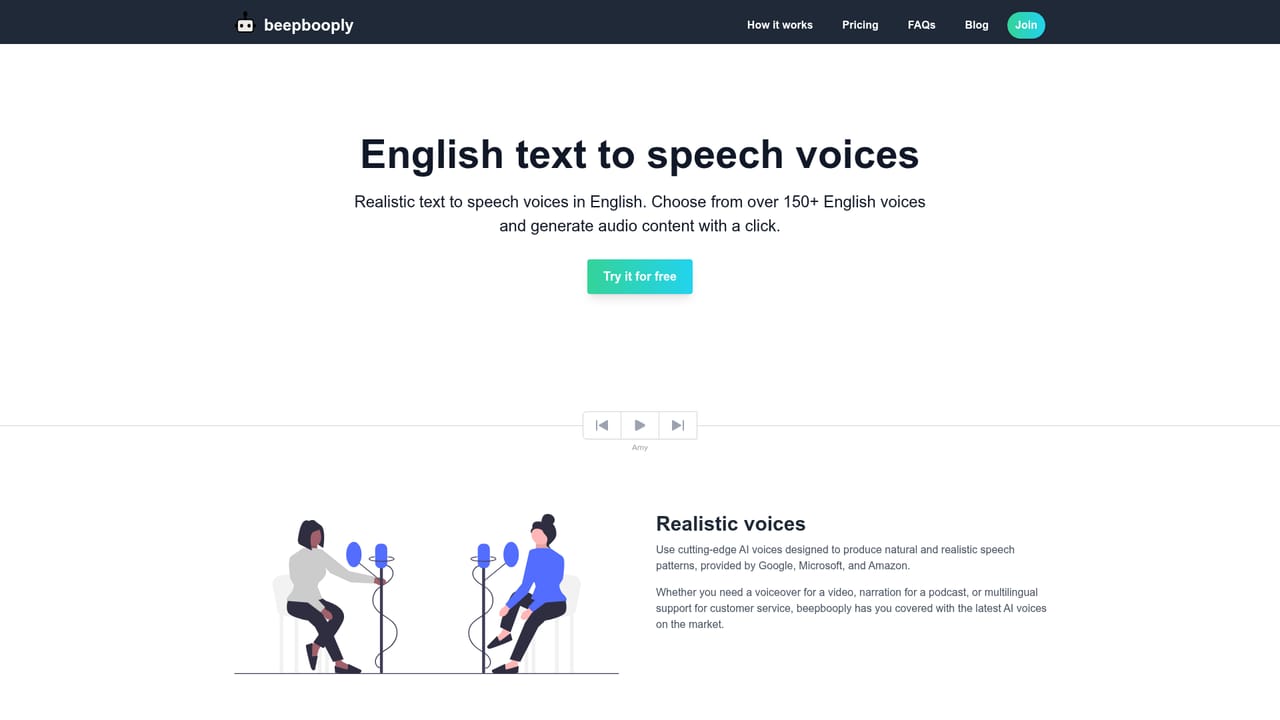
Beepbooply is a baby voice generator tool. A browser based text to speech tool with over 900 voices in more than 80 languages, sourced from Google, Microsoft and Amazon. Type a script, adjust pitch, volume and pacing, then generate and download audio.
Beepbooply is a browser based text to speech service built on voice models licensed from Google, Microsoft and Amazon. The pitch is straightforward: pick a voice, paste or type your script, press generate, then download the finished audio. The library runs past 900 voices covering more than 80 languages, and the language pages on the site reach well beyond the usual European set, with Basque, Zulu, Maltese, Welsh, Pashto, Burmese, Sundanese, Lao, Telugu, Tamil and Mongolian all represented alongside English, Spanish, Japanese and German. Each language typically offers several voices with distinct character, so casting a narrator is a matter of auditioning a handful of options rather than settling for one default.
In practice the workflow is three screens. A voice picker handles casting, a text area takes the script, and a generate button produces the audio, which can then be listened to and downloaded. Pitch, volume, pacing and speaking style are adjustable, and the site suggests mixing and matching voices within a project. Because generation is character metered, the practical constraint is script length rather than render time; the team frames this as creating hours of audio in seconds without booking a studio or a voice artist.
The obvious audience is creators working at volume: video voiceovers, podcast narration, e-learning modules and multilingual customer service prompts. The free tier earns its place for testing because it includes access to both basic and realistic voices, though downloads are limited to basic voices and projects expire weekly. Paid plans unlock commercial use, unlimited downloads and unlimited projects, which is the point where the tool becomes viable for client work.
Against dedicated voice studios, Beepbooply competes on breadth of languages and on price rather than on fine control. There are no cloning or custom voice training options mentioned, and no API is advertised on the homepage, so teams wanting programmatic generation or a branded synthetic voice will need to look elsewhere. It sits closest to the general purpose TTS web apps: broad catalogue, simple editor, prepaid or subscription billing, aimed at people who need finished audio files rather than a voice platform to build on.