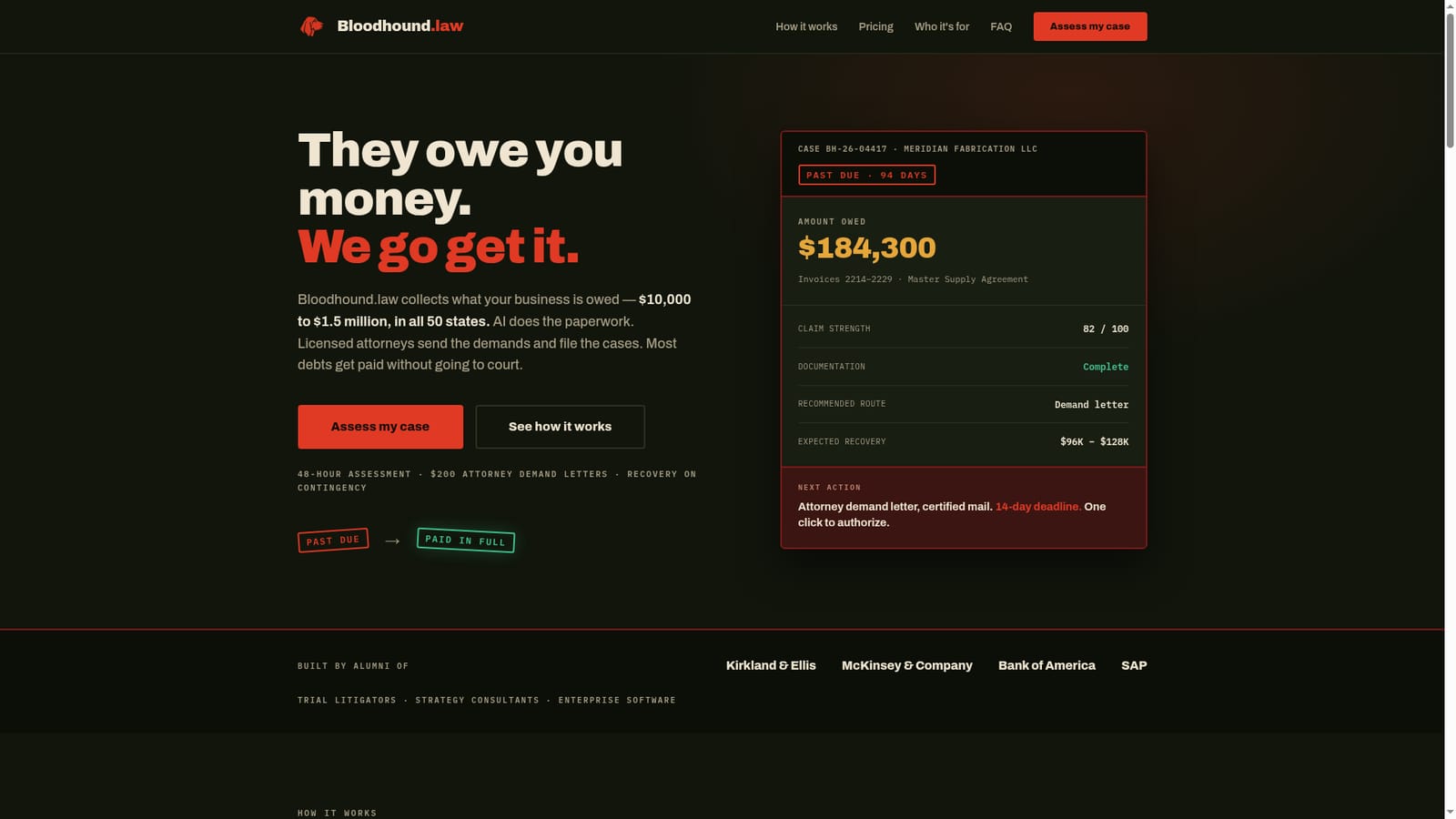
Bloodhound.law uses AI to assess business claims of $10K to $1.5M, then has licensed partner attorneys send $200 demand letters and escalate unpaid-debt cases for a share of recovery.
Bloodhound.law is a technology company that helps businesses recover money owed under contracts. It targets claims between $10,000 and $1.5 million in all 50 states, a range the site describes as too small for a large firm and too complicated for a typical collections agency. Typical matters include unpaid invoices, contract and partnership disputes, construction disputes, insurance claims and judgment collection.
The workflow starts with a case assessment. A business uploads an invoice or contract, which takes about five minutes, and within 48 hours receives a score of how strong the claim is, what it is likely worth and which route fits best: demand letter, arbitration, small claims or court. The assessment can also recommend stopping when the debtor cannot pay or the recovery would not justify the cost, which is a useful signal given that fees on escalated cases depend on recovery.
The first paid step is an attorney demand letter at a flat $200. A licensed attorney in the partner network signs it, sends it on law firm letterhead by certified mail with tracking, and sets a 14-day deadline. The letter cites the contract and amounts and includes any notice to cure that the contract or state law requires, so the claim is not weakened by a procedural gap. If the debtor still refuses, the case can move to negotiation, arbitration, small claims or state court through partner law firms, with a fee taken as a percentage of what is recovered.
Bloodhound.law is explicitly not a law firm. Software handles reading contracts, researching the debtor, scoring the claim and drafting paperwork, while licensed attorneys review and sign everything that goes out. Compared with hiring a litigation firm on an hourly basis, the model trades full-service representation for lower upfront cost and speed. Compared with a collections agency, it brings attorney involvement and contract-specific analysis. Claims outside the stated range are redirected to small claims guidance or a referral to a traditional firm.