Free trial
Free 45-minute onboarding sessions with the team can be booked through the early access page.
Learn moreA typed programming language built for AI agents and LLM functions

Boundary AI is a developer tool. BAML is Boundary's programming language for AI agent code: typed AI functions, an anti-slop type system with no `any`, always-on tracing, workflow primitives and distribution-aware testing. It runs standalone or bridges into Python, TypeScript, Java, Go, Rust, C# and more.
BAML (Basically A Made-up Language) is a programming language from Boundary that targets AI agent code rather than human application code. The premise is that Python and TypeScript were designed for human productivity, while agent workloads need strict typing, tracing and workflow control built in. The syntax deliberately echoes TypeScript, with unions, generics and lambdas, but removes escape hatches such as `any` and unchecked casts. Invalid states are meant to fail at compile time rather than surface at runtime. The core feature is the AI function. Instead of wiring an SDK by hand, a developer declares input and output types and gets structured data back from any provider, with streaming, batching, websockets and voice supported. Malformed model output is repaired against the declared types through schema-aligned parsing. Around this sit workflow primitives for concurrency, retries, cancellation and sandboxing, plus green threads that avoid the sync/async duplication common in other languages. Every function is traced and profiled locally with no sampling, and those traces can be read by agents. Testing is treated as a first-class concern: cases can come from hard-coded examples, CSV or object storage datasets, or real production traces, and flaky AI functions can be graded over many runs. The toolchain is positioned for agents as much as people. A compiler, an LSP for editors, and commands such as `baml describe` give models a way to inspect and edit `.baml` files. BAML can run standalone on macOS, Linux and Windows, or sit inside an existing codebase through a bridge that exposes types, functions and tracing to Python, TypeScript (Node and web), Java, Kotlin, C#, .NET, C++, Go, Rust and Swift. PHP and Ruby are listed as coming soon, and JavaScript is explicitly excluded. It suits engineering teams building LLM-backed features who want type safety and observability without rewriting their codebase, and who are comfortable with a newer, smaller ecosystem. The language is Apache-2 licensed and works offline; Boundary plans to charge for its hosted web services, starting with observability.
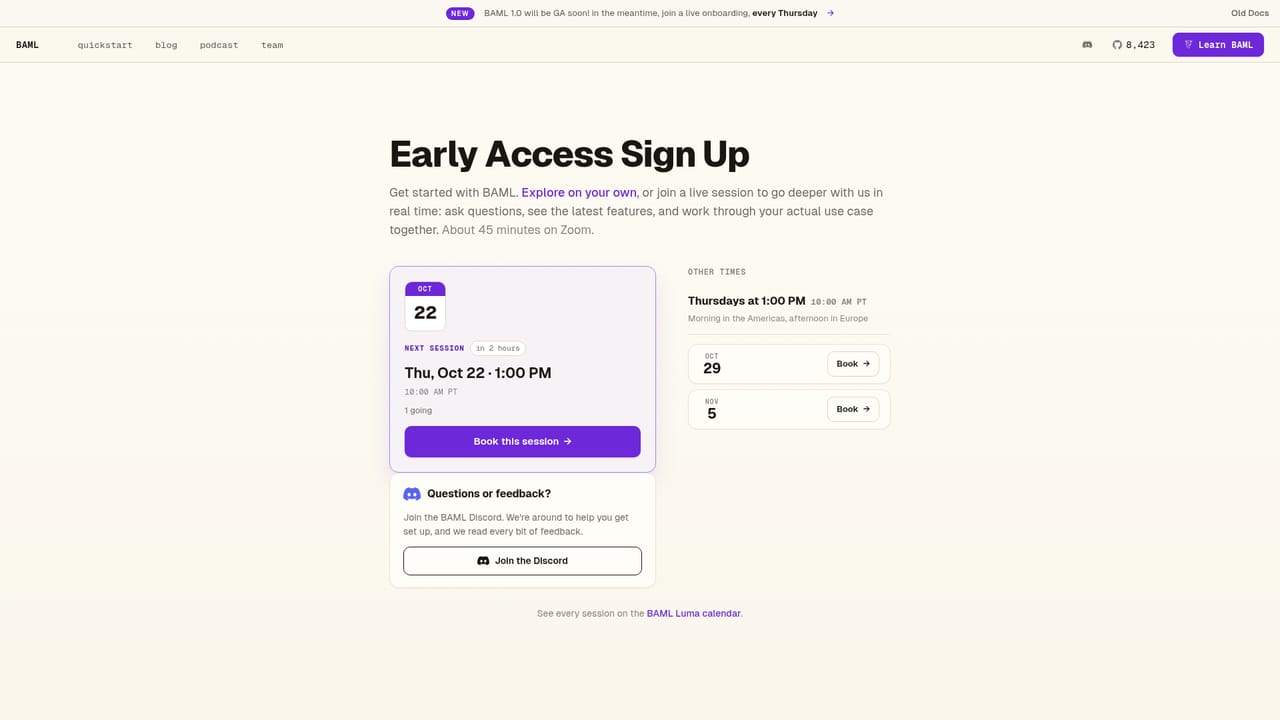
Free 45-minute onboarding sessions with the team can be booked through the early access page.
Learn moreThe BAML language is Apache-2, free and works offline. Boundary says it makes money on Boundary Web Services, beginning with observability, sold separately from the open language. No published price points appear on the homepage.
Learn moreSupport runs through the BAML Discord and free 45-minute live onboarding sessions with the team.
Learn moreBridges to Python (Pydantic v1 and v2), TypeScript for Node and web, Java, Kotlin, C#, .NET, C++, Go, Rust and Swift. PHP and Ruby are listed as coming soon; JavaScript is not supported.
Learn moreTyped AI functions with streaming, batching, websockets and voice across providers; schema-aligned parsing for structured output; a type system with no `any` or unchecked casts; always-on tracing and profiling; workflow primitives for concurrency, retries and cancellation; green threads; tests generated from data or production traces with grading across runs; a compiler, LSP and agent-facing commands such as baml describe.
Learn more AI Angels400+ customizable AI girlfriends for NSFW chat, voice calls, and roleplay
 Candy AIExperience the future of companionship with AI friends who chat, role-play, and connect with you on a human level.
 ourdream.aiA vast AI roleplay platform with millions of characters for chat, images, video and voiceAI Angels400+ customizable AI girlfriends for NSFW chat, voice calls, and roleplayCandy AIExperience the future of companionship with AI friends who chat, role-play, and connect with you on a human level.ourdream.aiA vast AI roleplay platform with millions of characters for chat, images, video and voice


