OrcaRouter

One OpenAI-compatible gateway that routes every prompt across 200+ models.

Advanced API
Screenshot of OrcaRouter, One OpenAI-compatible gateway that routes every prompt across 200+ models

What is OrcaRouter?

OrcaRouter is an OpenAI-compatible AI gateway that grades each prompt in under a millisecond, routes it across 200+ models at provider price with zero token markup, and layers on failover, caching, spend logs, guardrails and an agent firewall for production teams.

OrcaRouter is an AI gateway and LLM router that sits between an application and more than 200 models, sending each request to the model best suited to answer it. Every prompt is graded in under a millisecond and matched to frontier or open-source capacity depending on difficulty, so routine work goes to cheaper models and hard reasoning escalates to stronger ones. The service presents a single OpenAI-compatible endpoint: a developer sets base_url to api.orcarouter.ai/v1 and can call model orcarouter/auto, leaving the choice of model to the router. Token prices are the providers' published rates, with no markup on pay-as-you-go, subscriptions or bring-your-own-key usage. The feature set extends well past model selection. Adaptive routing learns the quality and cost trade-off from live workspace traffic, with policies for cheapest-that-clears-the-bar, highest quality or balanced. Automatic failover, prompt caching and load balancing are built in. Beyond routing, OrcaRouter adds governance: data cloaking replaces names, emails and card numbers before they reach a model; prompt logging is off unless enabled; guardrails block PII, secrets, jailbreaks and prompt injection before billing; and an agent firewall grades each tool or MCP call as allowed, reviewed or blocked. Prompt and response bodies are not logged by default, and retained logs can be sealed with hybrid post-quantum encryption. The product targets engineering teams running AI in production: backend developers who want vendor flexibility without rewriting integrations, platform teams that need spend visibility and per-prompt receipts, and security or compliance owners who must demonstrate controls mapped to 32 frameworks. It competes with plain multi-model aggregators and with managed gateways from cloud vendors, positioning itself on zero token markup, privacy defaults and agent-level controls. Set up is deliberately light, with SDK examples for Python, TypeScript, cURL and agent frameworks such as Claude Code and Codex, plus a public leaderboard and model catalogue for comparison shopping. Teams needing the deepest routing control will still evaluate model behaviour directly; OrcaRouter is best understood as the routing and governance layer rather than a model provider itself.

How do you use OrcaRouter?

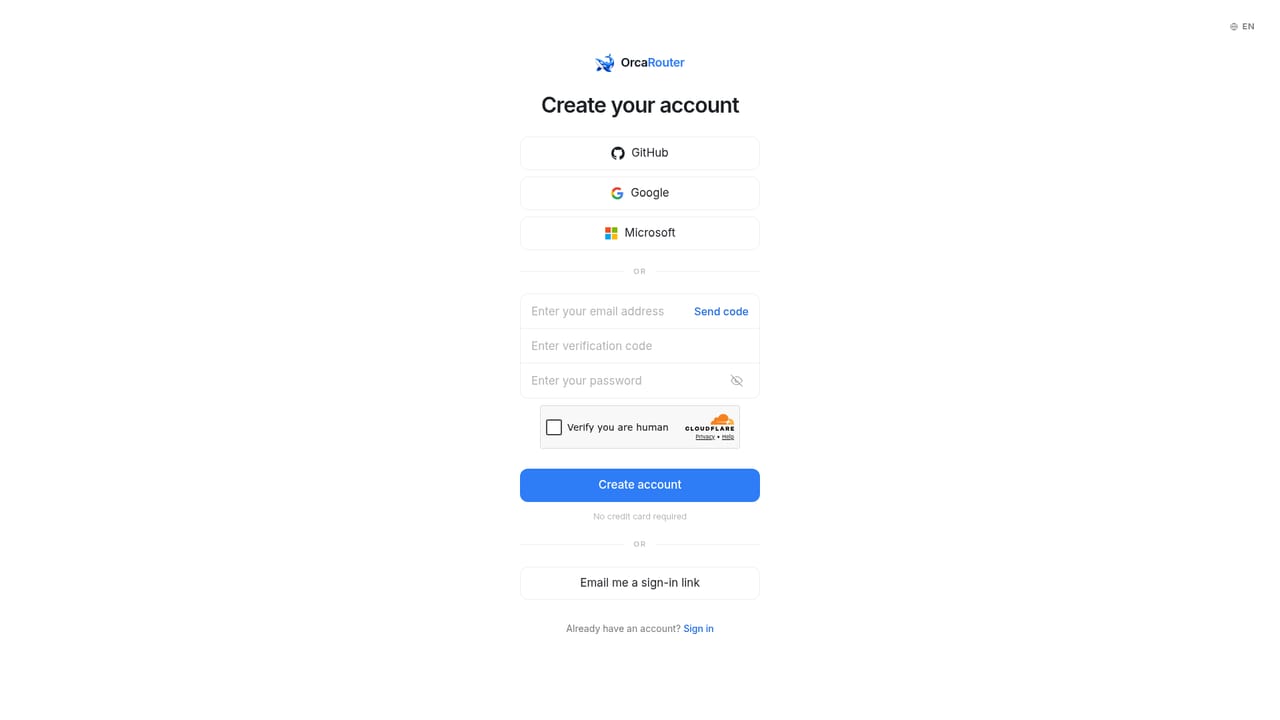
  1. 1Create an account and get an API key
    Register on the site, then generate an API key from the console. Keys carry the sk-orca prefix and the free Hacker plan includes up to 10 of them.
    OrcaRouter — Create an account and get an API key
  2. 2Point your SDK at the OrcaRouter endpoint
    Change base_url to https://api.orcarouter.ai/v1 and swap in your OrcaRouter key in the existing OpenAI client. No other code changes are required.
  3. 3Send a request to orcarouter/auto
    Use model orcarouter/auto and the gateway grades the prompt, picks a frontier or open-source model, and returns the answer. Failover and caching apply automatically.
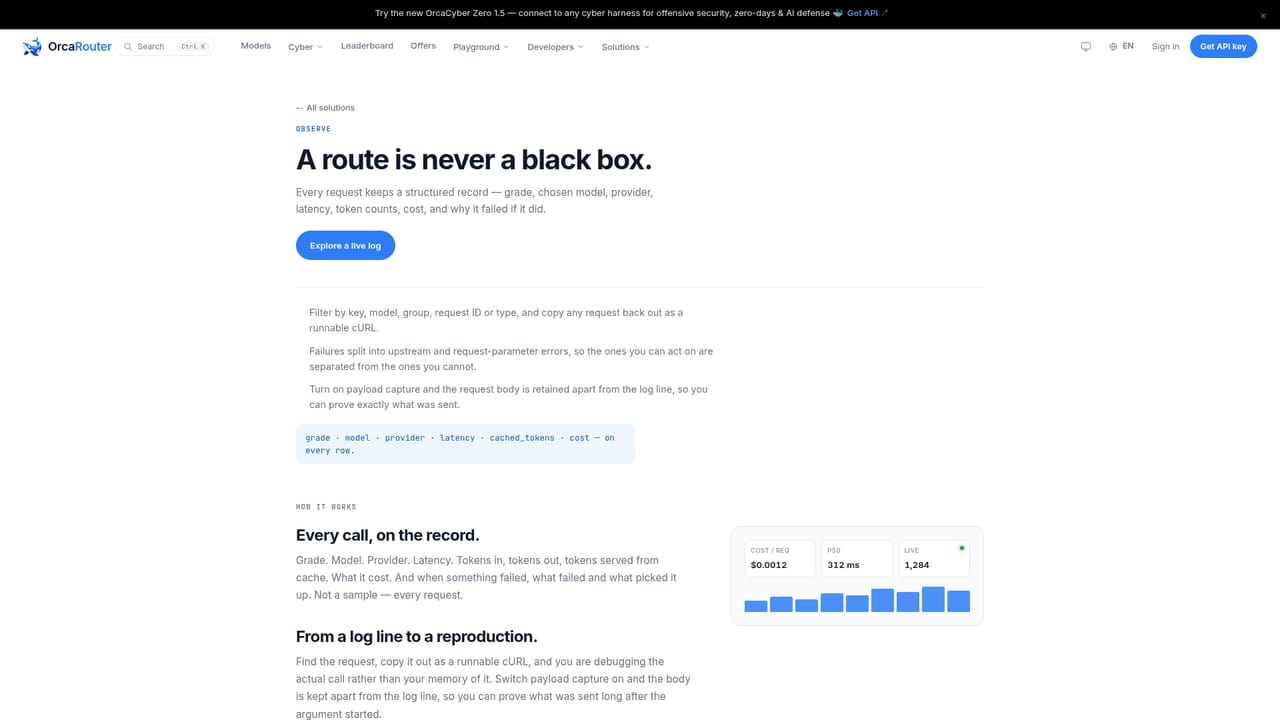
  4. 4Review spend and per-prompt receipts
    Open request logs to see live spend, routing decisions and a receipt for every call. Logging stays off until you enable it for the workspace.
    OrcaRouter — Review spend and per-prompt receipts
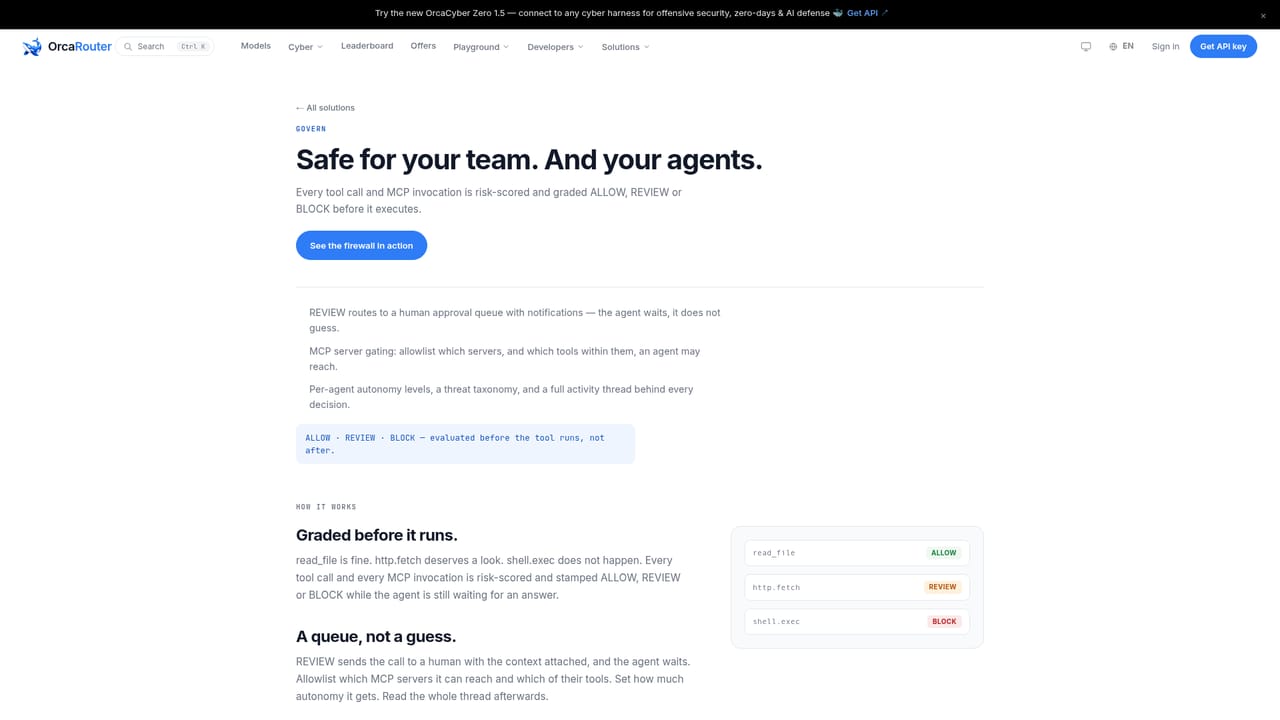
  5. 5Turn on guardrails and the agent firewall
    Enable guardrail rules to block PII, secrets and injection before the model sees them, and configure the firewall to allow, review or block each tool and MCP call.
    OrcaRouter — Turn on guardrails and the agent firewall

Pros and cons

Pros

  • Zero token markup on pay-as-you-go, subscriptions and bring-your-own-key, with per-call receipts for cost tracking.AI
  • Single OpenAI-compatible endpoint covers 200+ models, so switching providers does not require integration rewrites.AI
  • Prompt and response bodies are unlogged by default, with data cloaking and optional post-quantum sealing for retained logs.AI
  • Agent firewall and guardrails grade tool calls and block PII, secrets and injection before the model runs or billing starts.AI

Cons

  • No conventional free forever tier of the team plan; the $499 monthly Team plan is the entry point for compliance enforcement and unlimited keys.AI
  • The data-region setting only tags compliance reports and does not yet pin where data is stored or where inference runs.AI
  • Routing accuracy is still measured against public benchmarks (75.5% on RouterArena), so blind reliance on orcarouter/auto carries review overhead.AI
  • Some governance features such as TEE, data residency and compliance packs are gated behind request or paid plans, so the free tier understates the full product.AI

How much does OrcaRouter cost?

Pricing

Hacker is free forever with 200+ models, failover, a basic dashboard, prompt versioning, 10 API keys and zero token markup. Team costs $499/mo for up to 10 seats, compliance enforcement, unlimited keys and priority support. Enterprise adds SLAs, unlimited seats and dedicated infrastructure. Tokens bill at provider price.

Learn more

Support

Priority support on Team plans and dedicated support on Enterprise; trust centre offers audit reports under NDA and open-source crypto code.

Learn more

Integrations

Integration guides cover Python, TypeScript and cURL SDKs plus agent frameworks including Claude Code, Codex, OpenClaw and Hermes.

Learn more

Features

Adaptive routing with frontier escalation, automatic failover, load balancing and prompt caching across 200+ models. Governance covers guardrails, an agent firewall for tool and MCP calls, data cloaking, zero-retention defaults, BYOK, optional post-quantum log sealing, request logs, prompt versioning and compliance packs mapped to 32 frameworks.

Learn more

Frequently asked questions about OrcaRouter

  • How much does OrcaRouter cost?
    Hacker is free forever with 200+ models, failover, a basic dashboard, prompt versioning, 10 API keys and zero token markup. Team costs $499/mo for up to 10 seats, compliance enforcement, unlimited keys and priority support. Enterprise adds SLAs, unlimited seats and dedicated infrastructure. Tokens bill at provider price.
  • Does OrcaRouter have an API?
    Yes, OrcaRouter offers an API.
  • How do you use OrcaRouter?
    The walkthrough on this page covers 5 steps: 1. Create an account and get an API key 2. Point your SDK at the OrcaRouter endpoint 3. Send a request to orcarouter/auto 4. Review spend and per-prompt receipts 5. Turn on guardrails and the agent firewall.
  • What platforms does OrcaRouter support?
    OrcaRouter is available on Web App.
  • What does OrcaRouter integrate with?
    Integration guides cover Python, TypeScript and cURL SDKs plus agent frameworks including Claude Code, Codex, OpenClaw and Hermes.
  • What are the limitations of OrcaRouter?
    No conventional free forever tier of the team plan; the $499 monthly Team plan is the entry point for compliance enforcement and unlimited keys. The data-region setting only tags compliance reports and does not yet pin where data is stored or where inference runs. Routing accuracy is still measured against public benchmarks (75.5% on RouterArena), so blind reliance on orcarouter/auto carries review overhead.

Status

StatusActive
Views0
Outbound clicks0
Added10/22/2026

Platforms

Web App

Pricing

FreeSubscriptionPaid