Pricing
burntop is free and open source, distributed as a GitHub template with no stated paid tier, subscription, or hosting fee.
Learn moreA FastAPI, React and Postgres starter that fails the build when an AI agent cuts corners.

burntop is a developer tool. Open source FastAPI, React 19, and Postgres template with built-in auth, a reference CRUD module, and 200+ end-to-end tests that block agent-generated code with mocks or missing coverage from passing the build.
burntop is an open source full-stack template built for teams that generate most of their code with AI coding agents. It pairs a FastAPI and Postgres backend with a React 19 frontend, and ships with working authentication, a reference CRUD module, and more than 200 end-to-end tests that run against a real database and a live server rather than mocks. The core idea is enforcement: a route without test coverage, a mocked dependency, or an untested page fails the automated build, so an agent cannot quietly mark a feature done when it isn't. The template is aimed at developers who already lean on tools like Claude Code, Cursor, or Codex to scaffold applications and want guardrails around that workflow. Nested AGENTS.md files and a standards skill tell the agent how the codebase is organized and when a feature actually qualifies as finished, while the existing items module gives it a working pattern to copy for every new feature instead of inventing its own conventions. In practice, a developer creates a new repository from the GitHub template, starts the stack with Docker Compose, and either follows the quickstart manually or hands the README and AGENTS.md to an agent and lets it extend the app. Session auth with Google OAuth, password reset, and email verification are already implemented, along with a typed FastAPI backend that produces OpenAPI docs and a consistent error shape for the frontend to consume. Among boilerplate and starter-kit alternatives, burntop's distinguishing feature is the testing policy itself: banning mocking libraries and gating the build on real end-to-end coverage, rather than offering a generic scaffold and leaving verification up to whoever (or whatever) writes the next feature.
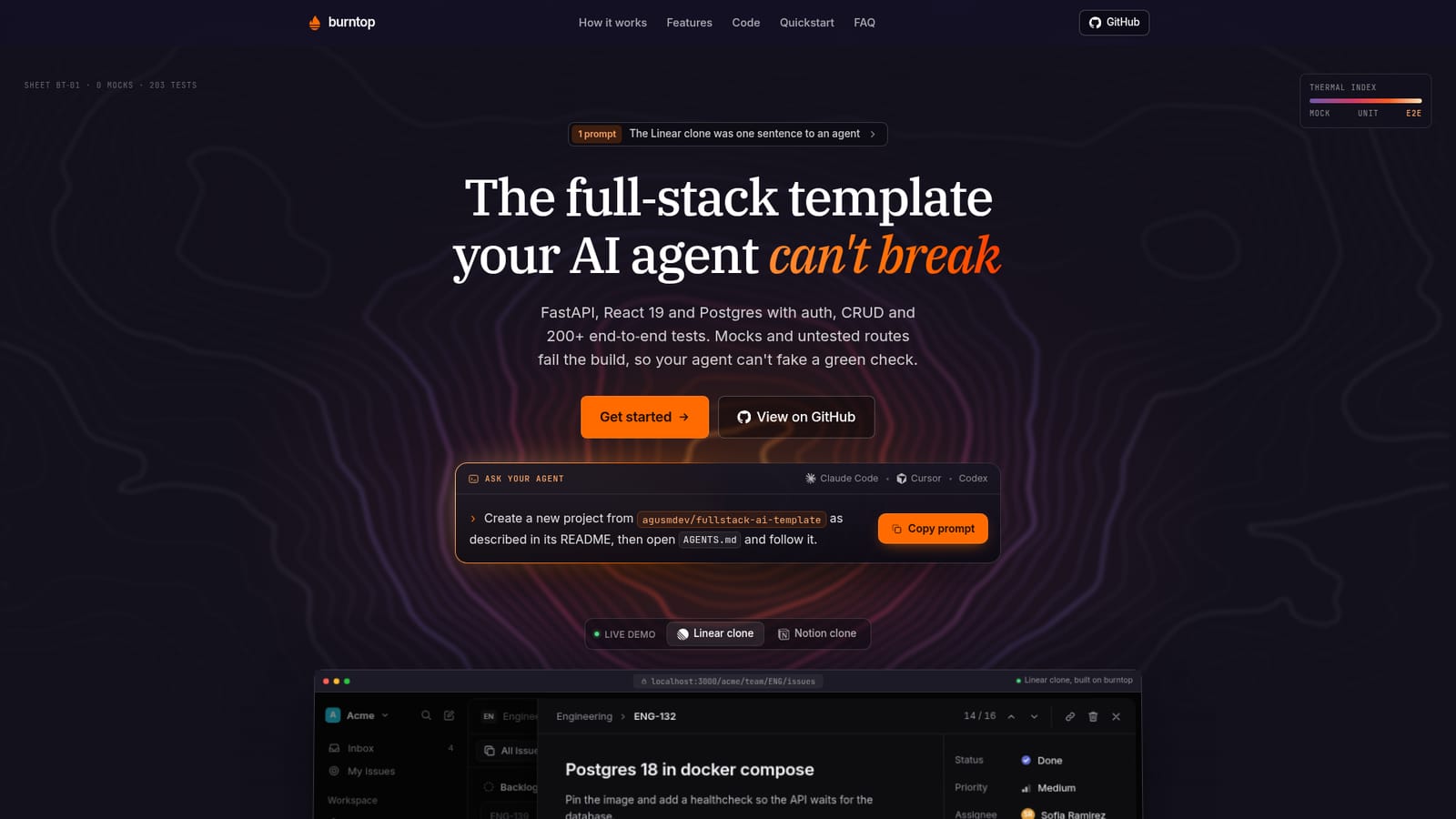
burntop is free and open source, distributed as a GitHub template with no stated paid tier, subscription, or hosting fee.
Learn moreSupport runs through the project's GitHub issues page and an FAQ section on the site; general contact is listed as contact@techwarely.com.
Includes Google OAuth for sign-in, Sentry for error tracking, GitHub Actions for CI, and Docker-based deployment; built to work with AI coding agents that read AGENTS.md, including Claude Code, Cursor, and Codex.
Working session auth with Google OAuth, password reset and verification; a reference CRUD module with search, filters, and pagination; 200+ real end-to-end tests banning mocks; a typed FastAPI backend with OpenAPI docs; Docker Compose setup with roughly 60 make targets for CI.
 AI Angels400+ customizable AI girlfriends for NSFW chat, voice calls, and roleplay
 Candy AIExperience the future of companionship with AI friends who chat, role-play, and connect with you on a human level.
 ourdream.aiA vast AI roleplay platform with millions of characters for chat, images, video and voiceAI Angels400+ customizable AI girlfriends for NSFW chat, voice calls, and roleplayCandy AIExperience the future of companionship with AI friends who chat, role-play, and connect with you on a human level.ourdream.aiA vast AI roleplay platform with millions of characters for chat, images, video and voice


