Free trial
A free entry point is offered through a Try for Free link that opens the hosted application, but the homepage does not state a trial length or which features are included.
Learn moreAI agents for static analysis, PR review and false positive cleanup
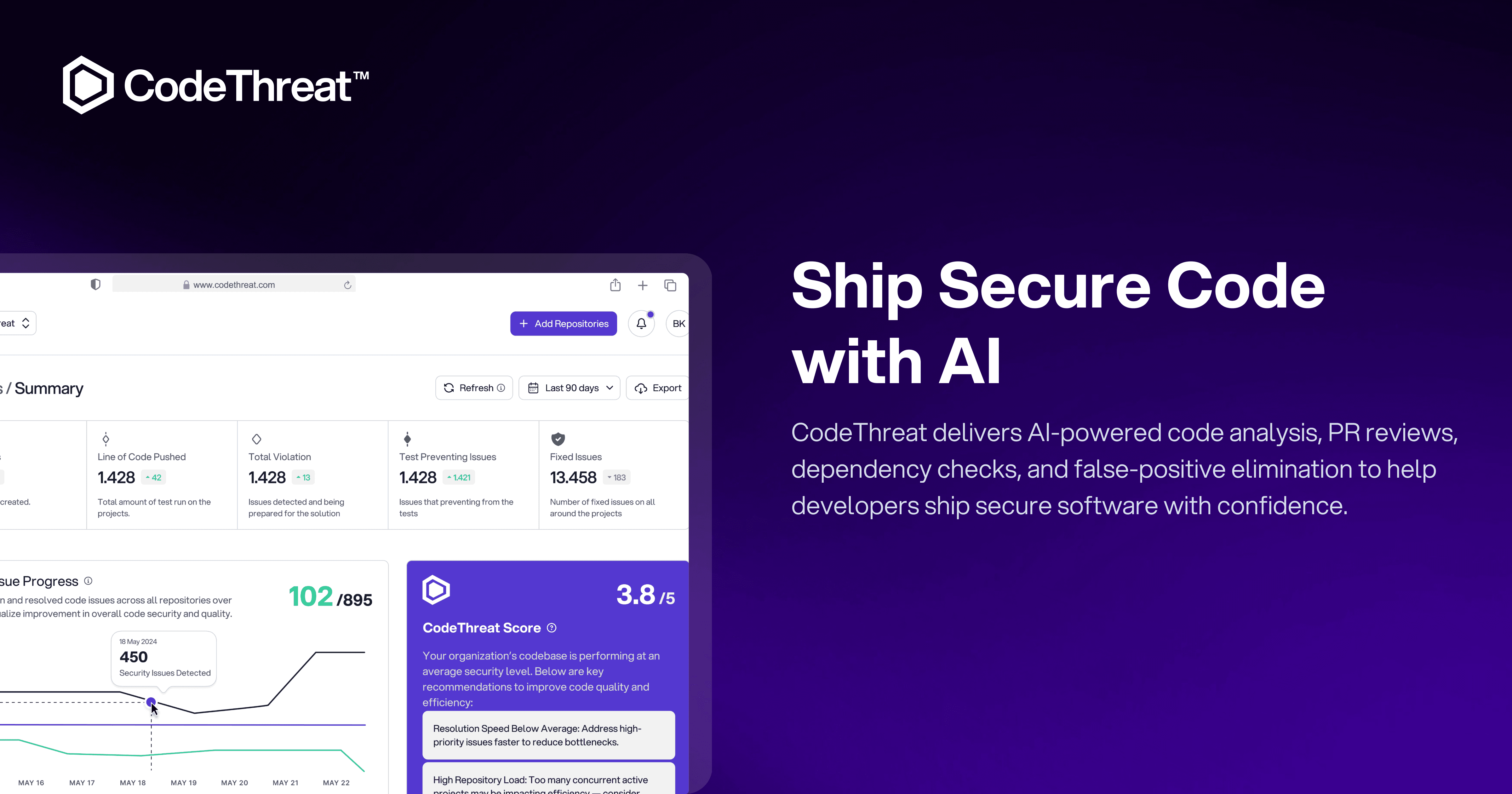
CodeThreat is a cybersecurity tool. CodeThreat pairs AI SAST with agentic pull request review, repository mapping and a false positive agent that re-checks findings and explains which ones are not exploitable. It supports 27+ languages and connects to GitHub, GitLab, Bitbucket and CI pipelines.
CodeThreat is an application security platform built around autonomous AI agents rather than conventional rule matching. The core claim is that its AI SAST engine reads your project in context, so it can flag logic flaws, data flows and authentication paths that pattern-based scanners tend to miss. Around that engine sit several specialist agents: one reviews pull requests before merge, one maps the repository, one documents architecture and endpoints, and one re-examines findings to explain why a given issue is probably not exploitable. The workflow mirrors how most teams already ship code. You connect a repository, and CodeThreat runs project-wide analysis rather than judging isolated files. Pull request reviews surface risks at the point of merge, which keeps security inside the normal review cycle instead of pushing it to a later audit. The false positive agent then goes back over what was flagged, marks findings that are non-exploitable and gives a reason for each, so developers spend their time on issues that actually matter. Repo mapping adds a visual layer that links components, flows and relationships, and the repo analysis agent produces notes on dependencies, endpoints and data flow for people joining an unfamiliar codebase. This is aimed at engineering and security teams that already run SAST but are tired of triaging noise, plus smaller teams that want review coverage without staffing a dedicated security function. It supports more than 27 languages and frameworks and plugs into GitHub, GitLab, Bitbucket, CI pipelines and cloud providers, so the surrounding workflow does not need to change. Entry is through the hosted app, with a demo booking route for teams that want a guided evaluation. The obvious comparison is traditional SAST suites on one side and general coding assistants on the other. CodeThreat sits between them: narrower than a full ASPM stack, deeper on security reasoning than a chat-based code helper. Pricing is not published on the homepage, and the accuracy of any AI reviewer still depends on project size and code quality, so a pilot on a real repository is the sensible way to judge it.
A free entry point is offered through a Try for Free link that opens the hosted application, but the homepage does not state a trial length or which features are included.
Learn moreConnects to GitHub, GitLab and Bitbucket, plus CI/CD pipelines and cloud providers, with support for over 27 programming languages and frameworks.
AI SAST with project context, agentic pull request review, a false positive agent that re-checks findings and explains dismissals, full repository analysis for architecture, endpoints and dependencies, repo mapping that visualises components and data flows, and support for 27+ languages and frameworks.
 AI Angels400+ customizable AI girlfriends for NSFW chat, voice calls, and roleplay
 Candy AIExperience the future of companionship with AI friends who chat, role-play, and connect with you on a human level.
 ourdream.aiA vast AI roleplay platform with millions of characters for chat, images, video and voiceAI Angels400+ customizable AI girlfriends for NSFW chat, voice calls, and roleplayCandy AIExperience the future of companionship with AI friends who chat, role-play, and connect with you on a human level.ourdream.aiA vast AI roleplay platform with millions of characters for chat, images, video and voice