Integrations
The homepage names 21 or more database platforms, including Snowflake, Databricks, IBM Db2, Oracle and Apache Hive, plus support for commercial cloud, on-premises, edge and air-gapped networks and IL2 to IL6 classified environments.
Turn tested SQL into a governed, AI-ready semantic layer

Coginiti is an analytics tool that turns tested SQL into a governed, AI-ready semantic layer. A semantic intelligence platform that takes data teams from SQL development and testing through versioning and governance to a deployable semantic layer, with connections to 21 or more database platforms, including on-premises, air-gapped and classified environments.
Coginiti is a Semantic Intelligence platform built around a simple idea: the semantic layer should be the last step of analytic work, not the first. Teams begin in the Data Workbench writing SQL, run queries against real data, version and review the logic, and only then promote the vetted definition into a governed semantic layer. The platform is positioned against tools that start at metric definition and leave the surrounding reasoning behind. The product spans the full lifecycle of business logic: develop, test, version, govern, deploy. Because work starts in SQL and ends in a governed layer, the queries, test results, collaboration threads, assumptions and operational context stay attached to the definitions that reach production. Coginiti frames this as organizational knowledge capture, a way to retain what analysts knew after the people who built the logic have moved on. Connectivity is the second pillar. Coginiti states support for 21 or more database platforms, which it claims is the broadest in the industry, ranging from Snowflake, Databricks, IBM Db2, Oracle and Apache Hive to commercial cloud, on-premises, edge and air-gapped networks, including IL2 to IL6 classified environments. That breadth explains the customer roster, which mixes government and defense bodies such as US NAVSUP, the US Army Corps of Engineers and DHS CISA with commercial names like CVS Health and O'Reilly Auto Parts. For AI programs, the pitch is grounding over inference. When an AI agent consults the semantic layer it queries governed definitions rather than raw column names, so answers are auditable and consistent with what analysts already treat as true. The tool is aimed at data engineering and analytics teams in regulated or heterogeneous estates, and at organizations whose AI initiatives depend on data quality. It competes with semantic layer and analytics engineering products, differentiated by its SQL-first workflow and classified environment support rather than by metric modeling alone.
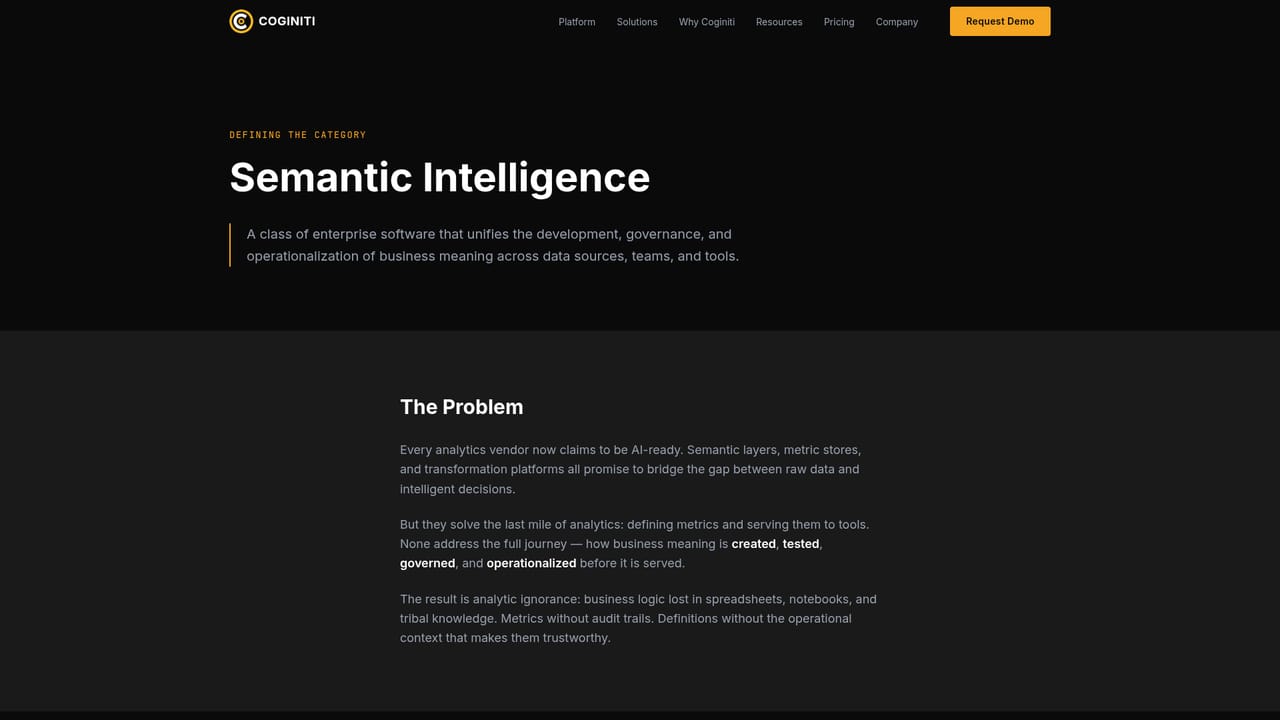
The homepage names 21 or more database platforms, including Snowflake, Databricks, IBM Db2, Oracle and Apache Hive, plus support for commercial cloud, on-premises, edge and air-gapped networks and IL2 to IL6 classified environments.
Covers a SQL Data Workbench for developing and testing queries against real data, versioning and stakeholder collaboration, governance and deployment of trusted logic into a semantic layer, connections to 21 or more database platforms across cloud, on-premises, edge and classified environments, and knowledge capture that keeps queries, tests, assumptions and context with each definition.
Learn more AI Angels400+ customizable AI girlfriends for NSFW chat, voice calls, and roleplay
 Candy AIExperience the future of companionship with AI friends who chat, role-play, and connect with you on a human level.
 ourdream.aiA vast AI roleplay platform with millions of characters for chat, images, video and voiceAI Angels400+ customizable AI girlfriends for NSFW chat, voice calls, and roleplayCandy AIExperience the future of companionship with AI friends who chat, role-play, and connect with you on a human level.ourdream.aiA vast AI roleplay platform with millions of characters for chat, images, video and voice


