Support
Support appears sales-led: engineers work with customer teams through definition, shipping and post-launch. A sales contact route, documentation and a trust center are linked from the site.
Learn moreVisual memory infrastructure that lets machines see, remember and act on video

Memories.ai is an API finder tool. A developer-facing video intelligence platform that indexes footage into a persistent memory layer for search, captioning, re-identification and agentic analysis, with APIs for visual search and video understanding plus the LUCI line for human-centric AI training.
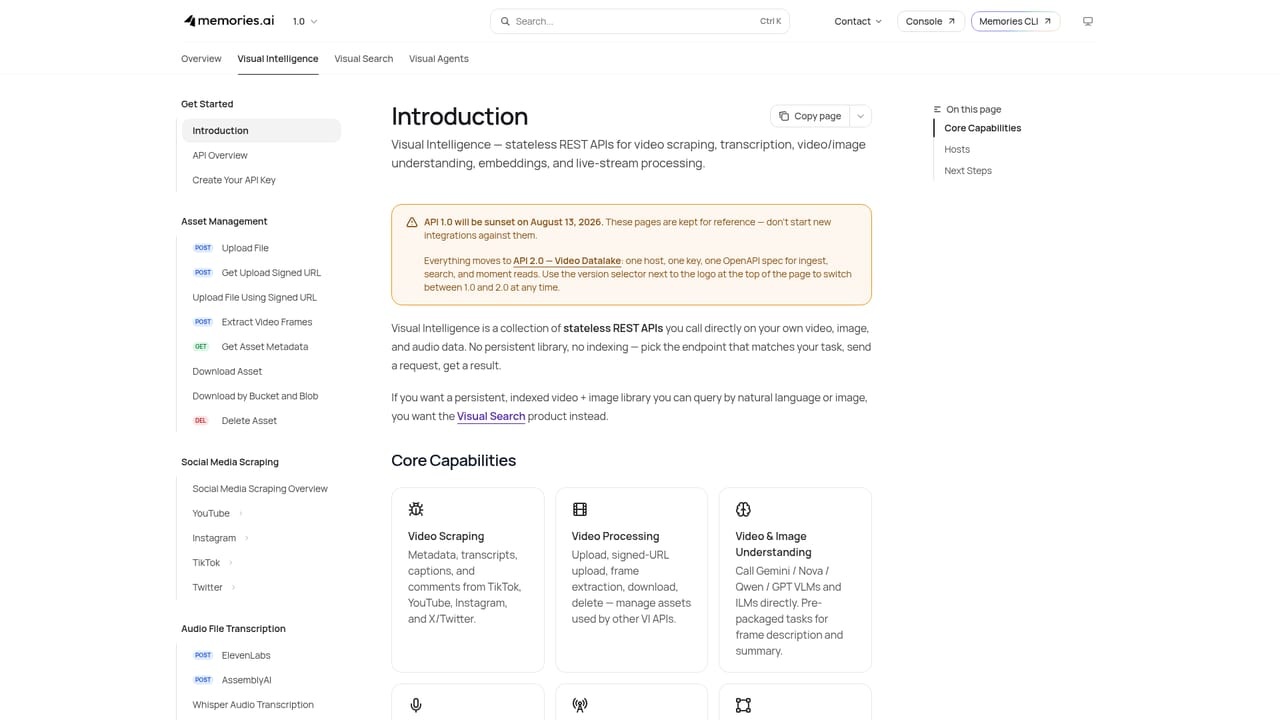
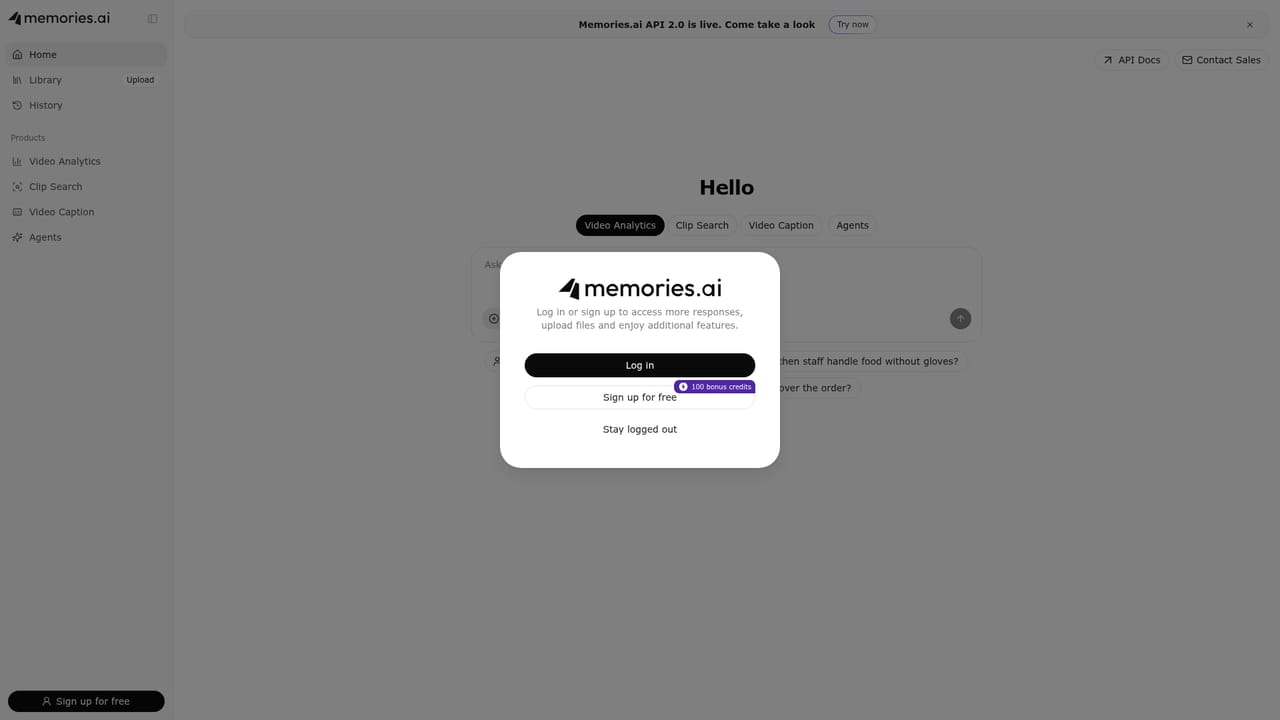
Memories.ai is a video intelligence platform built around one idea: footage should be understood and recalled, not simply stored. The company describes its work as a multimodal memory infrastructure, with a Large Visual Memory Model that processes video at scale and turns raw frames into structured data covering scenes, faces and spoken words. Footage is indexed, compressed and held in a persistent memory layer where people, events and actions can be queried later. The pitch is cumulative: the more video the system ingests, the richer its context becomes. The product comes in two shapes. Teams holding a single piece of footage can push it through the platform for an answer now, using the Video Intelligence API for captioning, streaming understanding and human re-identification. Teams building products that must remember across long periods use the Visual Search API to host, index and search video at scale. On top of that memory sit agentic workflows: analysing hours of footage quickly, flagging safety incidents as they occur, auto-tagging library content and surfacing specific moments. The buyer profile is technical. The site positions Memories.ai for developers and platform teams in consumer electronics, security, telecommunications, robotics and enterprise AI, with Nvidia, Microsoft, Samsung, Lenovo, Qualcomm and Ring displayed as partners. A separate line, LUCI, targets human-centric AI training and self-improving models, available as a desktop product and a wearable pin. Published research (MAGIC-Video, SpatialMem, O-MARC, OmniRetriever, MARC and others) backs the engineering claims, and the company traces its origins to Cambridge. Against general-purpose video tools that transcribe or summarise a single file, Memories.ai competes on persistence and scale. It is infrastructure first, with a developer API at the centre and SOC 2 Type II certification, edge, on-prem or cloud deployment, and a sales-led onboarding model that promises production systems in weeks.

Support appears sales-led: engineers work with customer teams through definition, shipping and post-launch. A sales contact route, documentation and a trust center are linked from the site.
Learn moreThe platform is designed to sit inside existing systems through its APIs, with edge, on-prem or cloud deployment. Partner logos include Microsoft, Nvidia, Samsung, Lenovo, Qualcomm and Ring; no off-the-shelf marketplace integrations are listed.
Learn moreCore capabilities include a Large Visual Memory Model that indexes frames, faces, scenes and speech, persistent memory across time, and agentic actions such as footage analysis, safety incident flagging and library auto-tagging. Two APIs are offered: Video Intelligence for captioning, streaming understanding and human re-identification, and Visual Search for hosting, indexing and searching video at scale.
Learn more AI Angels400+ customizable AI girlfriends for NSFW chat, voice calls, and roleplay
 Candy AIExperience the future of companionship with AI friends who chat, role-play, and connect with you on a human level.
 ourdream.aiA vast AI roleplay platform with millions of characters for chat, images, video and voiceAI Angels400+ customizable AI girlfriends for NSFW chat, voice calls, and roleplayCandy AIExperience the future of companionship with AI friends who chat, role-play, and connect with you on a human level.ourdream.aiA vast AI roleplay platform with millions of characters for chat, images, video and voice


