Free trial
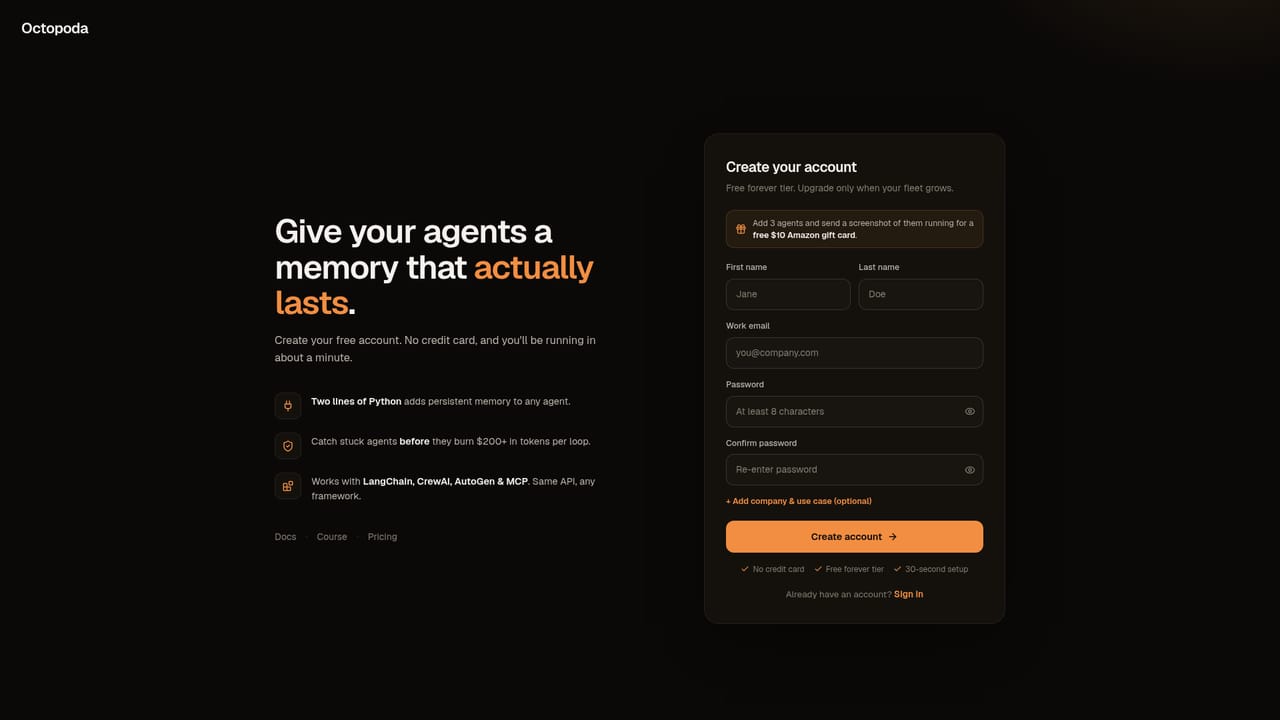
A free start is offered through the signup page, and the pip package plus a public GitHub repository (327 stars) are available to evaluate. The homepage does not state how long the free tier lasts or what it includes.
Learn morePersistent memory and loop detection for AI agents

Octopoda is a memory and safety layer for AI agents. It stores facts and state across sessions, versions every key, shares memory across agent teams, and detects loops, tool spam and runaway spend with circuit breakers and a hash chained audit trail.
Octopoda is a memory and control layer for AI agents. Agents built on any major framework tend to forget everything between runs: a support copilot loses the customer it spoke to yesterday, a coding agent relearns project conventions on every session, and a research agent throws away findings when the process restarts. Octopoda gives those agents a durable store they can write to and read from with a single call, and keeps the store alive across crashes, restarts and redeploys. Installation is a pip package, with one line of setup per framework. The product is built around four primitives. Remember writes any fact, preference or state, and can extract durable facts from full conversations. Recall retrieves memory by exact key lookup or by meaning, so natural questions work without key discipline. Version keeps full history on every key, supersedes stale facts instead of duplicating them, and supports snapshots and rollback. Share lets several agents join a shared memory space with a change log and last write wins conflict resolution, so a task handoff carries its context. A second layer watches for runaway behavior. Five detection signals (repeats, reflection loops, tool spam, duplicate writes, runaway chains) run in real time without configuration. Circuit breakers pause a looping agent, per agent thresholds tune sensitivity, and hard spend caps stop an agent from exceeding a budget. Every catch links to the events behind it in a hash chained audit trail that can be exported. Cross agent analytics report memory counts, storage, latency percentiles, burn rate and dollars recovered from avoided loops. The tool is aimed at engineering teams running agents in production or in a fleet, particularly where cost control and auditability matter. It is infrastructure rather than an end user application, so it competes with hand rolled vector stores, framework native memory modules and agent observability platforms. The distinguishing piece is the combination of memory, loop detection and audit in one place, backed by an open source repository with community traction.
A free start is offered through the signup page, and the pip package plus a public GitHub repository (327 stars) are available to evaluate. The homepage does not state how long the free tier lasts or what it includes.
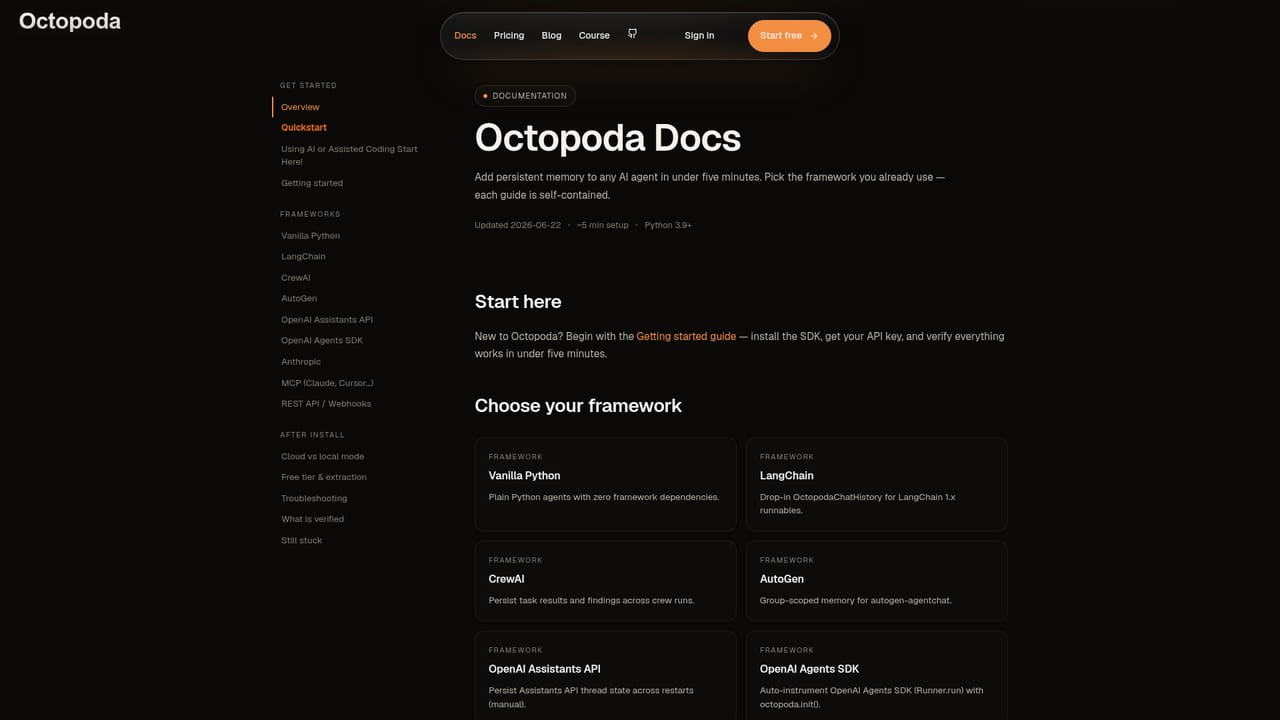
Learn moreSupport runs through documentation and a contact page, with framework specific guides for each supported stack. The homepage does not describe response times, paid support tiers or a community channel beyond the GitHub repository.
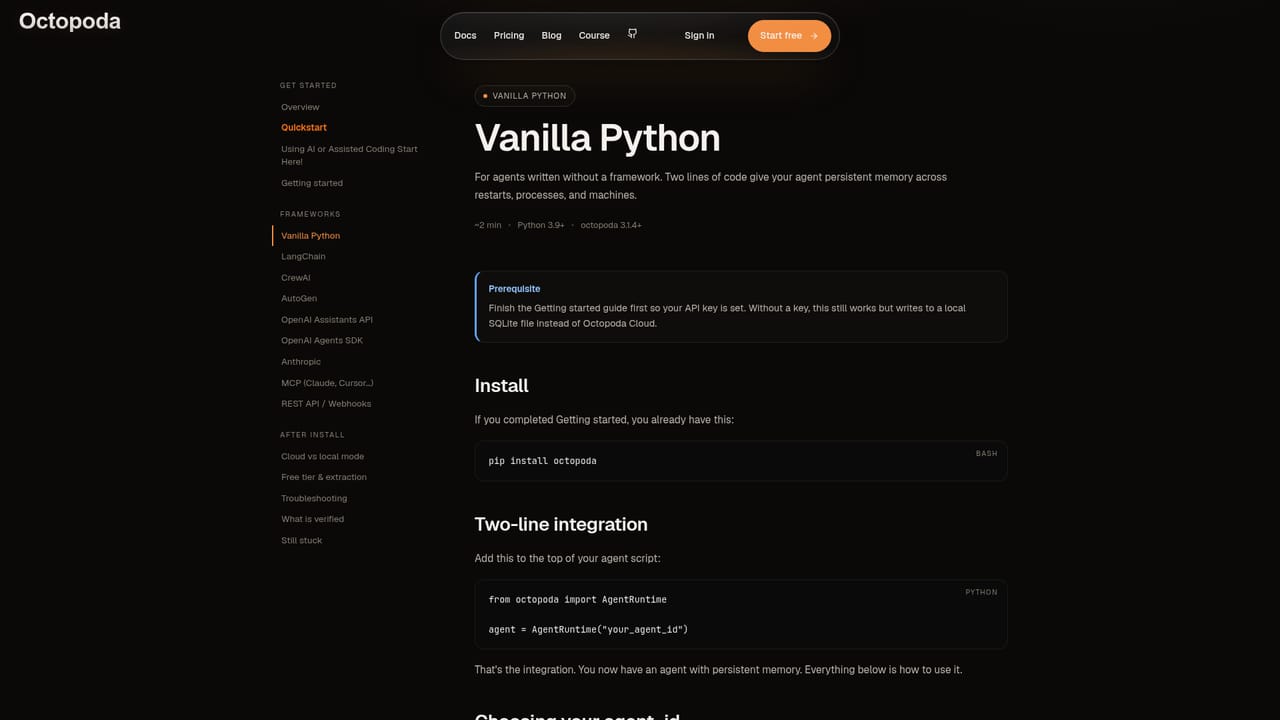
Learn moreDocumented support for LangChain, CrewAI, AutoGen, Model Context Protocol (MCP), the OpenAI Agents SDK, the Anthropic SDK, the Claude Agent SDK and plain Python with no framework. Other stacks can be discussed through the contact page.
Learn moreMemory primitives for remember, recall, version and share, including exact key lookup, semantic search, full key history, snapshots and rollback. Shared memory spaces with last write wins conflict resolution and a change log. Loop detection across five signals with circuit breakers, per agent thresholds and one click resume. Hard spend caps, live burn rate and recovered cost tracking. Cross agent analytics on memory counts, storage, latency and tags, plus a hash chained, exportable audit trail.
Learn more AI Angels400+ customizable AI girlfriends for NSFW chat, voice calls, and roleplay
 Candy AIExperience the future of companionship with AI friends who chat, role-play, and connect with you on a human level.
 ourdream.aiA vast AI roleplay platform with millions of characters for chat, images, video and voiceAI Angels400+ customizable AI girlfriends for NSFW chat, voice calls, and roleplayCandy AIExperience the future of companionship with AI friends who chat, role-play, and connect with you on a human level.ourdream.aiA vast AI roleplay platform with millions of characters for chat, images, video and voice


