Free trial
No card required to start: the Free plan is permanent, with 25 Ormind agent messages and 200 MB of storage across your dossiers. Paid plans add a 30-day money-back guarantee.
Learn moreShared dossiers that turn scattered documents into sourced decisions
Ormind is an AI mistress tool. Ormind keeps one shared dossier per real project, holding documents, sourced answers, decisions and open questions, with per-dossier permissions and optional use of your own Claude or ChatGPT plan.
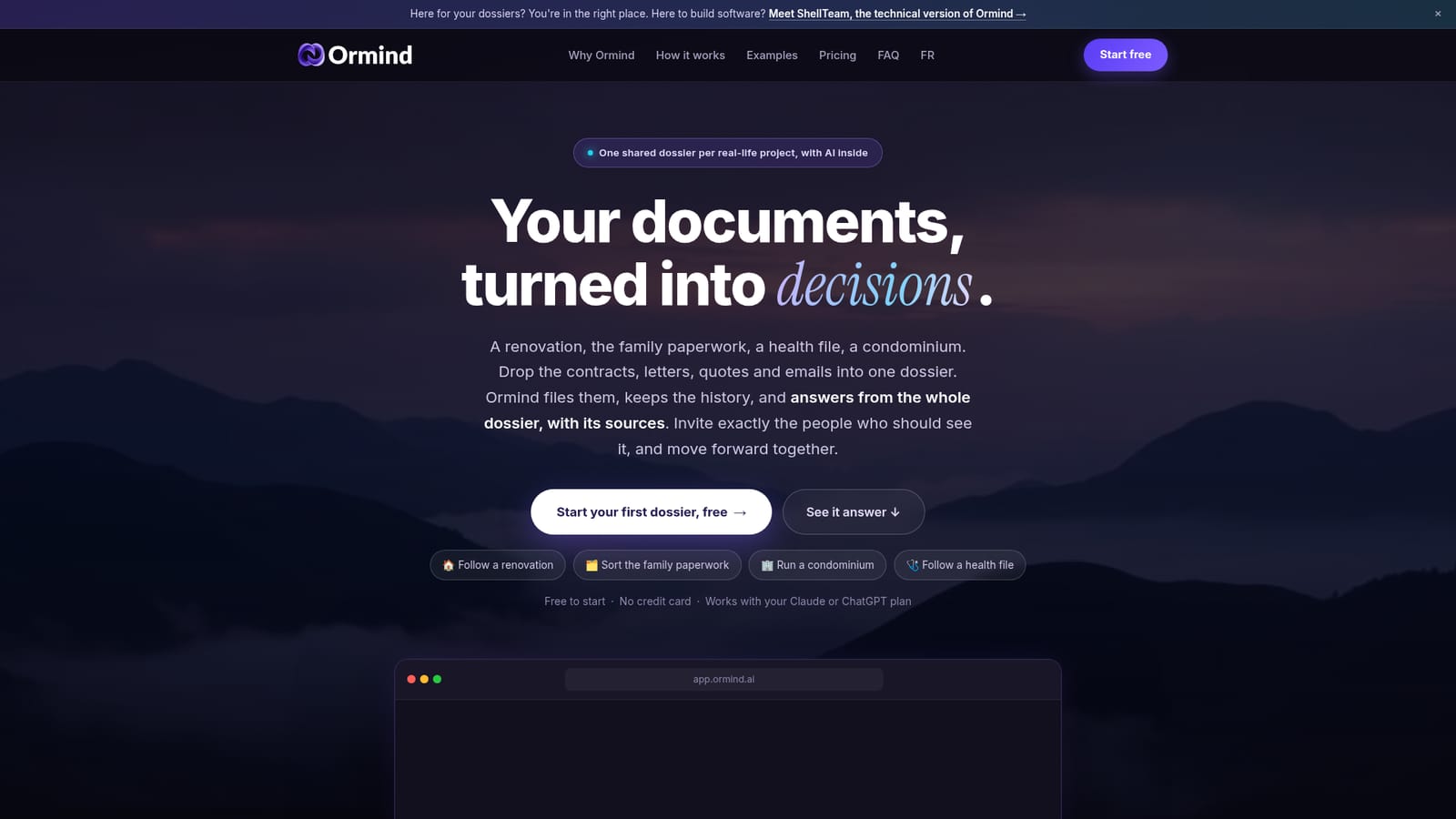
Ormind organizes real life projects into shared dossiers rather than leaving them scattered across inboxes, chat threads and download folders. A dossier is a container for one project (a renovation, a family estate, a condominium board, a health file) holding the documents involved, the people attached to it, and a running record of what has been decided versus what is still open. Ormind files and summarizes every file you add but never edits the originals, and it keeps a version history so earlier states remain reachable. In daily use the flow is straightforward. Documents are dropped into a dossier and summarized on arrival. Questions are then asked against everything in that dossier, and answers cite the specific source document behind each figure, so a budget figure can be traced back to the quote it came from. Each dossier also generates its own living pages for the parties involved, the budget and the timeline, updated as new material arrives. Dates and deadlines found in documents are proposed for a calendar only after someone confirms them, and decided items are separated from open questions. Reports and slide decks can be generated from the dossier and hosted at a dedicated link. Sharing is scoped per dossier: a contractor invited to the renovation sees nothing of the family paperwork, and permissions can be read, add documents or edit, adjustable or revoked at any time. Members get a what changed since your last visit view. The underlying model is flexible: users can connect their own Claude or ChatGPT plan, whose messages do not count against Ormind limits, or reach dossiers from inside Claude.ai and ChatGPT through a connector. Alternatives like general chatbots answer the question in front of them; Ormind is positioned around persistent project memory and shared access, and it is explicitly not a coding or app building tool (ShellTeam covers that). It suits owners managing contractors, families coordinating paperwork and deadlines, condo board members, and small groups running a complicated shared project.
No card required to start: the Free plan is permanent, with 25 Ormind agent messages and 200 MB of storage across your dossiers. Paid plans add a 30-day money-back guarantee.
Learn moreFree forever: 25 agent messages, 200 MB storage, unlimited invited members. Pro at $25/month (or $20/month billed annually): unlimited messages, 20 GB storage, frontier models, no badge. Agency at $79/month (or $63/month annually): 50 GB storage, highest limits, priority support. 30-day money-back guarantee on paid plans.
Learn morePriority support is listed on the Agency plan. Paid plans include a 30-day money-back guarantee, and cancellation is available anytime.
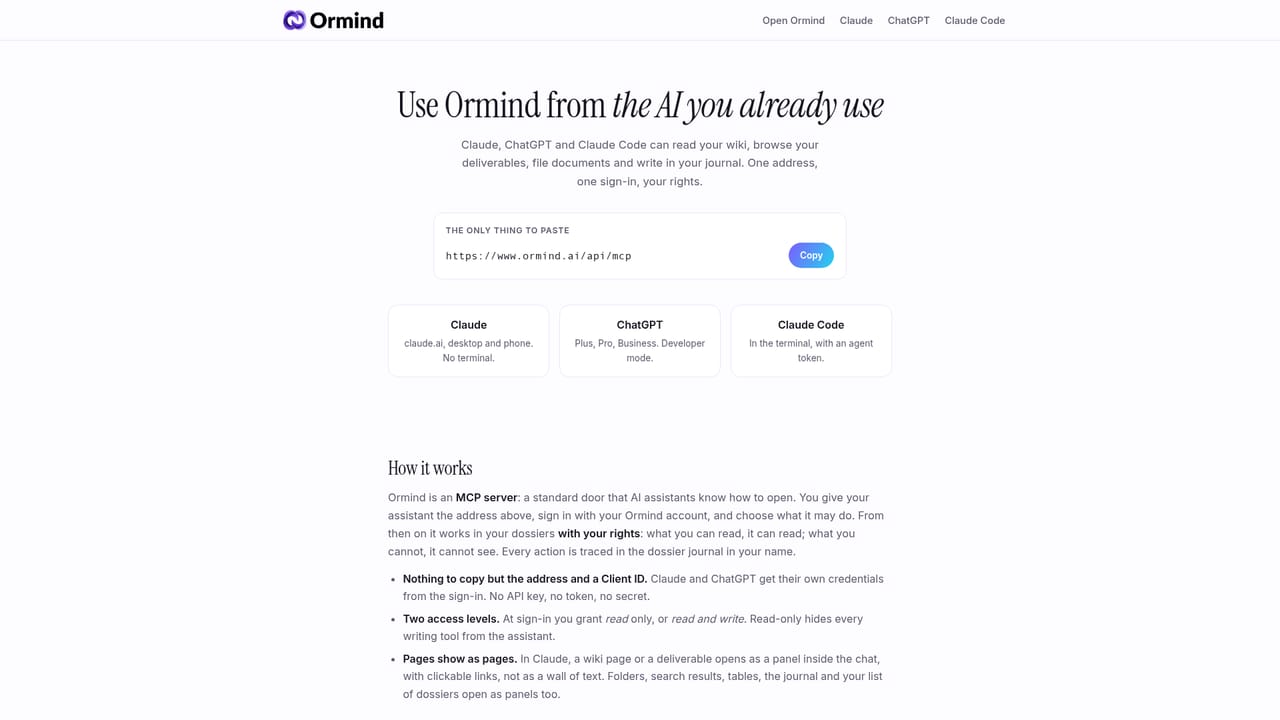
Connect your own Claude or ChatGPT plan so messages bypass Ormind limits, and add Ormind as a connector inside Claude.ai or ChatGPT to reach dossiers from those assistants.
Learn moreDocument filing and summarization with originals untouched and version history kept; sourced answers across a whole dossier; automatic living pages for parties, budget and timeline; decisions separated from open questions; per-dossier invites with read, add or edit rights; a what changed view; calendar proposals from document dates; reports and hosted slide decks; full export or deletion.
 AI Angels400+ customizable AI girlfriends for NSFW chat, voice calls, and roleplay
 Candy AIExperience the future of companionship with AI friends who chat, role-play, and connect with you on a human level.
 ourdream.aiA vast AI roleplay platform with millions of characters for chat, images, video and voiceAI Angels400+ customizable AI girlfriends for NSFW chat, voice calls, and roleplayCandy AIExperience the future of companionship with AI friends who chat, role-play, and connect with you on a human level.ourdream.aiA vast AI roleplay platform with millions of characters for chat, images, video and voice