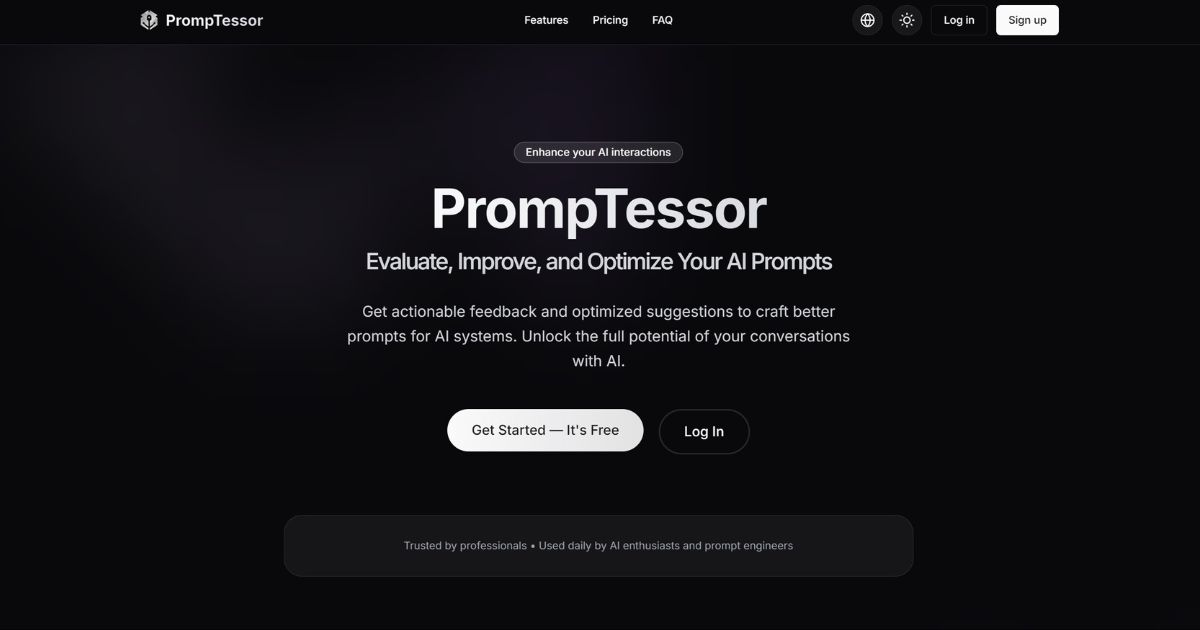
PrompTessor is a web-based workspace built around a single problem: AI output quality is bottlenecked by prompt quality. Instead of treating prompt writing as a one-off task, it packages generation, analysis, optimization, refinement, and reverse-engineering into a connected workflow, then lets users store results in a searchable library for reuse across projects.
The core interaction is a prompt-builder chat: a user describes a goal, and PrompTessor returns a structured, versioned prompt that can be copied, saved, or pushed through further passes — tightening scope, adding platform-specific detail, or converting a one-off request into a reusable template with fill-in variables. A reverse-prompt mode works in the opposite direction, taking an existing image, video, URL, or block of text and converting it into a prompt that can reproduce or extend that style. Generated prompts arrive with metadata such as recommended models (ChatGPT, Claude, Gemini), estimated token usage, and usage notes, giving users a way to judge fit and cost before running the prompt elsewhere. A history log tracks every generation, optimization, refinement, and reverse-prompt pass, and multi-language support extends the same workflow to prompts written in languages other than English.
The tool targets people who write prompts regularly rather than occasionally: marketers building campaign templates, content teams turning notes and transcripts into scripts or articles, developers refining prompts for coding assistants, and teams that need a shared, organized set of approved prompts instead of scattered notes and chat threads. It positions itself as a layer that sits in front of whichever model a team already uses rather than a chatbot alternative, which sets it apart from prompt libraries locked to a single model or platform.
Access starts with a free tier capped at a small monthly usage allowance, with paid subscription tiers raising that ceiling for heavier or team-level workflows, and one-time lifetime plans offered as an alternative to recurring billing. It suits individuals and small teams standardizing prompt work more than large organizations needing deep API or workflow integrations, since none are described on the current offering.