Qloo

Cultural intelligence layer that grounds AI agents in real human taste

Advanced
Screenshot of Qloo, Cultural intelligence layer that grounds AI agents in real human taste

What is Qloo?

Qloo is an enterprise cultural intelligence layer that models taste and affinity, giving AI agents and recommendation systems a privacy first way to ground personalization in what people actually like. Sold through demos rather than self serve plans, it targets product and engineering teams at consumer facing companies.

Qloo is a cultural intelligence layer built for AI systems and agents. It pairs a detailed cultural graph with proprietary taste intelligence, modeling two things at once: the intrinsic character of cultural entities and the affinities that connect people to them. The aim is to give agentic systems a working sense of what people actually like, value and choose, so responses feel considered rather than generically assembled. Qloo positions itself as privacy first, with no PII involved in the taste modeling. The product is aimed at engineering and product teams building recommendation, personalization or conversational experiences, not at individuals looking for a consumer app. Companies such as Samsung appear among its named users, and published client stories cover a personalized travel project with Michelin and cultural AI work with Match Group, which suggests the core buyers are enterprises with large catalogs of content, places or products to map against human preference. In practice, Qloo sits underneath an application as a grounding layer. The cultural taxonomy (locality knowledge, cultural ontology and consumer taste) supplies structure, while affinity modeling answers questions about how a person or audience relates to a film, city, brand, musician or cuisine. The stated benefit is that agents move past literal instructions and start noticing what the people they serve love. Aggregated, subjective and context aware signals are the inputs the system works from. Among alternatives, Qloo is closer to a data and API infrastructure play than to a chat assistant or a content generator. Teams weighing it against generic recommendation engines should note the cultural specificity it claims and the enterprise sales motion around it. Pricing and integration specifics are not published on the homepage, so evaluation typically starts with a demo request rather than a self serve signup.

How do you use Qloo?

  1. 1Review the capabilities overview
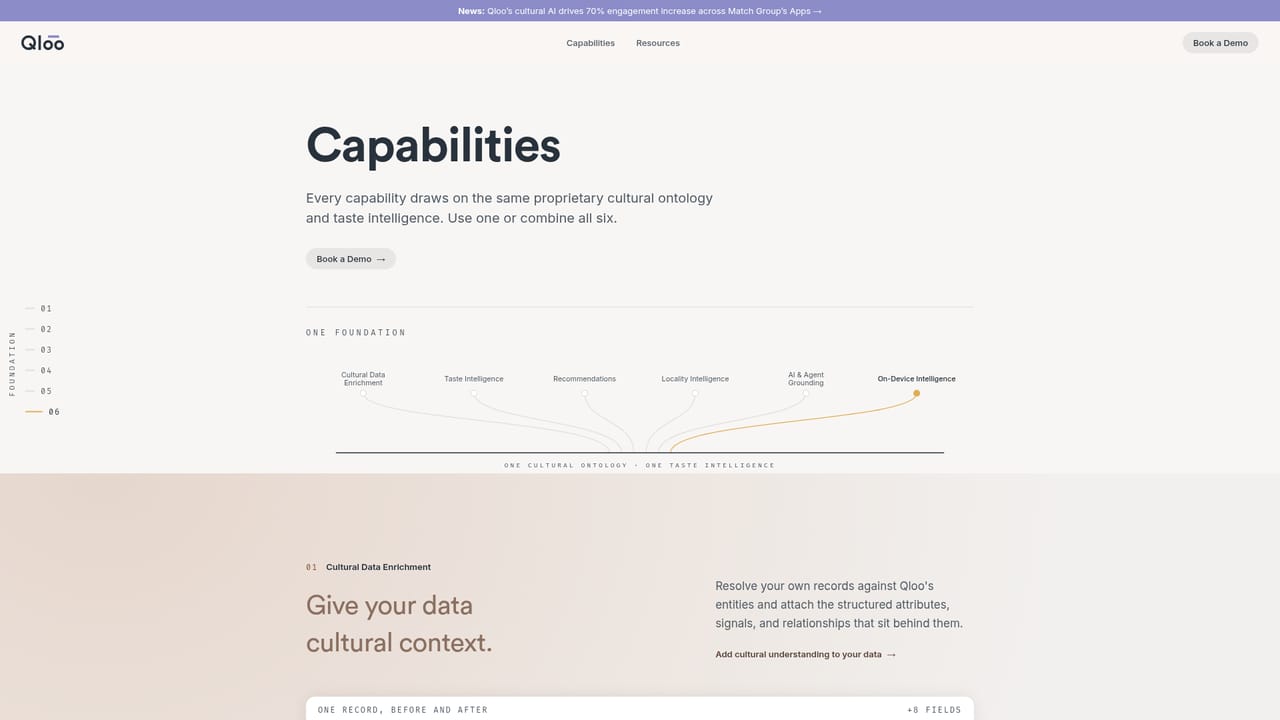
    Read the capabilities page to understand how the cultural graph, taste intelligence and grounding work together before you scope a project.
    Qloo — Review the capabilities overview
  2. 2Check published client stories
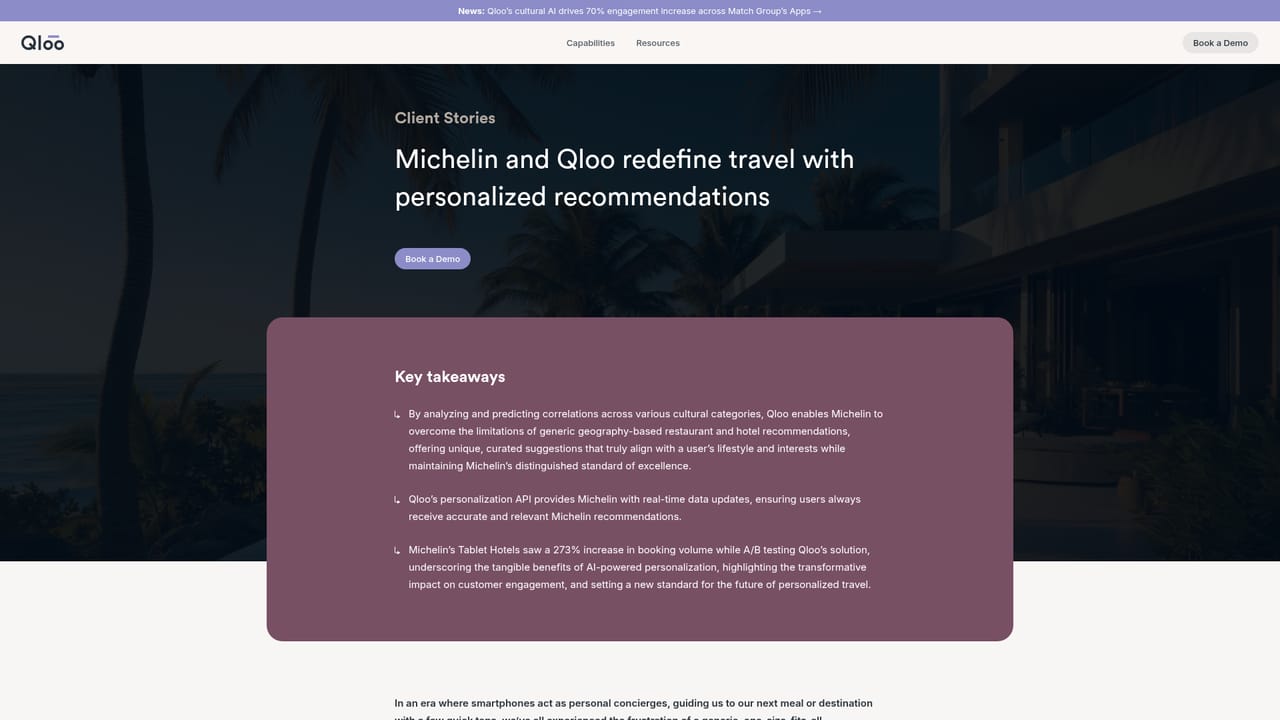
    Look at the Michelin and Match Group stories to see how personalization and cultural AI were applied in travel and dating products.
    Qloo — Check published client stories
  3. 3Book a demo
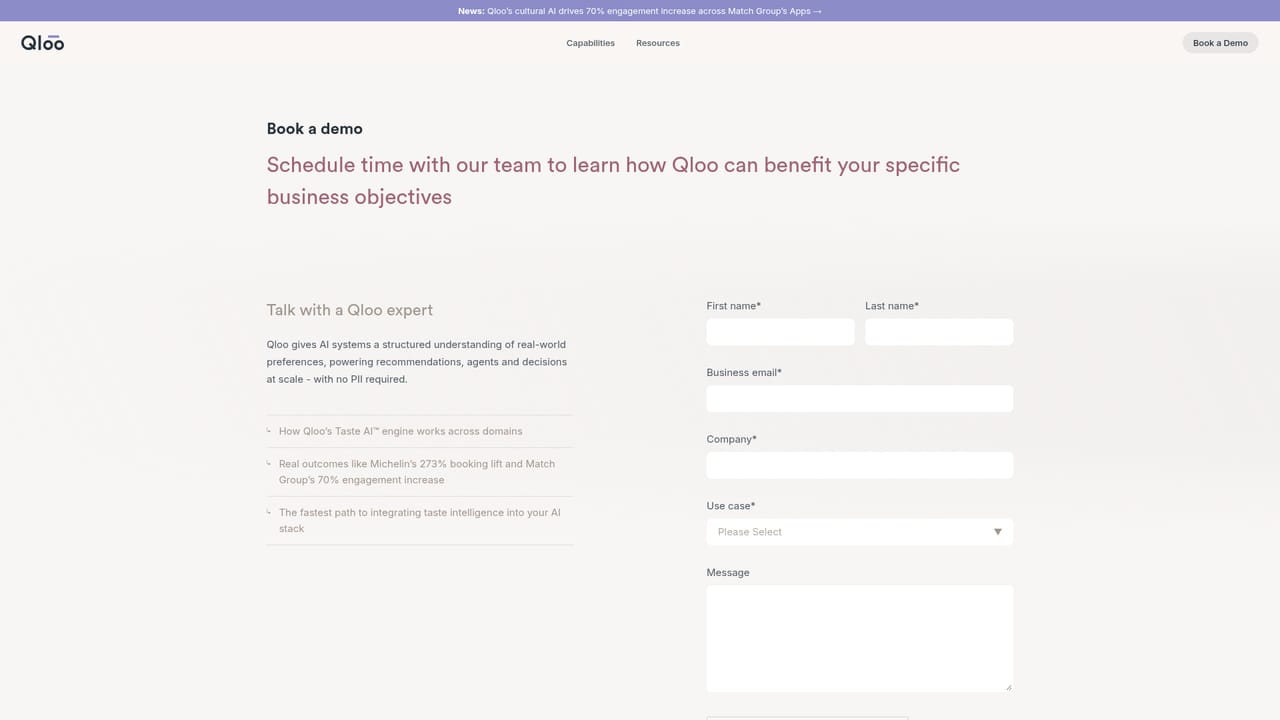
    Request a walkthrough through the demo form, which is the documented route into the product since no self serve signup is described.
    Qloo — Book a demo
  4. 4Scope your personalization use case
    Prepare the catalog, audience or agent behavior you want grounded, and bring it to the demo conversation to test fit.
  5. 5Integrate and evaluate
    Wire the taste layer into your application and compare outputs against your current recommendation baseline before committing.

Pros and cons

Pros

  • Combines a cultural graph with taste modeling, so recommendations rest on affinity data rather than keyword matching aloneAI
  • Explicitly privacy first with no PII, which eases data governance reviews for regulated consumer businessesAI
  • Published client stories with Michelin and Match Group show real deployments in travel and dating contextsAI
  • Designed as a grounding layer for agents, so it can sit under an existing assistant instead of replacing itAI
  • Covers broad cultural territory including locality knowledge and cultural ontology, not just media genresAI

Cons

  • Pricing, limits and contract terms are not published on the homepage, so costs are only discoverable through a sales conversationAI
  • No self serve signup or public sandbox described, which slows down prototyping for small teamsAI
  • Technical documentation and API specifics are not surfaced on the homepage, so integration effort is hard to judge upfrontAI
  • Claims about taste accuracy are hard for a buyer to verify without a paid pilot against their own catalogAI
  • The enterprise orientation makes it a poor fit for solo developers or hobby projectsAI

How much does Qloo cost?

Features

Combines a detailed cultural graph with proprietary taste intelligence. Models both the intrinsic character of cultural entities and the affinities between people and those entities. Supports agentic systems with grounding in consumer taste, cultural ontology and locality knowledge. Privacy first, with no PII in the modeling. Documented through customer stories in travel and dating.

Learn more

Frequently asked questions about Qloo

  • How do you use Qloo?
    The walkthrough on this page covers 5 steps: 1. Review the capabilities overview 2. Check published client stories 3. Book a demo 4. Scope your personalization use case 5. Integrate and evaluate.
  • What platforms does Qloo support?
    Qloo is available on Web App.
  • What are the limitations of Qloo?
    Pricing, limits and contract terms are not published on the homepage, so costs are only discoverable through a sales conversation. No self serve signup or public sandbox described, which slows down prototyping for small teams. Technical documentation and API specifics are not surfaced on the homepage, so integration effort is hard to judge upfront.

Status

StatusActive
Views0
Outbound clicks0
Added10/22/2026

Platforms

Web App

Pricing

Paid