SQOR

Ask a business question, get a number reconciled to your ledger

Intermediate
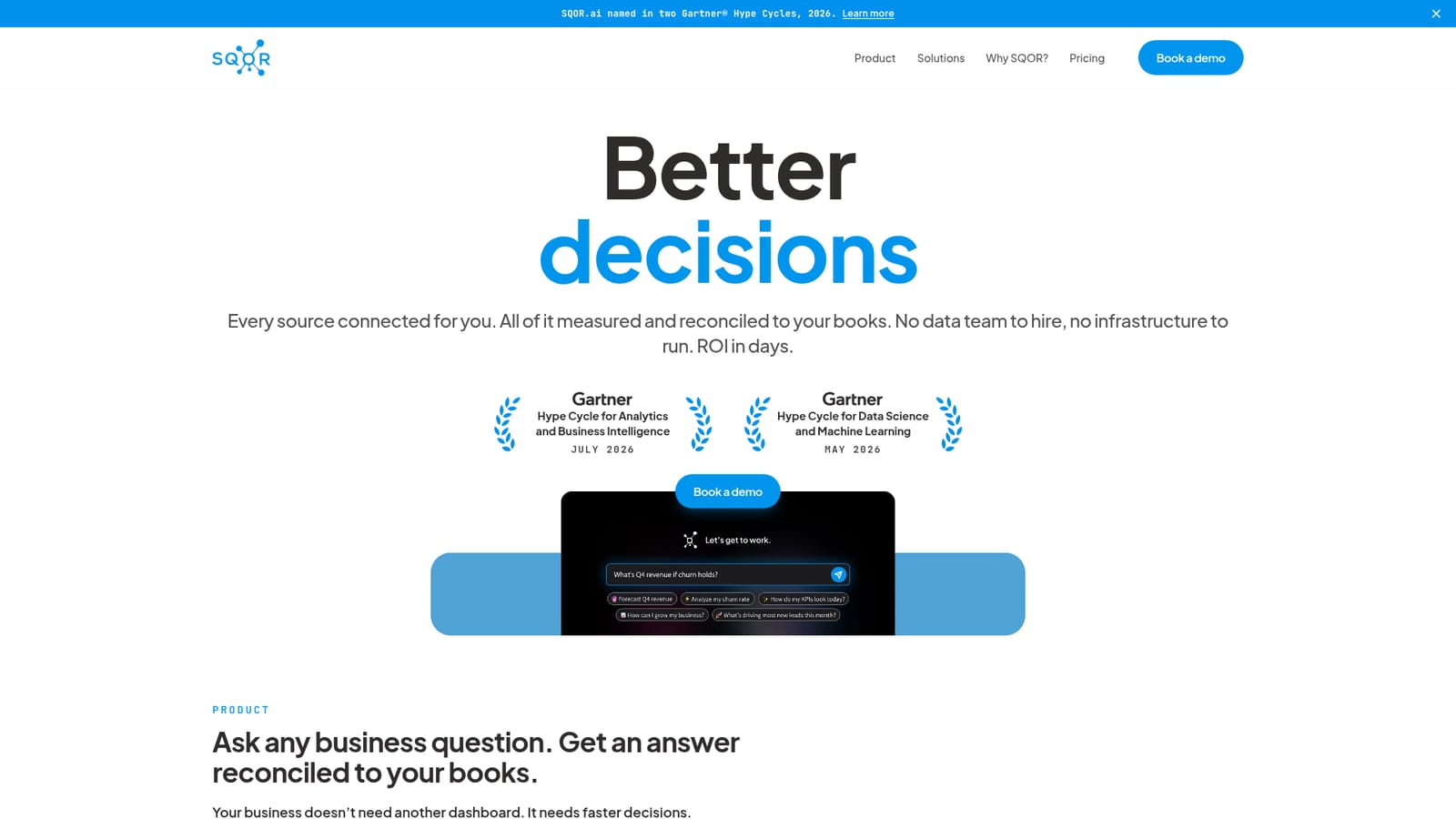
Screenshot of SQOR, Ask a business question, get a number reconciled to your ledger

What is SQOR?

SQOR is a decision-intelligence platform that connects read-only to warehouses and SaaS tools, builds its own KPI layer, and answers plain-language business questions with figures reconciled to the ledger. Geared to executives, operators, data teams and investors, with query-based pricing and unlimited seats.

SQOR is an autonomous decision-intelligence platform that sits on top of a company's existing data estate and answers business questions in plain language. Rather than asking teams to build models, dashboards and semantic layers, it reads the data where it already lives (a data warehouse such as BigQuery, Snowflake, Databricks, Redshift or Azure Synapse, or the SaaS tools where operating detail accumulates) and computes the metrics itself. Access is read-only, so nothing on the customer side is modified, and a warehouse is included for companies that do not have one. The core mechanic is the separation of computation from explanation. Machine learning calculates each figure and reconciles it to the source ledger to the cent, while the language model only narrates that computed value and never holds the number itself. That design is the basis for the vendor's claim that answers do not hallucinate and do not drift between sessions. A proprietary KPI spawner generates thousands of indicators from the data it finds, named from the customer's own schema and anchored to their books, including relationships across departments so silos do not hide causal links. On top of that, agents run continuously to explain movement, forecast direction and flag items needing attention. The product is aimed at executives, senior operators, data teams and private-equity or venture investors who need portfolio-wide visibility across companies that do not share a chart of accounts. Typical use is a leadership question about why a metric moved this quarter, what it is likely to do next, and which action would most improve it. SQOR positions itself against legacy BI tools and forward-deployed analytics consultants, arguing that its value is in decisions rather than reports. It is a serious enterprise purchase with annual commitments and query-based pricing, not a self-serve toy, and it assumes a real business with meaningful source systems.

How do you use SQOR?

  1. 1Book a demo and scope your question set
    Start with the vendor's scheduling link to discuss your data sources, the decisions leadership needs to make and the tier that matches your query volume.
    SQOR — Book a demo and scope your question set
  2. 2Connect sources with read-only access
    Point SQOR at your warehouse or your SaaS applications. No changes are made on your side, and a warehouse is provided if you have none.
    SQOR — Connect sources with read-only access
  3. 3Let the KPI layer generate itself
    The platform reads your schema, validates joins against real data and builds named KPIs anchored to your ledger across departments.
  4. 4Ask questions in plain language
    Pose a real business question in your own words and receive a computed figure plus the causal explanation and a forecast, traceable to source.
    SQOR — Ask questions in plain language
  5. 5Verify reconciliation and audit trails
    Check that outputs trace to source, calculation logic and computation date, then confirm the figures tie back to your books.
  6. 6Roll out to the wider team
    Invite unlimited users once the first question set is validated, and review query consumption against your annual allowance.
    SQOR — Roll out to the wider team

Pros and cons

Pros

  • Numbers are computed by machine learning and reconciled to the source ledger, not generated by the language modelAI
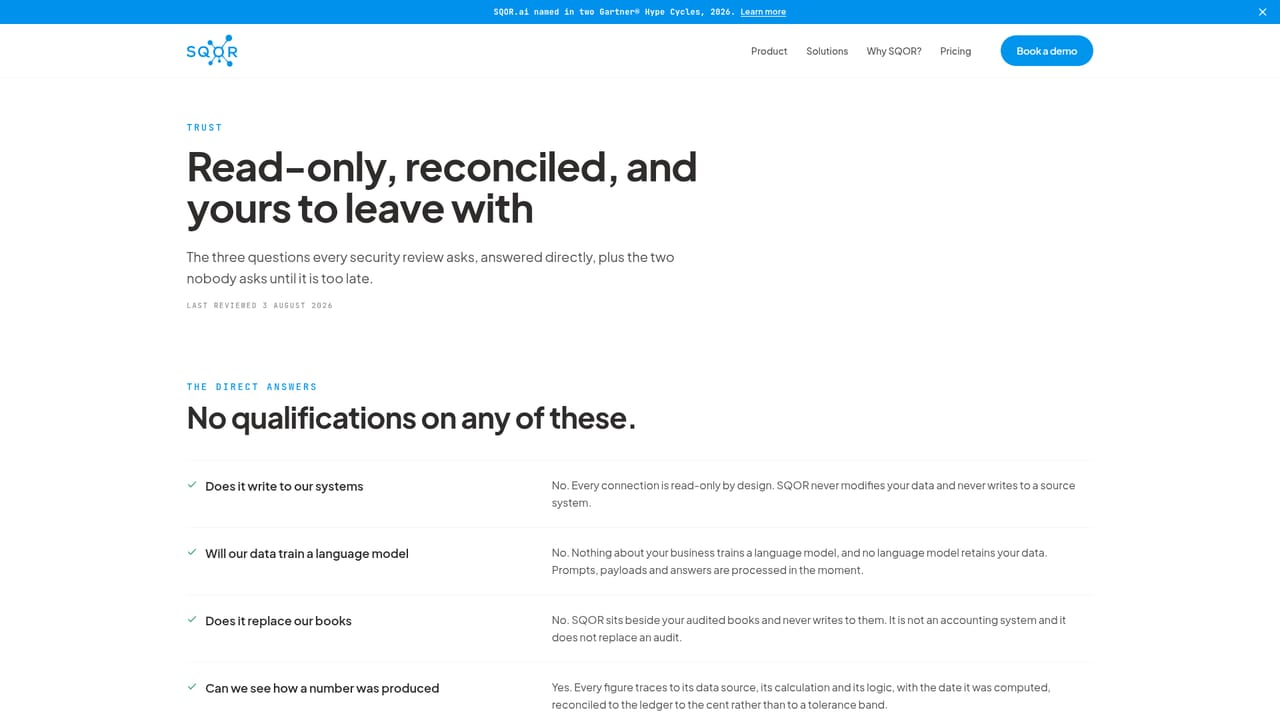
  • Read-only access means the tool never writes to source systems or replaces audited booksAI
  • Unlimited seats with query-volume pricing, so cost scales with questions rather than headcountAI
  • Ships with a data warehouse included for companies that do not already run oneAI
  • Coverage extends to SaaS applications such as CRM, billing, support and ad platforms, not just the warehouseAI

Cons

  • No public price list: every tier requires a sales conversation and an annual commitmentAI
  • Every engagement starts at the 25-user tier, which rules out small teams or individual evaluationAI
  • Data volume is capped at 1TB per tier, so larger estates will need a bespoke arrangementAI
  • Opaque query allowances (measured in hundreds of thousands of queries per year) make budgeting hard to predictAI
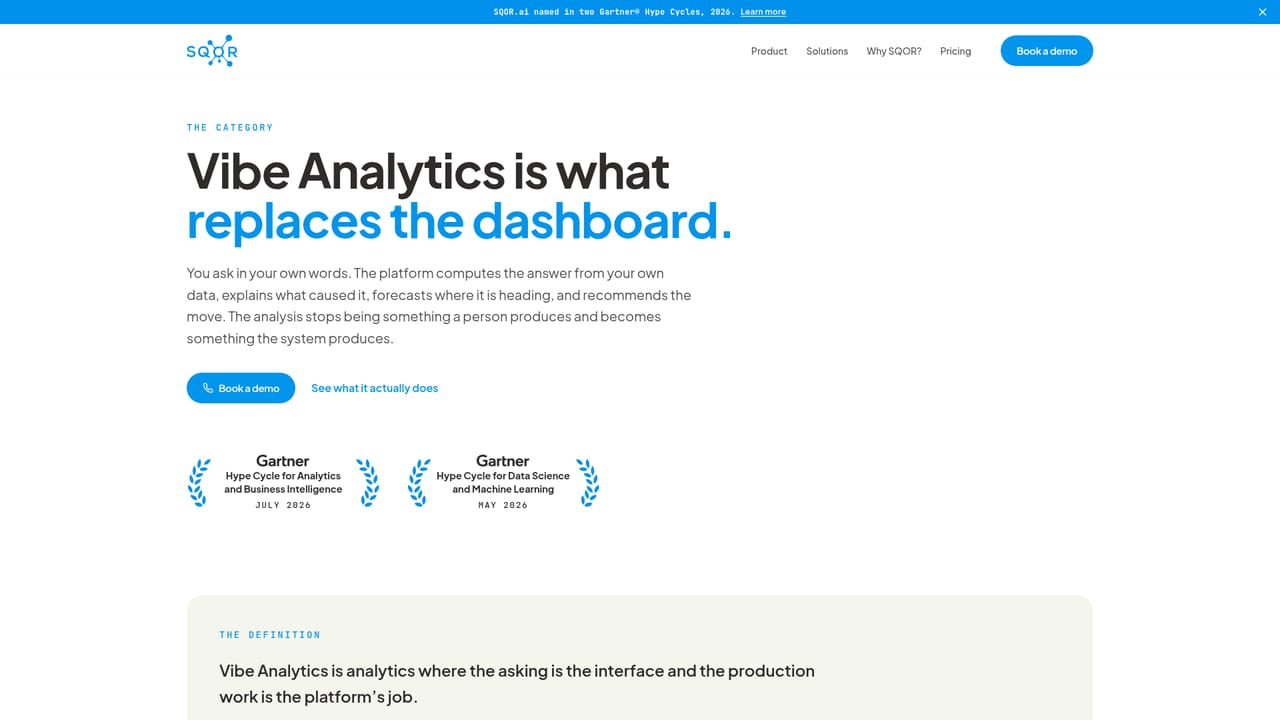
  • Gartner Hype Cycle mentions are the vendor's own framing and should not be read as an independent endorsement of fitAI

How much does SQOR cost?

Pricing

Three tiers (Team Pro, Team Premium, Enterprise) priced on annual query volume with unlimited seats and a warehouse included. Team Pro covers 135,000 queries per year, Team Premium 270,000, and Enterprise 540,000 scaling to 2.7 million. No list prices are published; all tiers require a sales conversation.

Learn more

Support

Onboarding covers connecting sources, capturing the questions leadership asks and getting teams testing on their own data. No dedicated help centre is published on the site; contact runs through demo booking.

Learn more

Integrations

Connects to warehouses including BigQuery, Snowflake, Databricks, Redshift and Azure Synapse, plus SaaS tools such as Salesforce, HubSpot, Shopify, Stripe, QuickBooks, Zendesk, Jira and Google Ads.

Learn more

Features

Plain-language question answering over warehouse and SaaS data, an automatic KPI spawner that names metrics from your own schema, causation and forecasting on every figure, continuous agents that surface issues proactively, and reconciliation to the ledger with full audit trails. Read-only by design, includes a data warehouse, and supports portfolio views across companies with differing charts of accounts.

Learn more

Frequently asked questions about SQOR

  • How much does SQOR cost?
    Three tiers (Team Pro, Team Premium, Enterprise) priced on annual query volume with unlimited seats and a warehouse included. Team Pro covers 135,000 queries per year, Team Premium 270,000, and Enterprise 540,000 scaling to 2.7 million. No list prices are published; all tiers require a sales conversation.
  • How do you use SQOR?
    The walkthrough on this page covers 6 steps: 1. Book a demo and scope your question set 2. Connect sources with read-only access 3. Let the KPI layer generate itself 4. Ask questions in plain language 5. Verify reconciliation and audit trails 6. Roll out to the wider team.
  • What platforms does SQOR support?
    SQOR is available on Web App.
  • What does SQOR integrate with?
    Connects to warehouses including BigQuery, Snowflake, Databricks, Redshift and Azure Synapse, plus SaaS tools such as Salesforce, HubSpot, Shopify, Stripe, QuickBooks, Zendesk, Jira and Google Ads.
  • What are the limitations of SQOR?
    No public price list: every tier requires a sales conversation and an annual commitment. Every engagement starts at the 25-user tier, which rules out small teams or individual evaluation. Data volume is capped at 1TB per tier, so larger estates will need a bespoke arrangement.

Status

StatusActive
Views0
Outbound clicks0
Added10/21/2026

Platforms

Web App

Pricing

PaidSubscription