SummarizePaper

AI summaries and a questioning assistant for arXiv papers, journals and preprints

Beginner
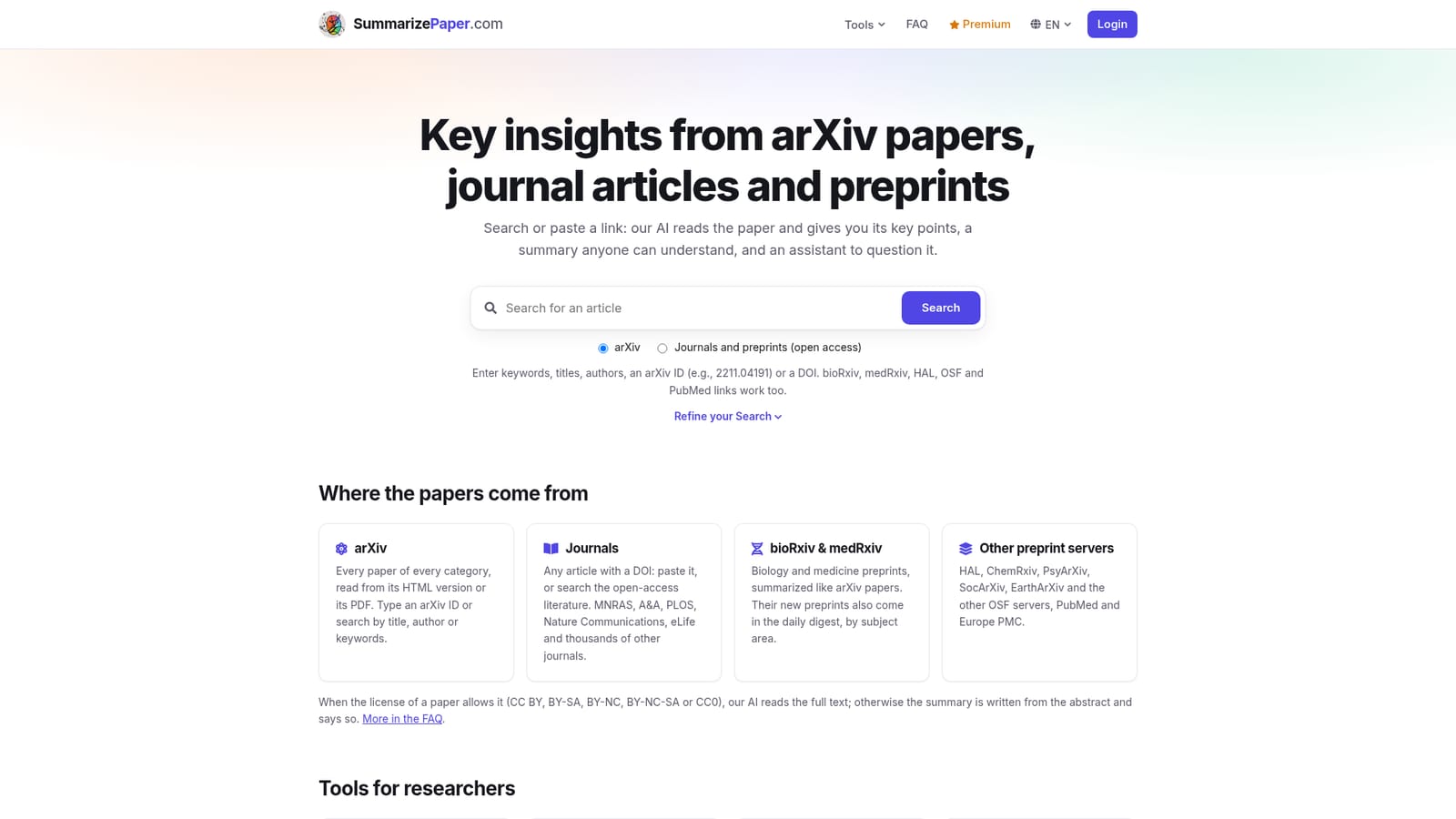
Screenshot of SummarizePaper, AI summaries and a questioning assistant for arXiv papers, journals and preprints

What is SummarizePaper?

SummarizePaper turns arXiv papers, DOI journal articles and preprints from bioRxiv, medRxiv, HAL and other servers into key points, plain-language summaries and an ask-anything assistant, with a daily digest and research monitoring tools attached.

SummarizePaper is a research reading tool built around one workflow: you point it at a paper and it returns something you can absorb in a couple of minutes. The site accepts arXiv IDs, DOIs, bioRxiv, medRxiv, HAL, OSF, PubMed and Europe PMC links, and it also runs its own search over the open access literature. Coverage is deliberately broad rather than arXiv-only: every arXiv category, thousands of DOI-registered journals, and biology and medicine preprints are all read by the same engine. Each paper produces several output shapes rather than a single block of text. Key points capture the claims, a lay summary restates the work for non-specialists, and blog-style articles are available for longer treatments. Summaries are generated in English, French and 14 other languages, which makes the tool usable for reading groups and cross-border collaborations. One important mechanic: when a paper carries a permissive license (CC BY, BY-SA, BY-NC, BY-NC-SA or CC0), the model reads the full text; otherwise it works from the abstract and the output states that limitation openly. Beyond single papers there is a chat layer. Questions can be asked of one paper or several at once in plain language, with answers drawn from full text where licensing permits. Four add-on tools push further into research logistics: a scoop watch that emails you when a new paper lands close to a project in progress, a bibliography check for retractions and unsupported citations, a map of which research groups publish most on a topic, and a conference companion that picks the talks worth attending. The audience is working researchers first, then students, journalists and scientifically curious readers who need to keep up without reading everything. Closest alternatives are general chat assistants fed with PDFs, or arXiv-only summary sites. SummarizePaper differentiates on source breadth, explicit licensing disclosure, and the digest plus monitoring tools around the summariser. The project is open source.

How do you use SummarizePaper?

  1. 1Search or paste a paper reference
    From the homepage, enter keywords, a title, an author name, an arXiv ID such as 2211.04191 or a DOI. bioRxiv, medRxiv, HAL, OSF and PubMed links are also accepted.
    SummarizePaper — Search or paste a paper reference
  2. 2Narrow results with field codes
    Use au:, ti:, abs:, co:, jr:, cat: or id: to target specific fields, and combine them with AND, OR and ANDNOT for precise queries.
  3. 3Read the key points and lay summary
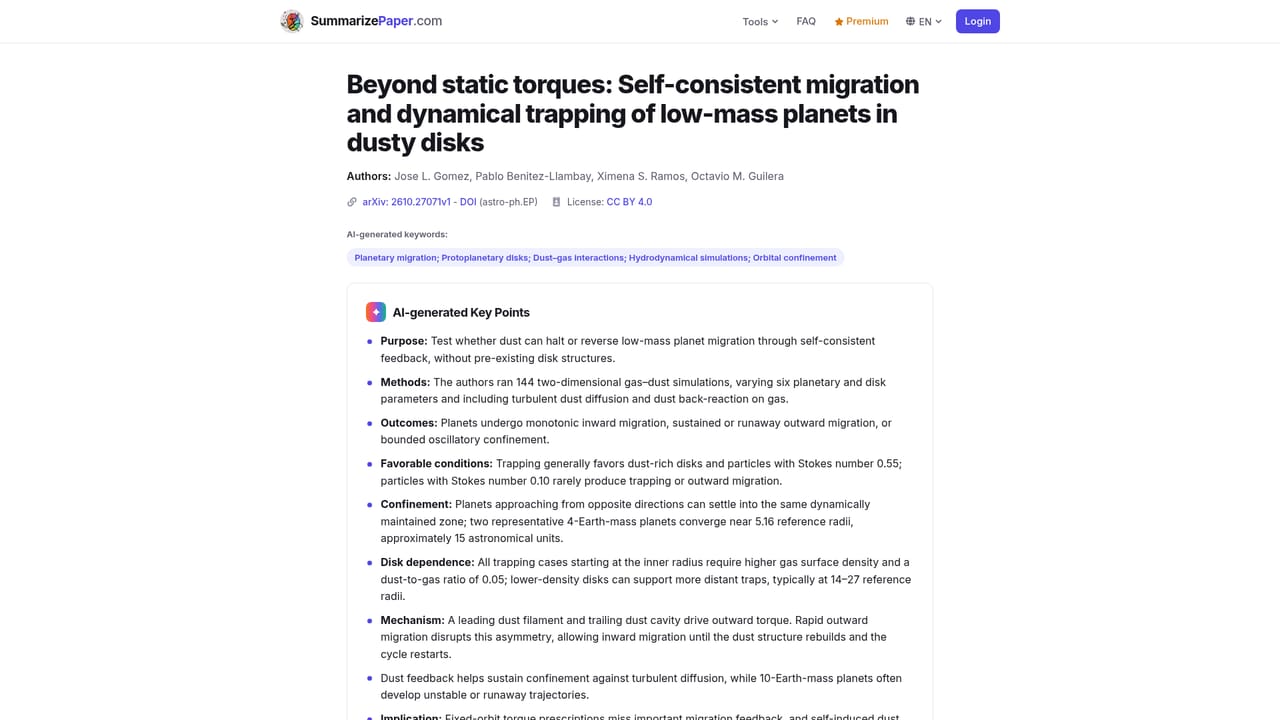
    Open a paper page to get its key points, a summary written for a general reader and longer blog-style write-ups where available.
    SummarizePaper — Read the key points and lay summary
  4. 4Question one or several papers
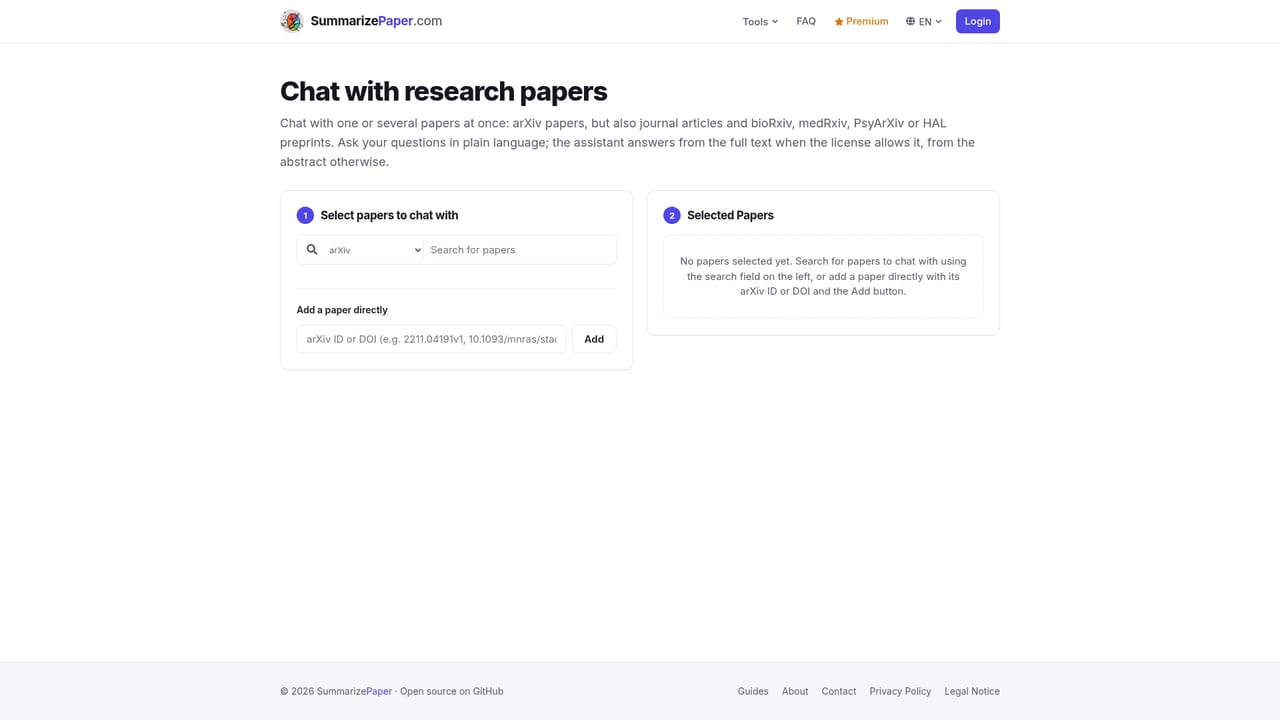
    Open the chat tool and ask in plain language. Answers come from the full text when the license allows it, and from the abstract otherwise.
    SummarizePaper — Question one or several papers
  5. 5Set up a digest for your fields
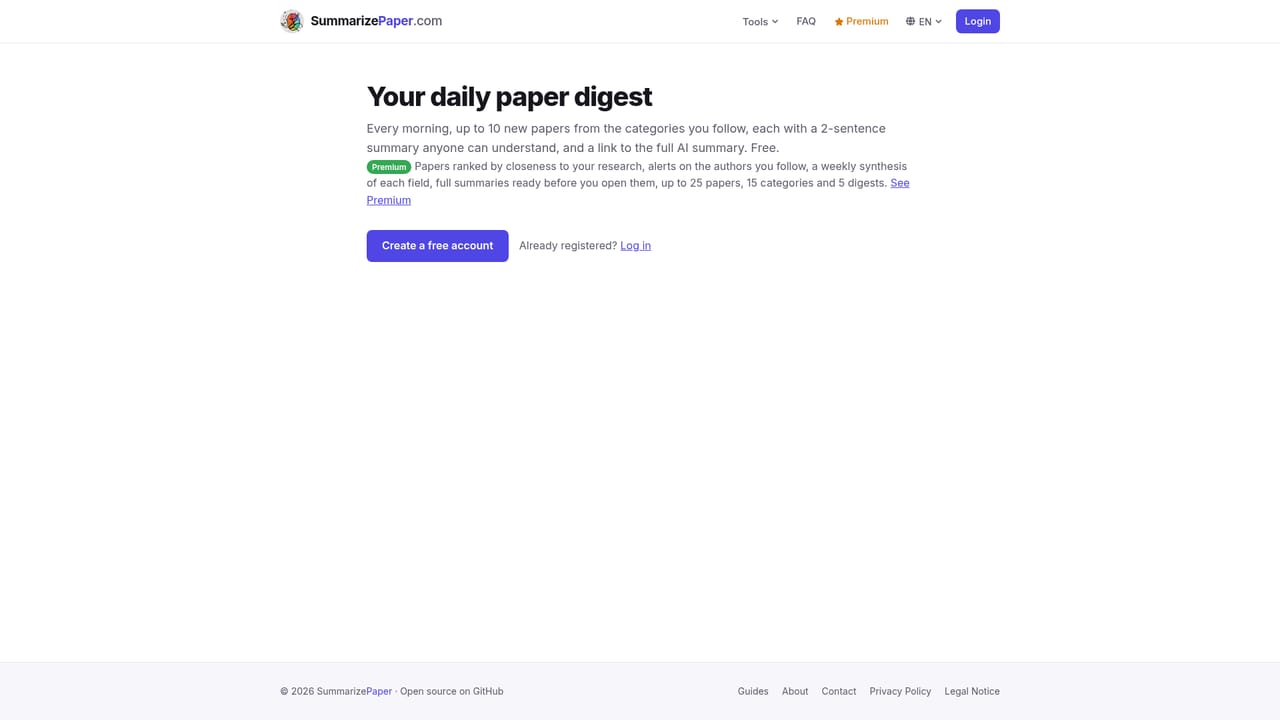
    Subscribe to the daily digest to receive new arXiv, bioRxiv and medRxiv papers grouped by subject area.
    SummarizePaper — Set up a digest for your fields
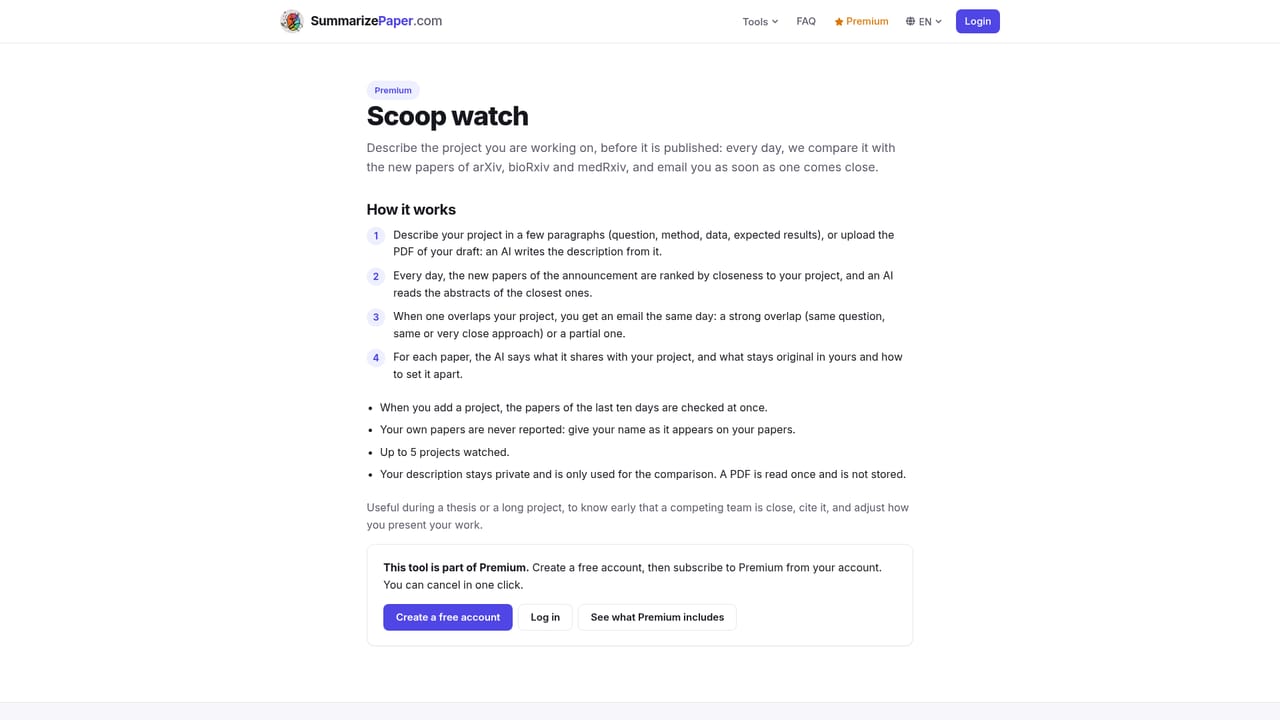
  6. 6Add monitoring tools for active projects
    Describe a project in progress with scoop watch and get an email when a close paper appears, then check your bibliography for retractions and unsupported citations.
    SummarizePaper — Add monitoring tools for active projects

Pros and cons

Pros

  • Accepts arXiv IDs, DOIs and links from bioRxiv, medRxiv, HAL, OSF, PubMed and Europe PMC, so coverage is not limited to one repositoryAI
  • Says plainly when a summary was built from the abstract only, because the paper license did not allow full text readingAI
  • Chat works across several papers at once, which suits literature reviews and comparing competing resultsAI
  • Summaries are available in English, French and 14 other languagesAI
  • Open source codebase, so the summarisation approach can be inspected rather than taken on trustAI

Cons

  • Full-text summarisation depends on the paper license, so paywalled and restrictively licensed articles get thinner, abstract-only outputAI
  • No pricing information is published on the homepage, which makes cost hard to judge before signing upAI
  • Summary quality on dense methods sections is not something the site documents or benchmarksAI
  • The extra tools (scoop watch, reference check, conference companion) add surface area that a single-paper reader may never needAI
  • No mobile apps or browser extension are described; the product is a web app onlyAI

How much does SummarizePaper cost?

Support

A public FAQ page covers how summaries are produced and the licensing rules that decide whether full text or only the abstract is read. Beyond that page, the homepage lists no dedicated help centre, contact form or support channel.

Learn more

Integrations

Works with arXiv, DOI-registered journals, bioRxiv, medRxiv, HAL, ChemRxiv, PsyArXiv, SocArXiv, EarthArXiv and other OSF servers, PubMed and Europe PMC. Source code is on GitHub. No third-party integrations are described.

Features

Paper summaries with key points, a lay summary and blog-style articles; input by arXiv ID, DOI or repository link; field-code search across arXiv; chat over one or several papers; a daily digest of new arXiv, bioRxiv and medRxiv papers; scoop watch, bibliography check, group mapping and conference companion tools; output in 17 languages.

Learn more

Frequently asked questions about SummarizePaper

  • How do you use SummarizePaper?
    The walkthrough on this page covers 6 steps: 1. Search or paste a paper reference 2. Narrow results with field codes 3. Read the key points and lay summary 4. Question one or several papers 5. Set up a digest for your fields 6. Add monitoring tools for active projects.
  • What platforms does SummarizePaper support?
    SummarizePaper is available on Web App.
  • What does SummarizePaper integrate with?
    Works with arXiv, DOI-registered journals, bioRxiv, medRxiv, HAL, ChemRxiv, PsyArXiv, SocArXiv, EarthArXiv and other OSF servers, PubMed and Europe PMC. Source code is on GitHub. No third-party integrations are described.
  • What are the limitations of SummarizePaper?
    Full-text summarisation depends on the paper license, so paywalled and restrictively licensed articles get thinner, abstract-only output. No pricing information is published on the homepage, which makes cost hard to judge before signing up. Summary quality on dense methods sections is not something the site documents or benchmarks.

Status

StatusActive
Views0
Outbound clicks0
Added10/21/2026

Platforms

Web App

Pricing

Freemium