UpSynth

Browser-based image upscaling with selective restore and prompt edits

Beginner
Screenshot of UpSynth, Browser-based image upscaling with selective restore and prompt edits

What is UpSynth?

UpSynth is a browser editor for upscaling, restoring and modifying images with selective control. A adjustable "magic" setting limits how much the AI invents, and the first upscale is free before credit packages apply.

UpSynth is a browser-based image enhancement editor that combines upscaling, restoration and prompt-driven editing in a single workspace. It targets people who have low-resolution or damaged pictures and want a sharper result without handing every decision to an automatic filter. Typical material includes old photos, scanned posters, illustrations, artwork, portraits, designs and game graphics. The workflow is built around three tools that can be chained. Upscale enlarges an image while analyzing it, rebuilding missing detail and reducing artifacts and noise, with the aim of keeping the original character intact. Restore works on a marked region: the user selects a face or fine detail that came out distorted, and the tool rebuilds it from the source image with minimal creative liberty, which matters for identity in old portraits. Modify also works on a marked region, but takes a text instruction, such as replacing or removing an object or changing visual details, and returns several variants to pick from instead of recalculating the whole picture. A distinctive control is the "magic" value, which sets how freely the AI invents detail. Around 50% stays very conservative, 100% is the recommended default, and 150% allows more imaginative detail at a higher risk of misinterpretation. The site also describes JPEG artifact removal, optionally without enlarging the file, aimed at images that have been compressed through repeated saving. Each step can be refined or undone, so a bad result does not force a restart. The product positions itself against one-click upscalers that offer little say over what changes. Its trade-off is more manual involvement: users mark areas, choose settings and compare variants. The first upscale is free, after which credit packages are purchased as needed. Examples are collected on a showcases page, and a how-to page explains how sample results such as style variants and a restored photograph were produced. UpSynth suits hobbyists restoring family pictures, designers preparing assets for print or web, and anyone who values predictable output over speed.
How do you use UpSynth?

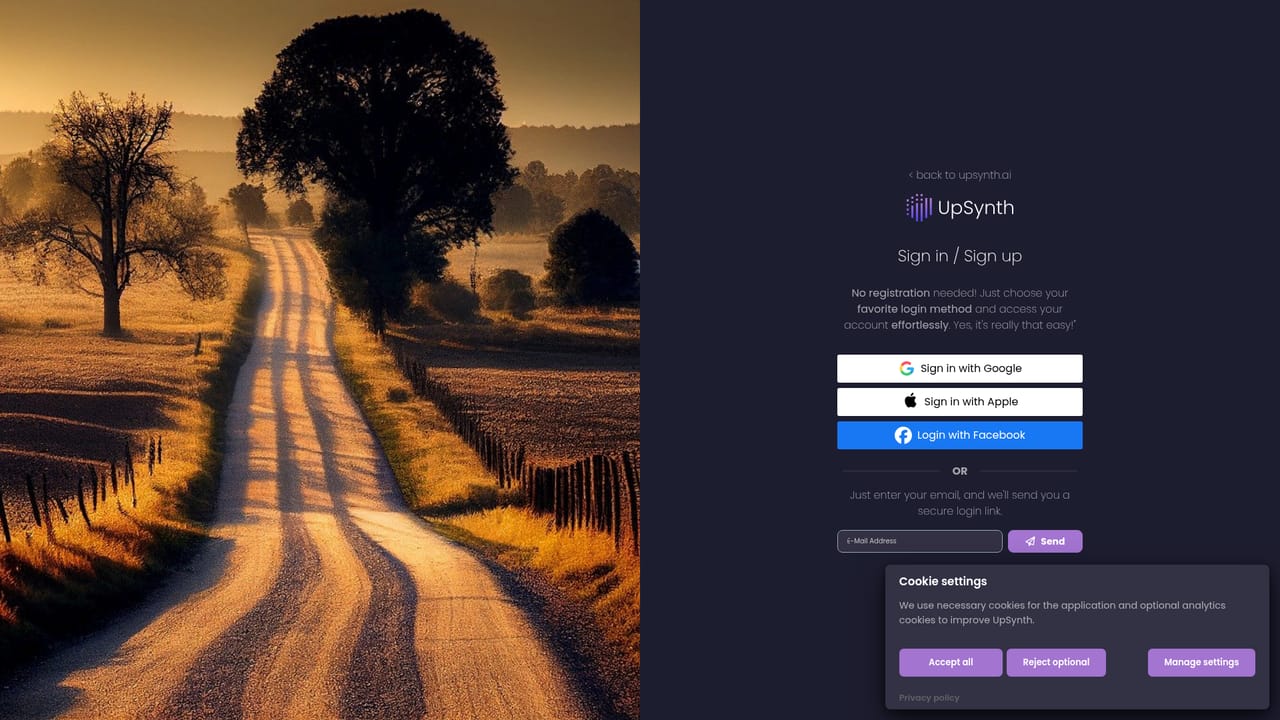
  1. 1Sign in for the free first upscale
    Open the login page to create an account. The first upscale is free, which makes it a low-risk way to judge the quality on your own image.
    UpSynth — Sign in for the free first upscale
  2. 2Upload an image and upscale it
    Load a photo, scan or graphic and run Upscale. Set the magic value, with 100% being the recommended starting point, and compare the result with the original.
  3. 3Restore faces and fine details
    If a face or small detail looks distorted, mark that area and use Restore. The tool rebuilds it from the original image with minimal creative changes.
  4. 4Modify areas with a prompt
    Mark a region and describe the change, such as removing an object or filling damaged parts. Pick the best of the variants offered, and undo any step you dislike.
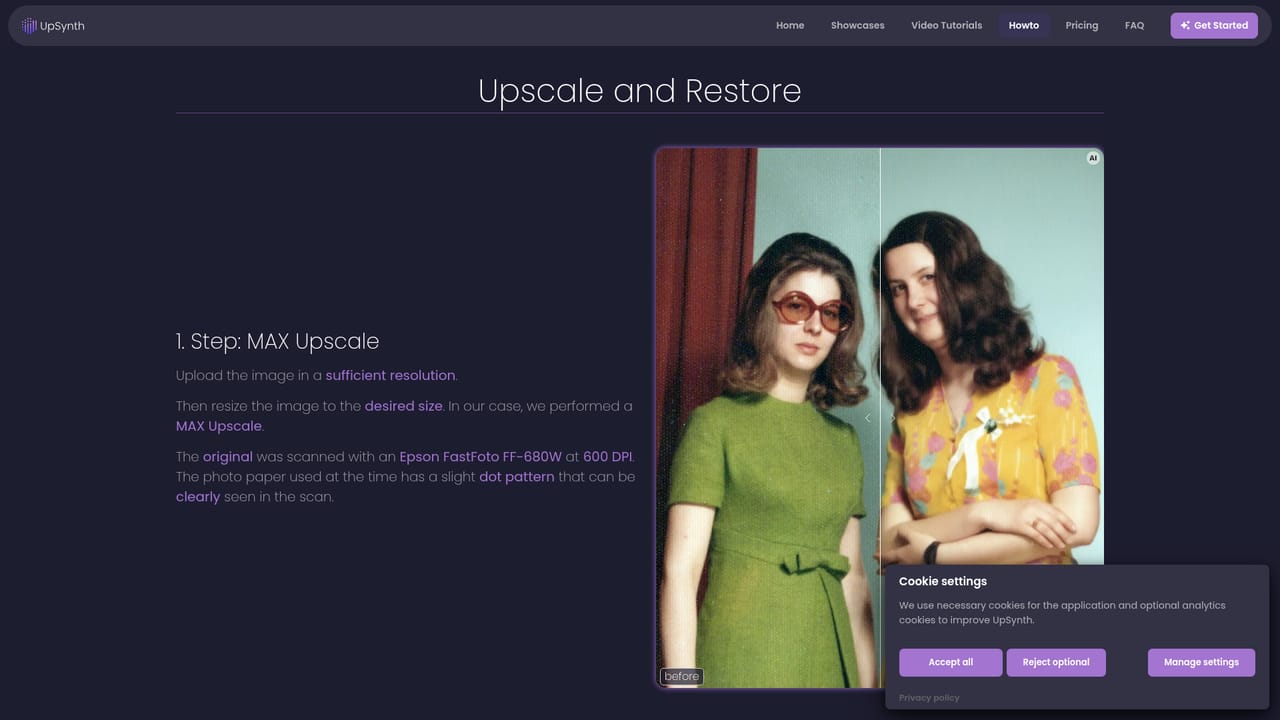
  5. 5Study the how-to and showcases
    The how-to page shows how example results were produced, and the showcases page collects more finished images for reference before buying credits.
    UpSynth — Study the how-to and showcases

Pros and cons

Pros

  • Magic setting lets users decide how conservative or creative the AI is during upscalingAI
  • Restore tool rebuilds marked faces and details close to the source to protect identityAI
  • Modify produces several variants from a text prompt on a selected area onlyAI
  • Steps can be refined or undone, so one poor result does not force a restartAI
  • Runs in the browser, and the first upscale is free to testAI

Cons

  • Requires marking areas and tuning settings, so it is slower than one-click upscalersAI
  • Higher magic values add more risk of invented or misinterpreted detailsAI
  • Beyond the free first upscale, usage depends on purchasing credit packagesAI
  • Account login is needed before any image can be triedAI
  • Homepage lists no desktop or mobile apps, API or integrationsAI

How much does UpSynth cost?

Free trial

The first upscale is free after signing up, so a single image can be tested before any purchase.

Learn more

Pricing

The first upscale is free. After that, Credit Packages can be purchased as needed. Package sizes and prices are not stated on the homepage.

Learn more

Features

Upscale with detail reconstruction and noise reduction, Restore for selected faces and details, Modify via prompt with multiple variants, an adjustable magic value (50% to 150%), JPEG artifact removal without enlarging, and undo at each step.

Learn more

Frequently asked questions about UpSynth

  • How much does UpSynth cost?
    The first upscale is free. After that, Credit Packages can be purchased as needed. Package sizes and prices are not stated on the homepage.
  • Does UpSynth offer a free trial?
    The first upscale is free after signing up, so a single image can be tested before any purchase.
  • How do you use UpSynth?
    The walkthrough on this page covers 5 steps: 1. Sign in for the free first upscale 2. Upload an image and upscale it 3. Restore faces and fine details 4. Modify areas with a prompt 5. Study the how-to and showcases.
  • What platforms does UpSynth support?
    UpSynth is available on Web App.
  • What are the limitations of UpSynth?
    Requires marking areas and tuning settings, so it is slower than one-click upscalers. Higher magic values add more risk of invented or misinterpreted details. Beyond the free first upscale, usage depends on purchasing credit packages.

Status

StatusActive
Views0
Outbound clicks0
Added10/18/2026

Platforms

Web App

Pricing

Free TrialPaid