Free trial
A 14-day free trial includes unlimited searches, and the site states no payment is required to begin. A student discount is available at signup with academic email verification.
Learn moreOne workspace for searching, organizing, and citing academic literature.
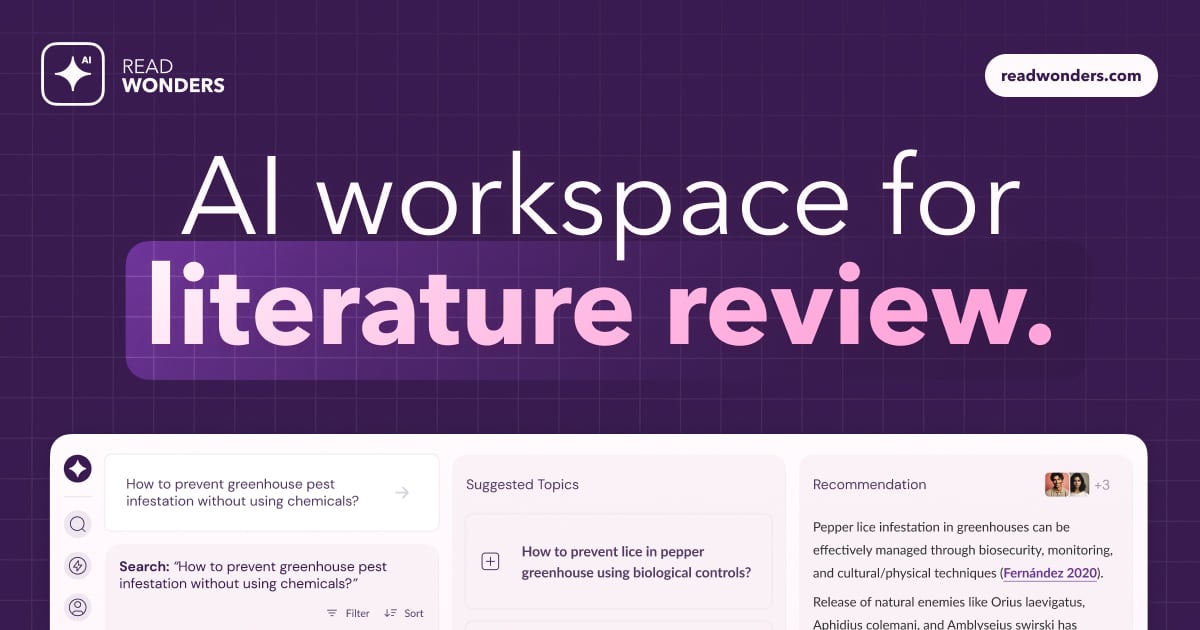
Wonders AI is a literature review workspace that searches 320M+ scholarly works via OpenAlex and Semantic Scholar, then supports organizing sources, annotating PDFs, generating citations in six styles, and exporting to Word, LaTeX, Zotero, and Overleaf. Built for students, academics, and research teams who need traceable sources rather than chatbot answers.
Wonders AI is a research workspace built around the literature review rather than the chat prompt. Its core is a search layer that queries 320M+ scholarly works drawn from OpenAlex and Semantic Scholar, including patents. You arrive with a rough question, and the product helps shape it into a searchable strategy using Boolean filters, then returns candidate sources you can inspect before committing to any of them. From there the work moves into an organize stage. Saved findings, highlights, notes, and PDFs sit on project boards where they can be rearranged until an argument takes shape, and each item stays tied to the source it came from. Color-coded highlighting and in-app PDF annotation support close reading, and a chat-with-a-paper feature lets you interrogate a single document without leaving the project. The third stage is writing. Wonders generates bibliographies and citations in APA, MLA, Chicago, Harvard, IEEE, and Vancouver, then exports to DOCX, PDF, LaTeX, HTML, or Markdown, with bibliography push to Zotero and LaTeX or BibTeX files for Overleaf. The pitch is that every claim stays traceable, so AI summaries can be checked at their source instead of trusted blindly. That orientation suits undergraduates writing a first review, graduate students and PhD candidates managing large reading loads, faculty supervising multiple theses, and professionals who need evidence-based output. Against general chatbots, the difference is scope and traceability: a dedicated corpus and step-by-step workflow instead of freeform answers. Against Elicit, the overlap is real, and the site itself concedes that many researchers run more than one tool. The company reports 24k+ scholars and cites use at several universities, and institutions can roll the product out to a cohort. Pricing is $20 per month, or $12 monthly on annual billing, with a student rate near $6 per month against an academic email.
A 14-day free trial includes unlimited searches, and the site states no payment is required to begin. A student discount is available at signup with academic email verification.
Learn morePlus is listed at $20 per month, or $12 per month billed yearly ($144 per year). Students with an active academic email pay about $6 per month on annual billing, which the site describes as roughly a third of the $19 to $20 monthly list price of comparable tools. All plans start with a 14-day free trial.
Learn moreAn in-app help and messaging widget (Featurebase) covers updates, help articles, and direct contact with the team. Reviewers describe support as responsive; no phone or dedicated enterprise support tier is stated.
Learn moreZotero connection for pushing findings into a chosen or newly created collection, LaTeX and BibTeX export for Overleaf, and Word via DOCX export. No other integrations are documented on the homepage.
Search across 320M+ scholarly works and patents from OpenAlex and Semantic Scholar with Boolean filters and guided query refinement. Organize sources on project boards with color-coded highlights, notes, in-app PDF annotation, and chat with a paper. Write and cite in APA, MLA, Chicago, Harvard, IEEE, or Vancouver, then export to DOCX, PDF, LaTeX, HTML, or Markdown.
Learn more AI Angels400+ customizable AI girlfriends for NSFW chat, voice calls, and roleplay
 Candy AIExperience the future of companionship with AI friends who chat, role-play, and connect with you on a human level.
 ourdream.aiA vast AI roleplay platform with millions of characters for chat, images, video and voiceAI Angels400+ customizable AI girlfriends for NSFW chat, voice calls, and roleplayCandy AIExperience the future of companionship with AI friends who chat, role-play, and connect with you on a human level.ourdream.aiA vast AI roleplay platform with millions of characters for chat, images, video and voice


