What these tools do
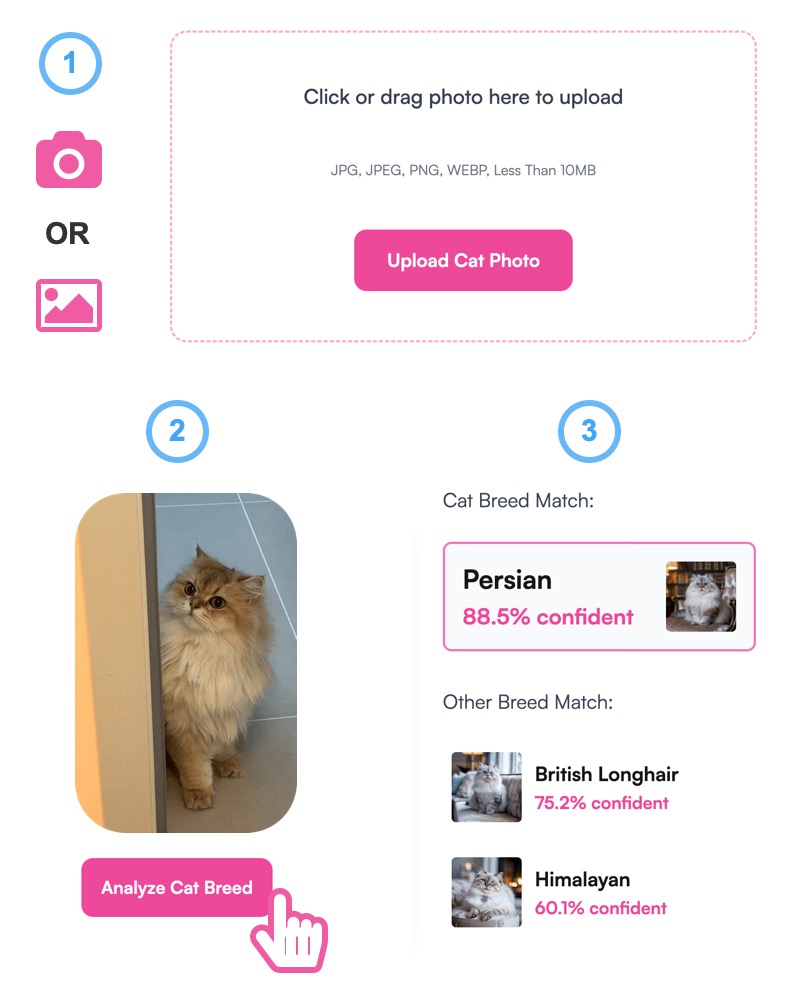
Cat breed identification tools accept a photo, either uploaded from a camera roll or taken live in an app, and compare it against breed profiles to suggest what the cat might be. Output usually includes a short list of candidate breeds, sometimes a confidence score, and often notes on size, temperament and grooming needs. They replace the slower route of scrolling breed galleries and comparing ear shape, coat pattern and body type by eye. The audience is mostly cat owners, especially people with rescue cats and no pedigree paperwork, plus anyone curious about a neighbourhood stray. Accuracy is genuinely limited: most cats are domestic shorthairs, and visual similarity to a breed does not prove ancestry. Treat results as clues, not certificates.
How to choose one
Start with the input method. A web uploader suits someone with a folder of photos on a laptop, while a phone app is better for a cat that will not sit still. Check how results are presented: a single confident answer sounds reassuring but hides uncertainty, whereas three ranked matches with confidence levels tell you more honestly what the model can and cannot see. Look at whether breed profiles include traits and care tips, since that is what makes a guess useful for a new owner. Free options cover most casual curiosity, so only consider paying if you want repeated scans or extra detail. And confirm the tool actually handles cats: some recognisers are built for dogs and treat felines as an afterthought.
Notable tools
Furriq is a web app that returns photo-based breed clues and is unusually upfront about how confident each guess is, which makes it a sensible first stop. Pricing is a free trial with paid tiers.
WhatBreedIsMyCat takes an uploaded cat photo and returns three likely breed matches alongside traits and care tips. It is free and runs in the browser, so no install is needed.
Cat Scanner is a phone app for iOS and Android: point the camera at a cat and get a breed guess within seconds. It is free with a freemium tier, and the live camera suits cats that move.
Breed.dog is a free web tool built around dog breeds rather than cats, so it belongs here only as a comparison point for how these photo classifiers behave.
Common questions
How accurate is cat breed id?
Visual classifiers can only judge appearance, and most cats have mixed ancestry that no photo resolves. Expect plausible guesses rather than a verified breed. A high confidence score reflects how closely the photo matches a breed profile, not proof of lineage.
Is a cat breed scanner free to use?
Most are, at least for a first scan. Free web tools such as WhatBreedIsMyCat cost nothing, while apps like Cat Scanner pair a free tier with paid extras. Furriq offers a free trial before paid plans, so test one scan before committing.
What photo works best for cat breed identification?
A clear, well-lit shot of the whole cat, taken from the side, shows coat pattern, body shape and tail. Close-ups of the face alone miss too much. Several photos from different angles usually beat one perfect portrait.
When to look elsewhere
If the question is less about the animal and more about where a photo was taken, the Image Geolocation category fits better. For identifying objects, plants or general scenes rather than breeds, see Image Analysis.