Free trial
A sample project on one of your own models is offered with no commitment, and scope is confirmed before any work begins. It is a paid-scope quote rather than a free self-serve trial.
Learn morePhoto compositing for manufactured, modular and prefab homes
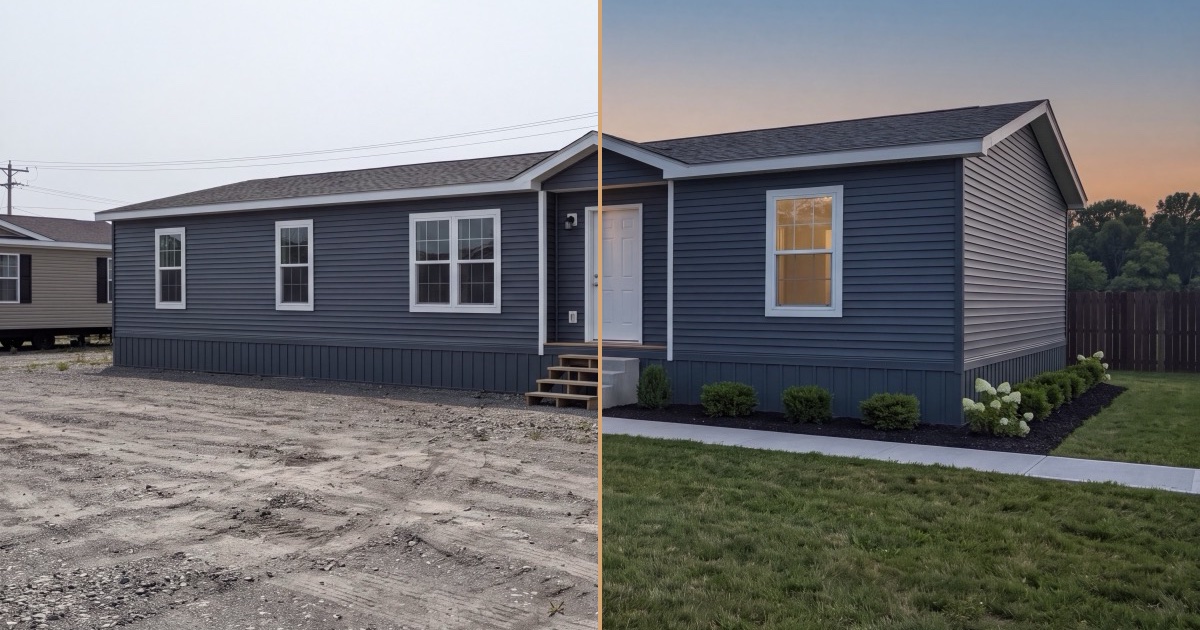
Feng My Shui is a background tool. A production service that retouches and composites existing photographs of manufactured, modular, prefab and park model homes into new landscaped, wooded, coastal or backyard settings, keeping every architectural detail fixed to the source photo.
Feng My Shui is a creative production service for builders of manufactured, modular, prefab and park model homes, plus ADUs and backyard cottages. It takes the product photographs a manufacturer already owns (factory lot shots, gravel pads, dealer yards, overcast skies) and turns them into marketing imagery of the same home sitting in landscaped suburban lots, wooded acreage, coastal or lakeside settings, or a residential backyard. The promise is narrow and deliberate: the architecture is treated as fixed. Window count and placement, doors, roof pitch, siding profile, trim, colors, proportions and scale all come from the original photograph and are not redrawn. In practice the workflow runs in six stages. The client sends existing exterior photos, the home is isolated exactly as shot, and signage, stickers, lot clutter, unfinished skirting and temporary steps are cleaned up while sky, light and color are refined. The original background is then replaced with matched scenery, with attention to shadow direction, ground contact, perspective and scale. AI image models, including Google's Nano Banana, carry part of the load next to conventional retouching and upscaling, but a person reviews each image twice: against the source photograph for accuracy and against the rest of the set for consistency. Files arrive upscaled for web, listings, brochures and ads, organised by model. This sits between two options a home builder usually weighs. A 3D rendering studio rebuilds the product from plans, which is slow and expensive per model and can drift from what actually ships. Commodity photo editing swaps backgrounds cheaply but rarely holds lighting, shadow and scale together across a catalog. Feng My Shui starts from the real photograph instead, and is positioned as an ongoing production partner rather than a one-off edit, with monthly plans sized to release volume and repeatable settings so a full lineup reads as one brand. It suits marketing teams at builders, dealers and retail centers with catalogs worth keeping visually uniform. Buyers should note that every project starts as a paid sample and that cost is quoted per catalog after the sample is reviewed, so there is no self-serve tier or instant checkout.
A sample project on one of your own models is offered with no commitment, and scope is confirmed before any work begins. It is a paid-scope quote rather than a free self-serve trial.
Learn morePricing is not published on the site. Ongoing work is quoted on volume: how many models, how many environments per model, and how often new homes are released. A proposal follows the sample project, once the studio has seen your product and understands your catalog.
Learn moreQuestions go to the studio by email at studio@fengmyshui.com, and scope or delivery dates are confirmed directly with the team before work starts.
Existing photos are retouched, enhanced and composited into new scenery with the home treated as fixed: window count, size and placement, doors and porches, roof pitch and materials, siding profile, trim, colors, proportions and scale. Signage, stickers, props, lot clutter, unfinished skirting and temporary steps are removed, while ground, landscaping, sky, light, shadows, season and time of day are replaced. Upscaled high-resolution files are organised by model.
 AI Angels400+ customizable AI girlfriends for NSFW chat, voice calls, and roleplay
 Candy AIExperience the future of companionship with AI friends who chat, role-play, and connect with you on a human level.
 ourdream.aiA vast AI roleplay platform with millions of characters for chat, images, video and voiceAI Angels400+ customizable AI girlfriends for NSFW chat, voice calls, and roleplayCandy AIExperience the future of companionship with AI friends who chat, role-play, and connect with you on a human level.ourdream.aiA vast AI roleplay platform with millions of characters for chat, images, video and voice


