Integrations
The homepage shows agents wired to GitHub, Jira, Linear, Slack, PagerDuty, Datadog, Sentry, Jenkins, Vercel, Databricks, BigQuery, Snowflake, Salesforce, Confluence, Notion, Okta and Google Drive.
Background agents for recurring engineering work, plus frontier AI training data

Labelbox builds training environments and expert data for frontier AI labs, and Recursion, a platform of event-triggered background agents that handle recurring engineering, research, finance and sales tasks and deliver reviewable results.
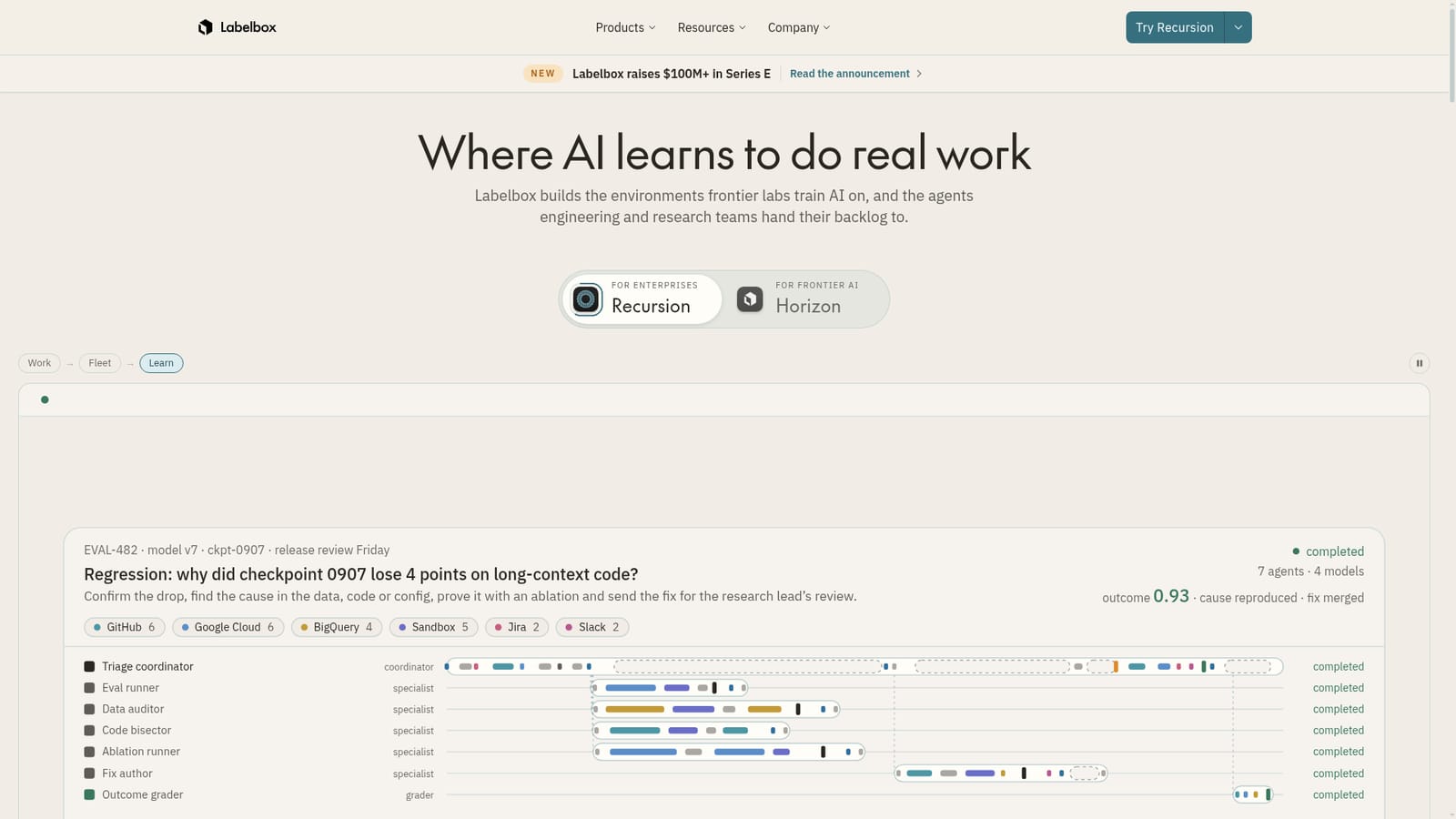
Labelbox operates on two fronts. For frontier AI labs, it builds the training environments and expert-produced data that models learn from. For enterprises, it offers Recursion, a platform of autonomous agents that take over recurring engineering, research and business tasks. The homepage splits the offer accordingly, with Recursion aimed at enterprise teams and Horizon aimed at frontier AI developers, and a separate expert network page covers the human contributors behind the data. Recursion is the part most buyers will evaluate directly. Instead of acting as an assistant inside an editor, its agents start on their own when something happens: a failing build, an alert, a new checkpoint, a merged pull request or a fixed schedule. They then work in the background until a deliverable exists, usually a tested pull request, a root-cause draft, a report or a brief. The site lists dozens of prebuilt jobs, including a bug fixer, a dependency upgrader, a flaky test fixer, incident investigation, vulnerability patching, eval regression triage, experiment sweeps, forecast refreshes, RFP drafting and vendor risk review. Triggers and outputs tie into tools such as GitHub, Jira, Linear, Slack, PagerDuty, Databricks, BigQuery, Salesforce and Google Drive. In practice, a session is run by a coordinator that delegates to specialist agents, which may run on different models, with a separate grader agent scoring each outcome. Graded sessions leave behind memories, notes and skills that later sessions read before acting, so the system is designed to improve with use. The featured example traces a drop in a model's long-context coding score to its cause, proves it with an ablation and sends the fix for human review. The product suits engineering, ML research, security, finance and sales operations teams with a steady backlog of repeatable work. It sits closer to agent orchestration platforms than to coding copilots, and the same company also competes in the data labeling and evaluation market. Pricing and trial terms are not published on the homepage, so evaluation likely starts with a conversation with sales.
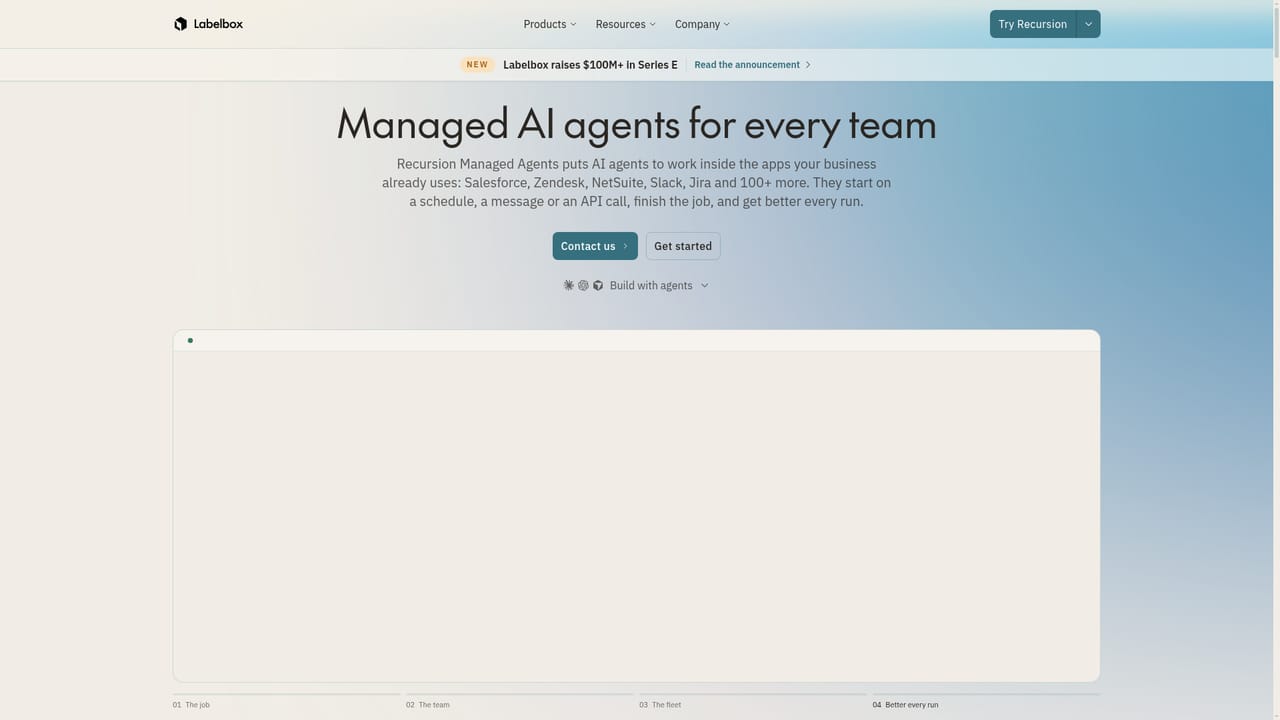
The homepage shows agents wired to GitHub, Jira, Linear, Slack, PagerDuty, Datadog, Sentry, Jenkins, Vercel, Databricks, BigQuery, Snowflake, Salesforce, Confluence, Notion, Okta and Google Drive.
Event-triggered background agents (schedules, alerts, commits, API calls), coordinator and specialist agents across multiple models, grader agents scoring every run, memory and skills carried between sessions, and prebuilt jobs for engineering, security, ML research, evals, finance, sales and procurement.
Learn more AI Angels400+ customizable AI girlfriends for NSFW chat, voice calls, and roleplay
 Candy AIExperience the future of companionship with AI friends who chat, role-play, and connect with you on a human level.
 ourdream.aiA vast AI roleplay platform with millions of characters for chat, images, video and voiceAI Angels400+ customizable AI girlfriends for NSFW chat, voice calls, and roleplayCandy AIExperience the future of companionship with AI friends who chat, role-play, and connect with you on a human level.ourdream.aiA vast AI roleplay platform with millions of characters for chat, images, video and voice