Support
Support is reached through the demo request form, and the site publishes methodology and benchmark material rather than a help centre. No dedicated documentation or support page is listed.
Ontology-powered graphs that make enterprise AI traceable and grounded

Lettria builds ontology-powered knowledge graphs that unify structured data and unstructured documents into a traceable context layer for enterprise AI. Two products, Knowledge Studio for exploration and Perseus for building, target regulated industries that need grounded answers with provenance rather than plain vector retrieval.
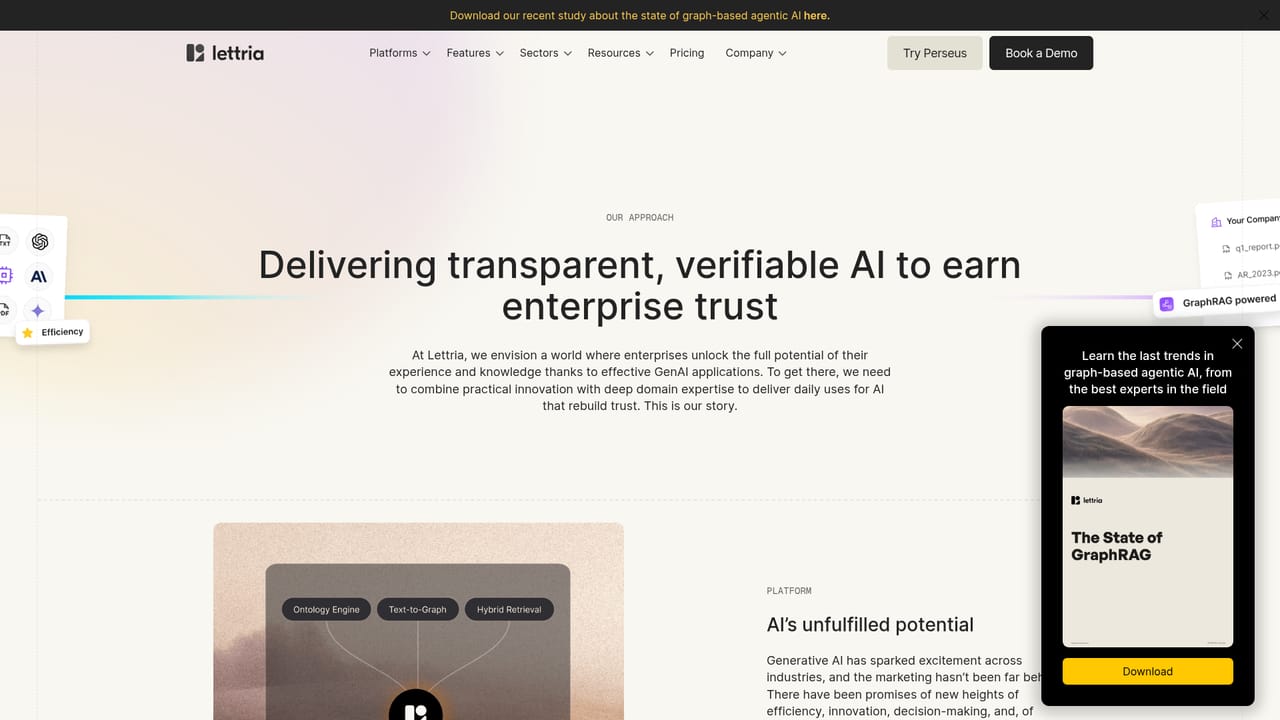
Lettria is an enterprise platform that sits underneath an AI stack rather than in front of it. Its core product, the Graph Context Layer, takes two very different kinds of input, structured records and unstructured documents, and merges them into ontology-powered knowledge graphs. Those graphs then serve as context for the language models and agents an organisation already runs, so answers are anchored to defined entities and relationships instead of being assembled from loose text similarity. The company positions the output as grounded, traceable and trusted, which speaks directly to the audit and compliance expectations of regulated industries. Two entry points are offered. Knowledge Studio is the exploratory route, aimed at teams that want to see how their own corpus behaves once it becomes a graph. Perseus is the builder route, a separate application for teams constructing on top of the graph layer. A published whitepaper on the state of graph-based agentic AI covers the underlying methodology, and Lettria points to benchmarks, papers and technical talks alongside eight years of applied AI work and production enterprise deployments as evidence of maturity. The practical audience is data engineering, knowledge management and AI platform teams in sectors where a wrong answer carries cost: finance, insurance, healthcare, legal and industrial operations. Someone still needs to define the ontology and curate the source material, so this is not a drop-in tool for an individual writer or marketer. Compared with retrieval systems that chunk documents and rely on embeddings alone, Lettria's differentiator is the explicit semantic model connecting entities across sources. That structure supports multi-hop questions and provenance trails that flat vector search struggles to provide, at the price of more upfront modelling work.
Support is reached through the demo request form, and the site publishes methodology and benchmark material rather than a help centre. No dedicated documentation or support page is listed.
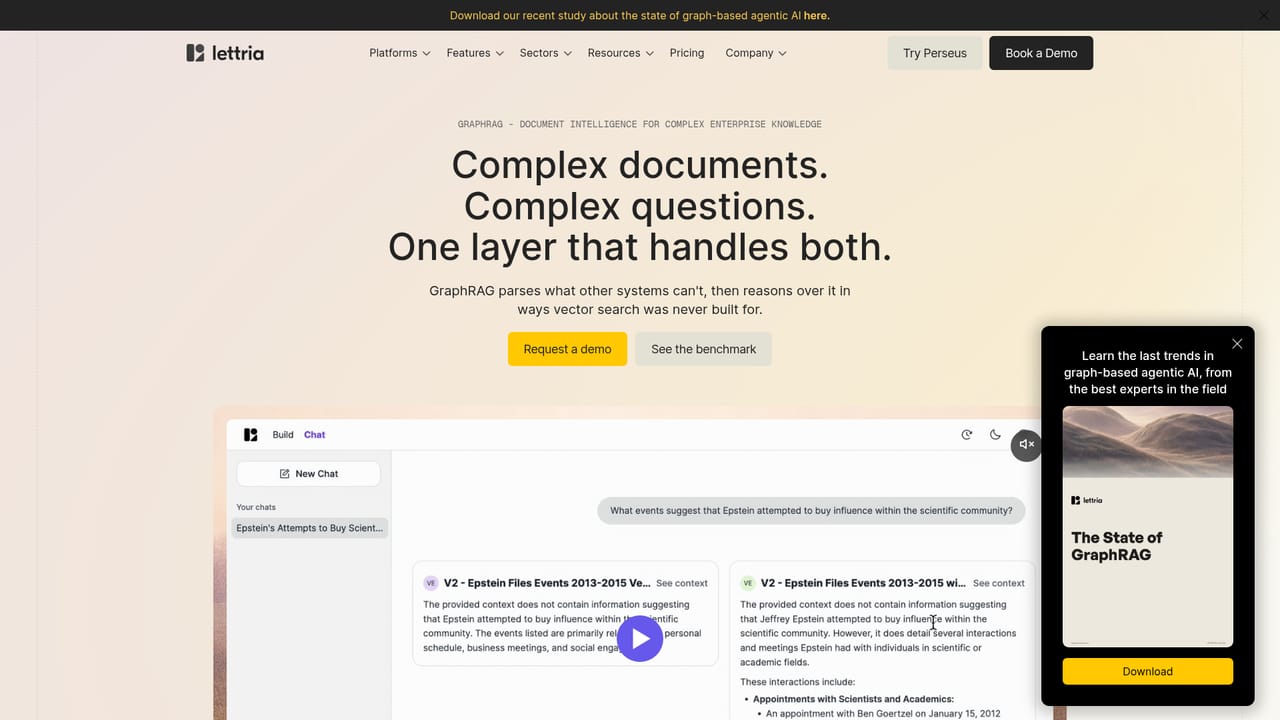
The Graph Context Layer merges structured data and unstructured documents into ontology-powered graphs that serve as grounded context for enterprise AI, with traceability built into the output. Knowledge Studio supports exploration of your own corpus, Perseus supports building on the graph layer, and GraphRAG covers how graph context feeds retrieval and generation.
Learn more AI Angels400+ customizable AI girlfriends for NSFW chat, voice calls, and roleplay
 Candy AIExperience the future of companionship with AI friends who chat, role-play, and connect with you on a human level.
 ourdream.aiA vast AI roleplay platform with millions of characters for chat, images, video and voiceAI Angels400+ customizable AI girlfriends for NSFW chat, voice calls, and roleplayCandy AIExperience the future of companionship with AI friends who chat, role-play, and connect with you on a human level.ourdream.aiA vast AI roleplay platform with millions of characters for chat, images, video and voice


