Integrations
Custom Services let organisations embed Open Knowledge Maps discovery components in their own systems; live case studies are linked from the supporting membership page. Direct connectors for third party tools are not listed.
Learn moreMap a research topic as a visual overview of scientific knowledge
Own Open Knowledge Maps? Verify ownership to get a dofollow link
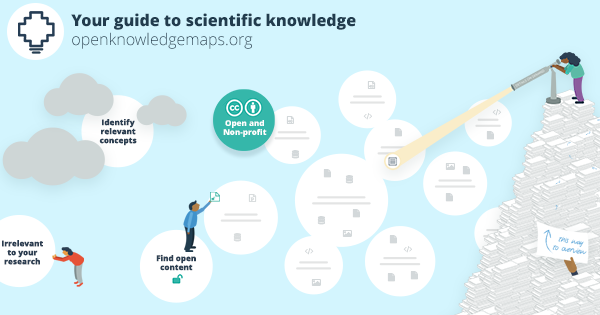
Open Knowledge Maps is an academic research tool. A nonprofit, AI-assisted scientific search engine that turns a topic query into a clustered visual map of research outputs. It searches BASE (400M+ outputs, 400+ languages) and PubMed, filters by date, type and metadata quality, and claims no hallucinated results, since maps are built from metadata alone.
Open Knowledge Maps is a nonprofit search engine for scientific literature that returns a visual map instead of a ranked list. You enter a topic, choose a source (PubMed for the life sciences or BASE for all disciplines), and the platform groups matching outputs into labelled clusters so the main concepts of a field become visible at a glance. From a cluster you can move to the underlying resources and decide what deserves a closer read. The coverage claim is large: more than 400 million outputs across 400+ languages drawn from over 11,000 sources via BASE, with PubMed handling biomedical queries. Maps can include 25 output types beyond journal articles, among them datasets, software, images, theses and conference objects. Search can be filtered by date range, relevance or recency, by document type and by language, and a metadata quality switch requires an abstract of at least 300 characters for higher map quality. The project is explicit that it does not generate text and does not hallucinate: results are built only from the underlying metadata, which matters when a map is going into a literature review or a grant application. It is aimed at students starting a thesis, researchers scoping an unfamiliar field, librarians teaching search skills, and anyone who needs a fast structural picture of a topic before committing to a reading list. Positioning is where Open Knowledge Maps differs from general AI research assistants. It is open source in spirit, charitable and funded through supporting memberships from universities and libraries, with custom services that let institutions embed its discovery components in their own systems. The trade off is scope of ambition: it maps and points, and leaves summarising and deep analysis to other tools. Alternatives include citation graph tools and conversational literature assistants, which go deeper on individual papers but rarely offer this cluster-level visual entry point.
Custom Services let organisations embed Open Knowledge Maps discovery components in their own systems; live case studies are linked from the supporting membership page. Direct connectors for third party tools are not listed.
Learn moreKnowledge maps built from your query, with PubMed and BASE as sources, 25 output types including datasets, software, theses and images, date and relevance sorting, language and resource type filters, and a metadata quality switch that requires abstracts of at least 300 characters. The platform states results are based only on underlying metadata, with no hallucinations.
Learn more AI Angels400+ customizable AI girlfriends for NSFW chat, voice calls, and roleplay
 Candy AIExperience the future of companionship with AI friends who chat, role-play, and connect with you on a human level.
 ourdream.aiA vast AI roleplay platform with millions of characters for chat, images, video and voiceAI Angels400+ customizable AI girlfriends for NSFW chat, voice calls, and roleplayCandy AIExperience the future of companionship with AI friends who chat, role-play, and connect with you on a human level.ourdream.aiA vast AI roleplay platform with millions of characters for chat, images, video and voice


