Free trial
A free start is offered: the homepage invites users to sign up and start scraping without a credit card. No trial duration or credit allowance is stated.
Learn moreOne REST API that turns social video URLs into transcripts, summaries and stats
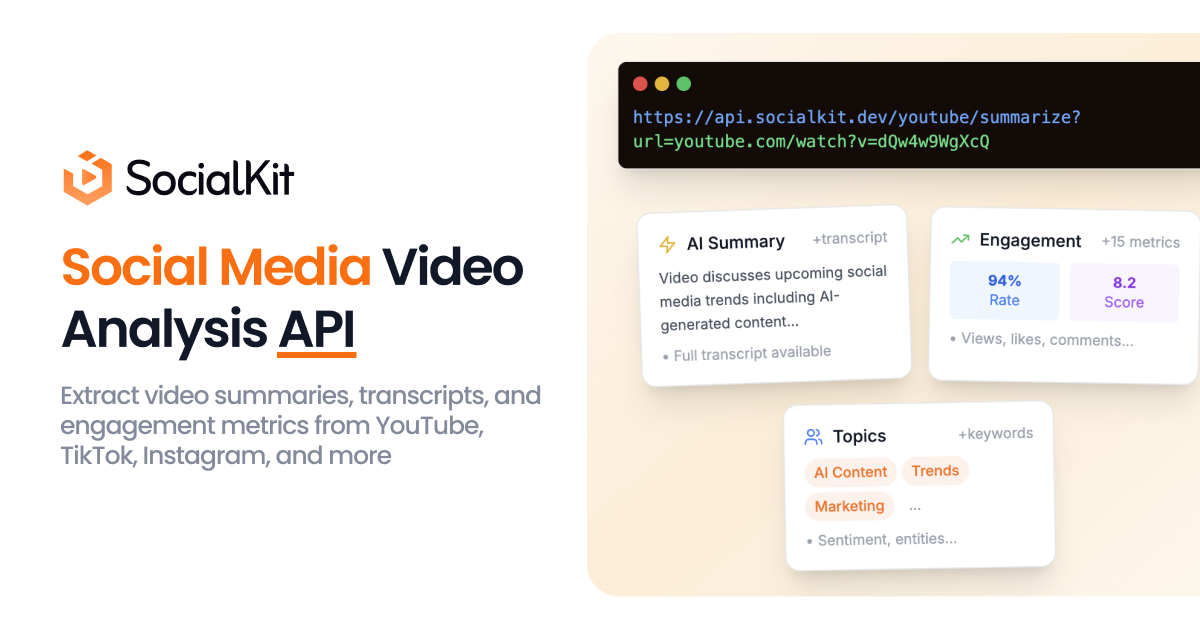
SocialKit is a scraping API that turns YouTube, TikTok, Instagram, Facebook, X and LinkedIn URLs into clean JSON, including transcripts, AI summaries, key points, comments and engagement stats. It suits developers and research teams building social listening, influencer analysis or AI agent workflows, with MCP and no-code integrations.
SocialKit is a scraping and extraction API for social video and post data. It converts a public URL from YouTube, TikTok, Instagram, Facebook, X or LinkedIn into structured JSON, handling the proxy rotation, page parsing and platform quirks that would otherwise sit on your engineering backlog. For teams whose real need is video analysis, the interesting endpoints are the transcript and summarizer routes: a single request to the YouTube, TikTok, Instagram, Facebook or generic video-file API returns a written transcript plus a short summary, key points and detected topics. The product is aimed at developers and technical teams rather than casual end users. Anything that consumes social content at volume fits: a social listening dashboard, an influencer comparison tool, a research pipeline, or an AI agent that needs to know what a video actually said. Video files hosted outside the major platforms can be submitted through the dedicated transcript and summary endpoints, so internal call recordings and uploaded clips use the same schema as public posts. In practice, the workflow is deliberately thin. You pick an endpoint, paste the URL or send it programmatically with your access key, and receive a JSON payload with predictable field names. Responses are metered in credits, with most requests costing one credit and heavier queries (longer videos, more results) costing more. The homepage also documents a first-party Claude Code skill and a hosted MCP server, so an assistant such as Claude or Cursor can call the same endpoints as tools without custom glue code. Against alternatives, SocialKit competes less on raw scraping breadth and more on packaging: transcripts, AI summaries and engagement metrics arrive in one consistent response shape across six platforms, and no-code connectors remove the need for a bespoke scraper. The trade-off is that you are buying a data layer, not an interface: there is no visual analytics product here, and the value depends entirely on your own downstream tooling.
A free start is offered: the homepage invites users to sign up and start scraping without a credit card. No trial duration or credit allowance is stated.
Learn moreCredit-based pricing with monthly, yearly (30 percent off) and pay-as-you-go options. Most requests cost one credit, with longer videos or larger result sets costing more; credits refresh monthly and do not roll over. Exact figures are not shown on the homepage.
Learn moreCustomer quotes on the homepage single out responsive, efficient support, but no dedicated help centre or support page is listed beyond the developer documentation.
Learn moreNative connectors for Zapier, Make and n8n, a hosted MCP server for Claude, Cursor and other MCP clients, a first-party agent skill for Claude Code, Cursor and Codex, and a documented REST API with an OpenAPI spec.
Learn moreOver 40 endpoints covering YouTube and Shorts, TikTok, Instagram Reels and posts, Facebook, X and LinkedIn, plus transcript and summary APIs for uploaded video files. Responses include transcripts, AI summaries with key points, topics, comments, video and channel stats, profiles, posts, search results and downloads, all in structured JSON.
Learn more AI Angels400+ customizable AI girlfriends for NSFW chat, voice calls, and roleplay
 Candy AIExperience the future of companionship with AI friends who chat, role-play, and connect with you on a human level.
 ourdream.aiA vast AI roleplay platform with millions of characters for chat, images, video and voiceAI Angels400+ customizable AI girlfriends for NSFW chat, voice calls, and roleplayCandy AIExperience the future of companionship with AI friends who chat, role-play, and connect with you on a human level.ourdream.aiA vast AI roleplay platform with millions of characters for chat, images, video and voice