Supportlogic

AI infrastructure that turns support tickets into predictive signals.

Advanced API
Screenshot of Supportlogic, AI infrastructure that turns support tickets into predictive signals

What is Supportlogic?

Supportlogic is a pattern recognition tool. SupportLogic provides an AI infrastructure layer for customer support: 16 ambient agents, an MCP server, a Snowflake-native data cloud and REST API that extract signals from tickets, chats and calls and expose them to CRMs and AI assistants.

SupportLogic is an AI infrastructure layer built for customer support organizations. Rather than replacing the helpdesk, it sits underneath the CRM, voice platforms and data lakes a team already runs, extracting signals from tickets, chats and calls and feeding them back as scores, alerts and context. The pitch is that CRMs were designed for human triage of tickets, while the next wave of work involves AI agents that need clean data, persistent context and open interfaces. SupportLogic supplies those three pieces through a Snowflake-native Data Cloud, an MCP server and a REST API. The platform is organized around what it calls a Cognitive AI Cloud, which includes 16 ambient agents covering sentiment, escalation prediction, case routing, coaching, knowledge, voice, account health and summarization. Beneath them sit foundation agents that maintain memory across channels and systems, extract more than 40 signals from raw interactions, and sync data from source systems without copying it. On top, teams interact through a Command Center for operators, embeddable widgets inside Salesforce, Zendesk, ServiceNow, Jira or Freshdesk, and a customer portal. Assistants such as Claude, ChatGPT, Gemini and Microsoft Copilot can query the same data through Model Context Protocol endpoints. In practice, a support leader connects the CRMs, contact center tools, data warehouse and knowledge bases already in use. SupportLogic then surfaces account health scores, churn risk and open escalations inside existing workflows, and routes or prioritizes cases based on signals rather than static rules. The vendor cites production results including a decrease in case volume after deploying the Knowledge Agent, fewer escalations across an install base, faster resolution with intelligent routing and reduced churn from account health signals. The product is aimed at mid-market and enterprise support and customer experience teams, particularly those running high ticket volumes across several systems and exploring how to expose support data to AI assistants. It competes less with helpdesk software than with bolt-on sentiment, survey and quality management tools, positioning itself as the connective layer for an agentic support stack.

How do you use Supportlogic?

  1. 1Review the platform architecture
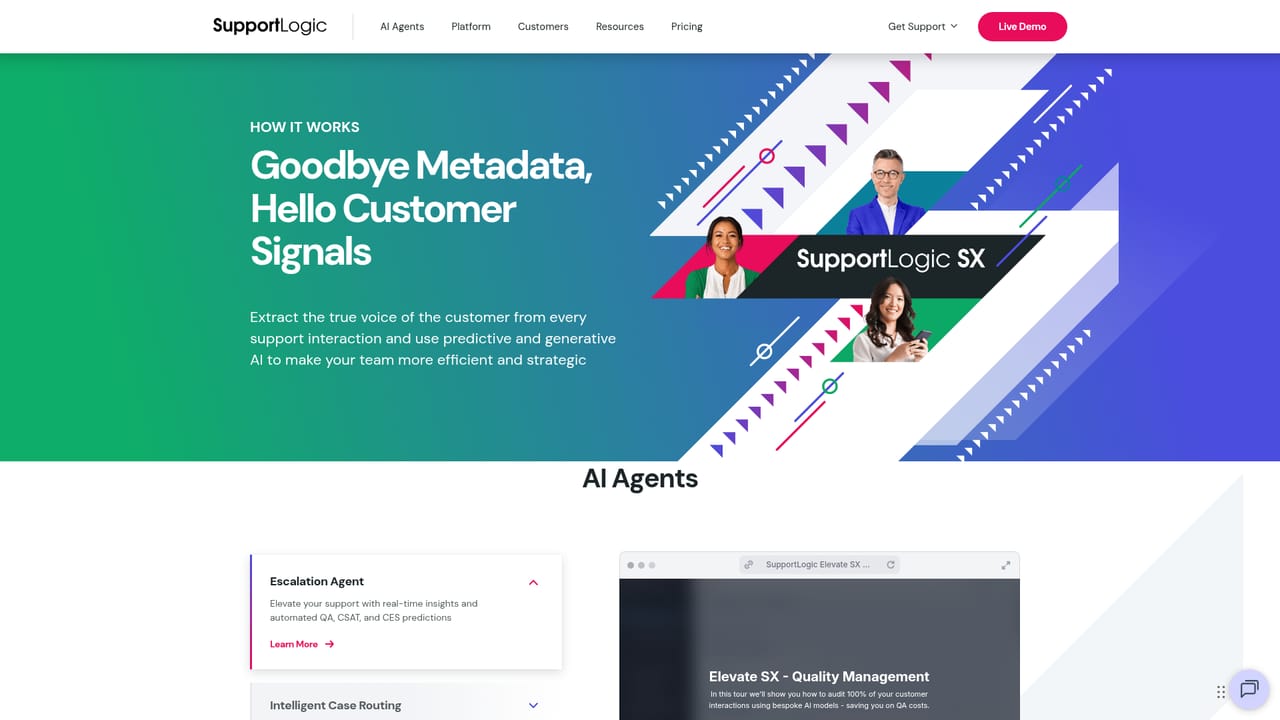
    Start on the platform page to understand the layers: ambient agents, foundation agents, systems of record and the open interfaces that connect them.
    Supportlogic — Review the platform architecture
  2. 2See the product in action
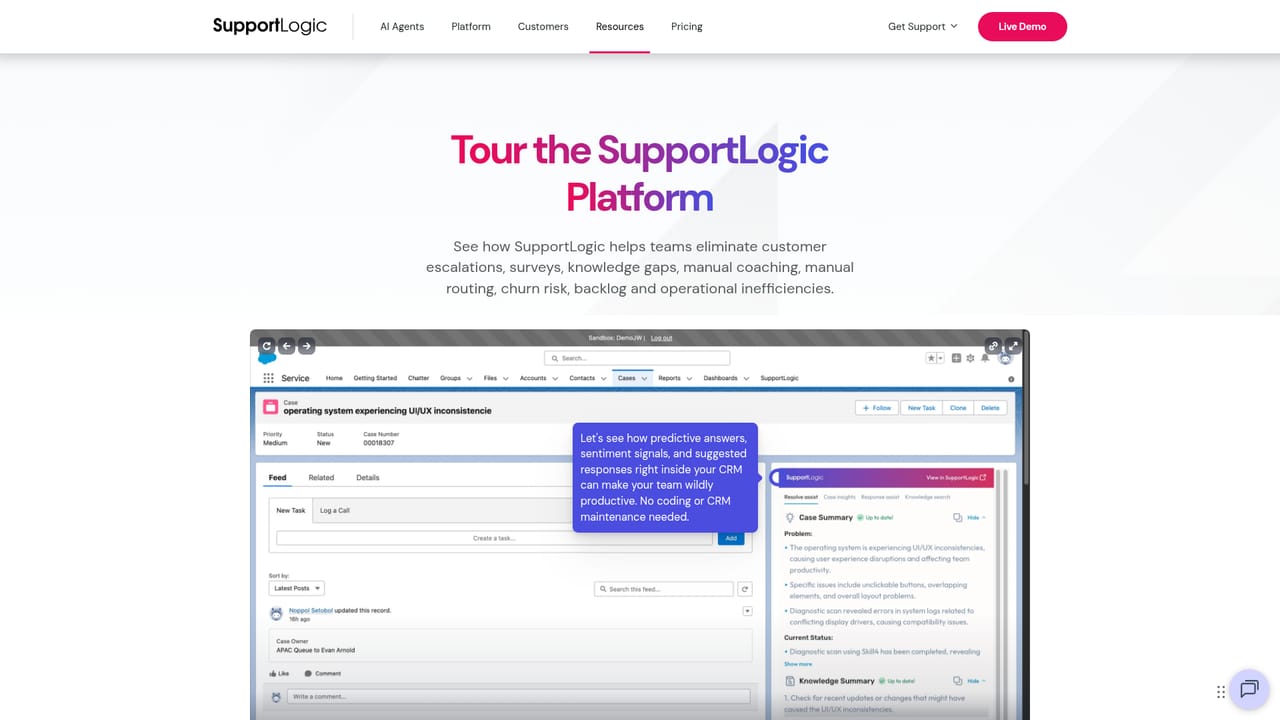
    Product tours walk through the Command Center, CRM widgets and the signals surfaced for operators and support leaders.
    Supportlogic — See the product in action
  3. 3Check customer outcomes
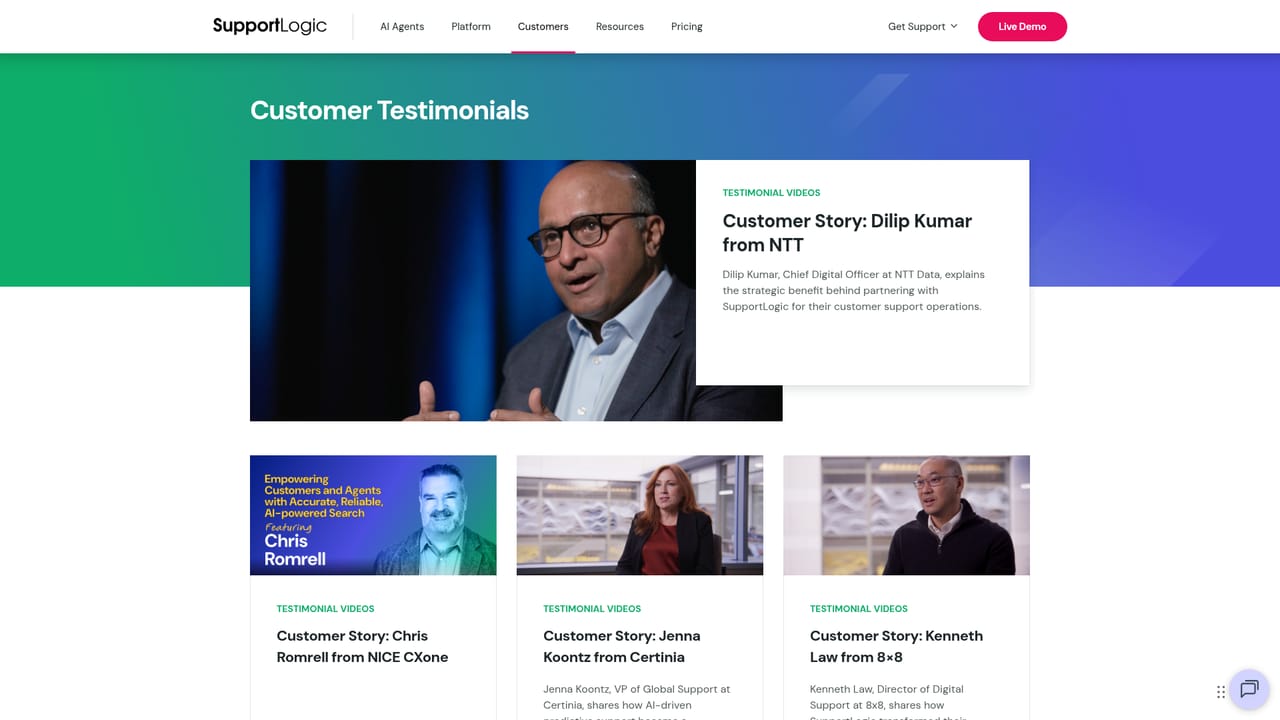
    Read testimonials and case studies to see how teams with similar stacks measure escalation, SLA and CSAT impact.
    Supportlogic — Check customer outcomes
  4. 4Book a demo
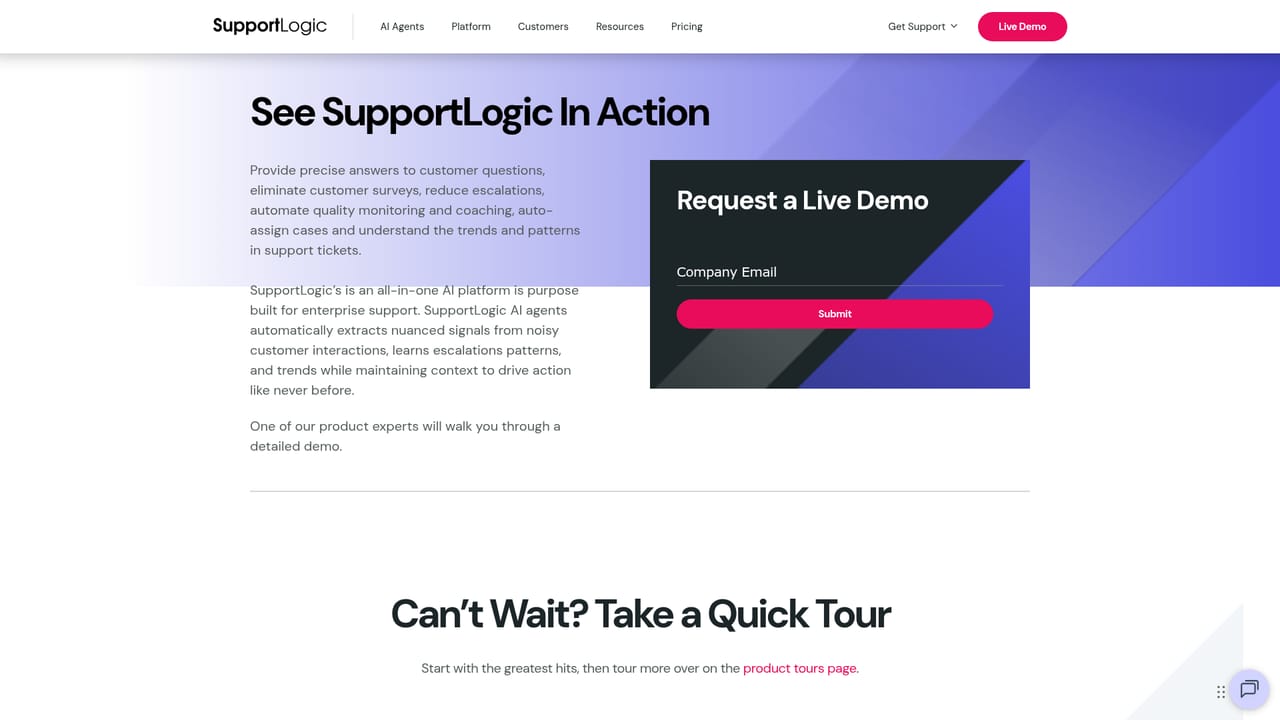
    Request a demo to discuss your CRM, contact center and warehouse setup and map which agents apply to your workflows.
    Supportlogic — Book a demo
  5. 5Connect systems and expose data
    After onboarding, connect CRMs, voice platforms and data lakes, then expose scores and signals through the MCP server, widgets or API.

Pros and cons

Pros

  • Works underneath existing CRMs and contact center tools instead of forcing a rip-and-replace.AI
  • Open access through MCP server, REST API and a Snowflake-native Data Cloud.AI
  • Broad agent coverage from sentiment and escalation to routing, coaching and knowledge.AI
  • CRM widgets let agents see signals inside Salesforce, Zendesk, ServiceNow, Jira and Freshdesk.AI
  • Vendor publishes production metrics from named customers such as Databricks and Coveo.AI

Cons

  • No public pricing, so cost can only be assessed through a sales conversation.AI
  • Value depends on connecting multiple systems and warehouses, which is a real implementation project.AI
  • The 16-agent catalog risks overlap with existing quality management and survey tools.AI
  • Published outcome numbers are vendor-selected customer stories, not independent benchmarks.AI
  • Heavy data and API surface may demand engineering and security review before rollout.AI

How much does Supportlogic cost?

Integrations

Connects to CRMs (Salesforce, Zendesk, ServiceNow, Jira, Dynamics, Freshdesk), voice and chat tools (NICE, Genesys, 8x8, Zoom, Webex, RingCentral), data lakes (Snowflake, BigQuery, S3, Oracle) and knowledge systems (Confluence, SharePoint, Salesforce Experience Cloud, MindTouch).

Learn more

Features

Cognitive AI Cloud with 16 ambient agents (sentiment, escalation, routing, coaching, knowledge, voice, account health, summarization), foundation agents for context, signal and data extraction, a Snowflake-native Data Cloud, MCP server, REST API, CRM widgets and a Command Center.

Learn more

Frequently asked questions about Supportlogic

  • Does Supportlogic have an API?
    Yes, Supportlogic offers an API.
  • How do you use Supportlogic?
    The walkthrough on this page covers 5 steps: 1. Review the platform architecture 2. See the product in action 3. Check customer outcomes 4. Book a demo 5. Connect systems and expose data.
  • What platforms does Supportlogic support?
    Supportlogic is available on Web App.
  • What does Supportlogic integrate with?
    Connects to CRMs (Salesforce, Zendesk, ServiceNow, Jira, Dynamics, Freshdesk), voice and chat tools (NICE, Genesys, 8x8, Zoom, Webex, RingCentral), data lakes (Snowflake, BigQuery, S3, Oracle) and knowledge systems (Confluence, SharePoint, Salesforce Experience Cloud, MindTouch).
  • What are the limitations of Supportlogic?
    No public pricing, so cost can only be assessed through a sales conversation. Value depends on connecting multiple systems and warehouses, which is a real implementation project. The 16-agent catalog risks overlap with existing quality management and survey tools.

Status

StatusActive
Views0
Outbound clicks0
Added10/21/2026

Platforms

Web App

Pricing

Paid