Tray.io

AI-ready iPaaS for integrations, agents, MCP and governed apps

Advanced API
Screenshot of Tray.io, AI-ready iPaaS for integrations, agents, MCP and governed apps

What is Tray.io?

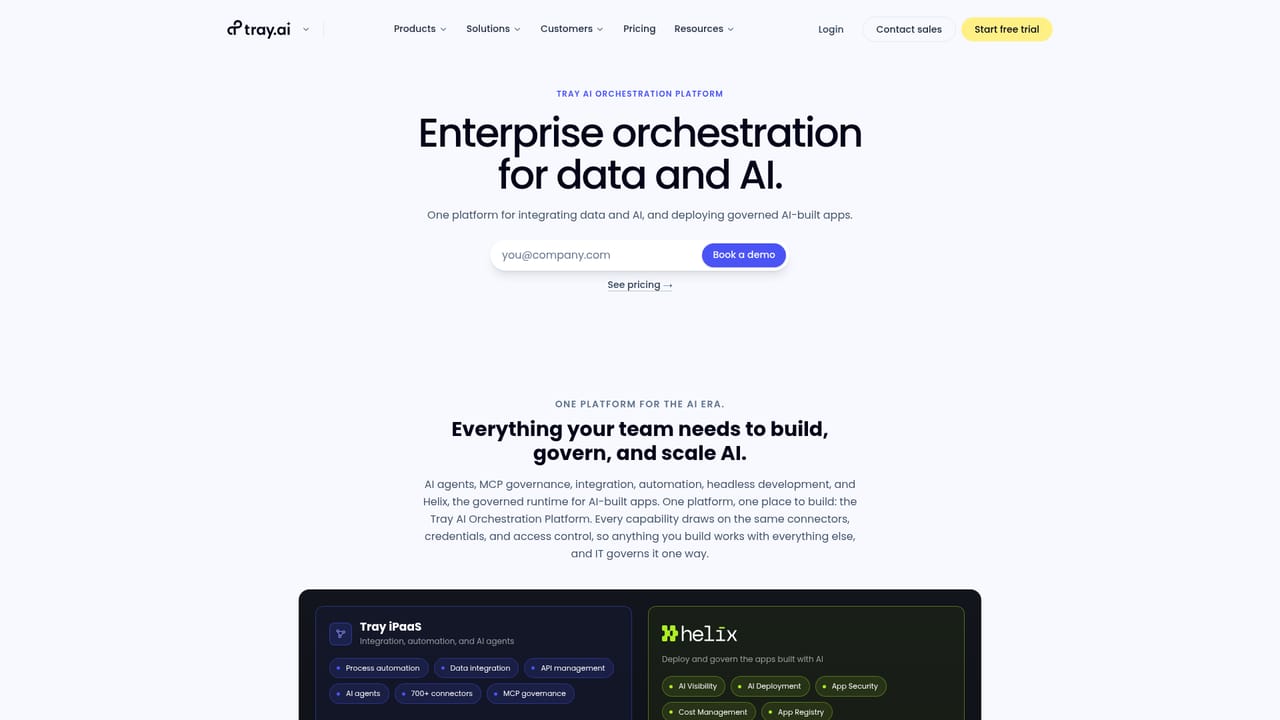
Tray.io is a meta AI automation tool. An enterprise-grade iPaaS that unifies integrations, automations, AI agents and MCP governance behind 700+ connectors and one shared credential and audit layer, plus a managed runtime for deploying AI-built apps.

Tray.ai is an AI-native integration and automation platform aimed at engineering, RevOps and platform teams who need to connect a large software estate and then run AI on top of it. The core pitch is consolidation: more than 700 connectors sit behind a single credential store and a single access model, so an integration, an automation, an agent tool call or a vibe-coded app all draw on the same permission layer. That shared foundation is what separates Tray from stitching together a workflow tool, a separate agent builder and a standalone MCP gateway. The platform splits into three practical surfaces. Tray iPaaS covers traditional integration and process automation work, with data pipelines, API management and a visual low-code canvas called Tray Build alongside a headless mode that works with Claude Code, Codex and other coding assistants. Merlin Agent Builder handles conversational and autonomous agents, including guardrails and a composable agent hub. Agent Gateway governs Model Context Protocol traffic, exposing any connector as a managed, audited tool. A separate product line, Tray Helix, targets the deployment problem for AI-built apps: one command moves an app from a coding assistant into a managed runtime with SSO, per-app cost attribution and an internal registry. In day to day use, a team typically wires a source system to a destination, then layers an agent on the same connectors rather than rebuilding authentication. Governance is the differentiator throughout: ownership is recorded on every artifact, credentials are scoped, and every workflow run, tool call and agent action lands in one audit trail. Tray competes with legacy iPaaS vendors on integration breadth and with newer agent orchestration startups on AI features. It is a better fit for organizations with real compliance pressure than for individuals who just want a quick two-app zap. Expect a learning curve, real onboarding effort and enterprise-style sales conversations before you see value.

How do you use Tray.io?

  1. 1Read the platform overview first
    Start on the platform page to map the four surfaces (iPaaS, Merlin Agent Builder, Agent Gateway, Helix) against what your team actually needs, before requesting a demo.
    Tray.io — Read the platform overview first
  2. 2Pick your entry point
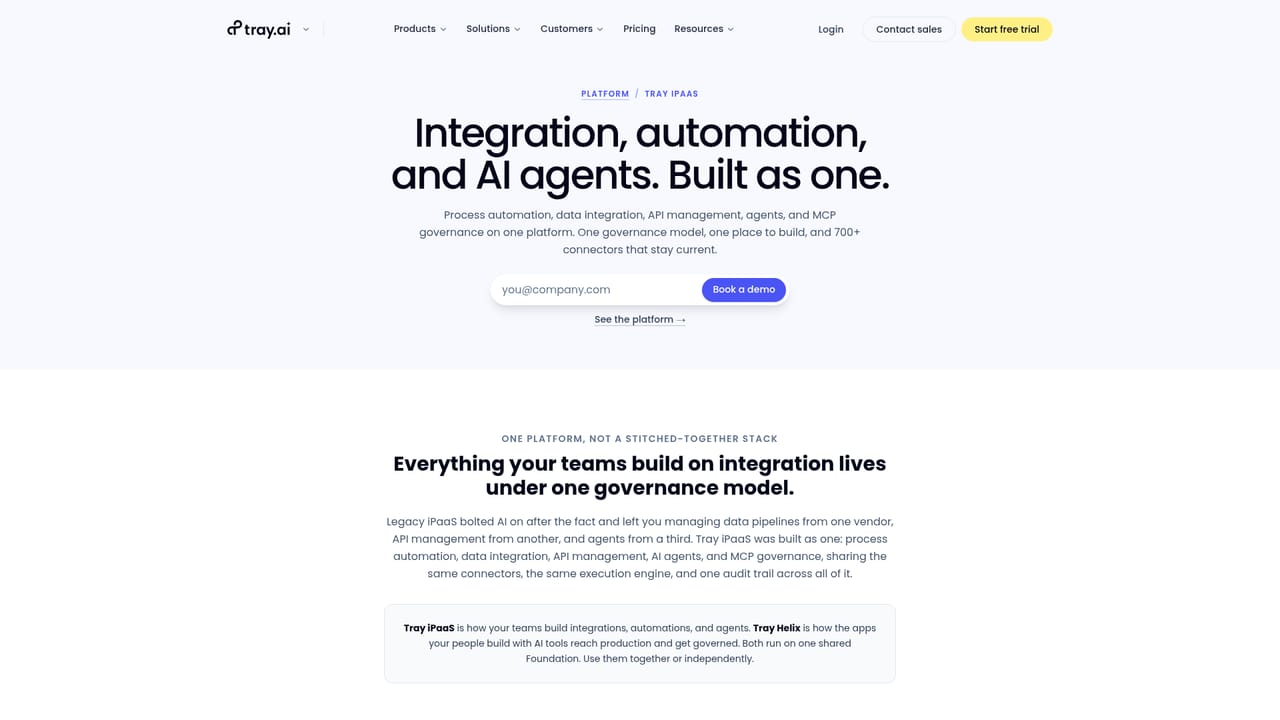
    Choose the iPaaS page for integration and process automation work, or the Merlin Agent Builder page if agents are the first goal. Each lays out the building blocks for that surface.
    Tray.io — Pick your entry point
  3. 3Connect systems through the shared connector layer
    In the product, authenticate your source and destination services once. The same credential store then serves workflows, agents and MCP tools, so you do not repeat auth per project.
  4. 4Build and test an agent or automation
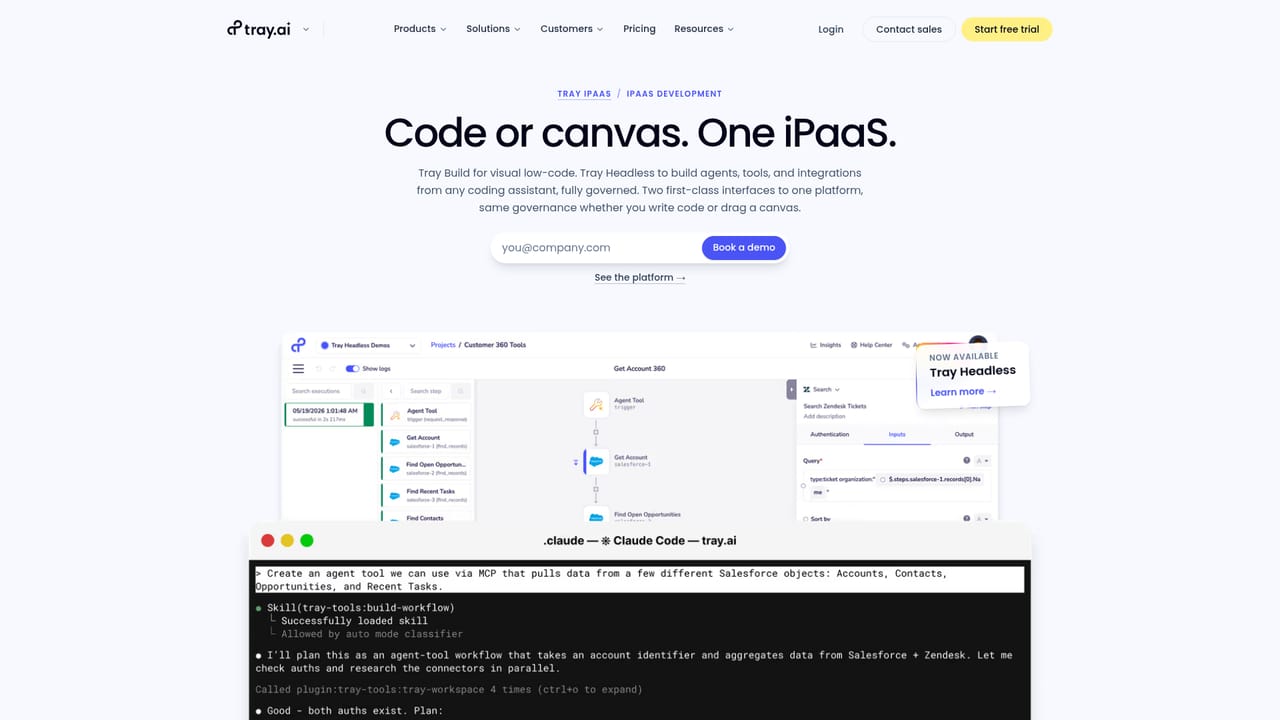
    Use the visual canvas for low-code builds or the headless mode with your coding assistant. Add guardrails and scope credentials before promoting anything beyond a test run.
    Tray.io — Build and test an agent or automation
  5. 5Deploy governed and review the audit trail
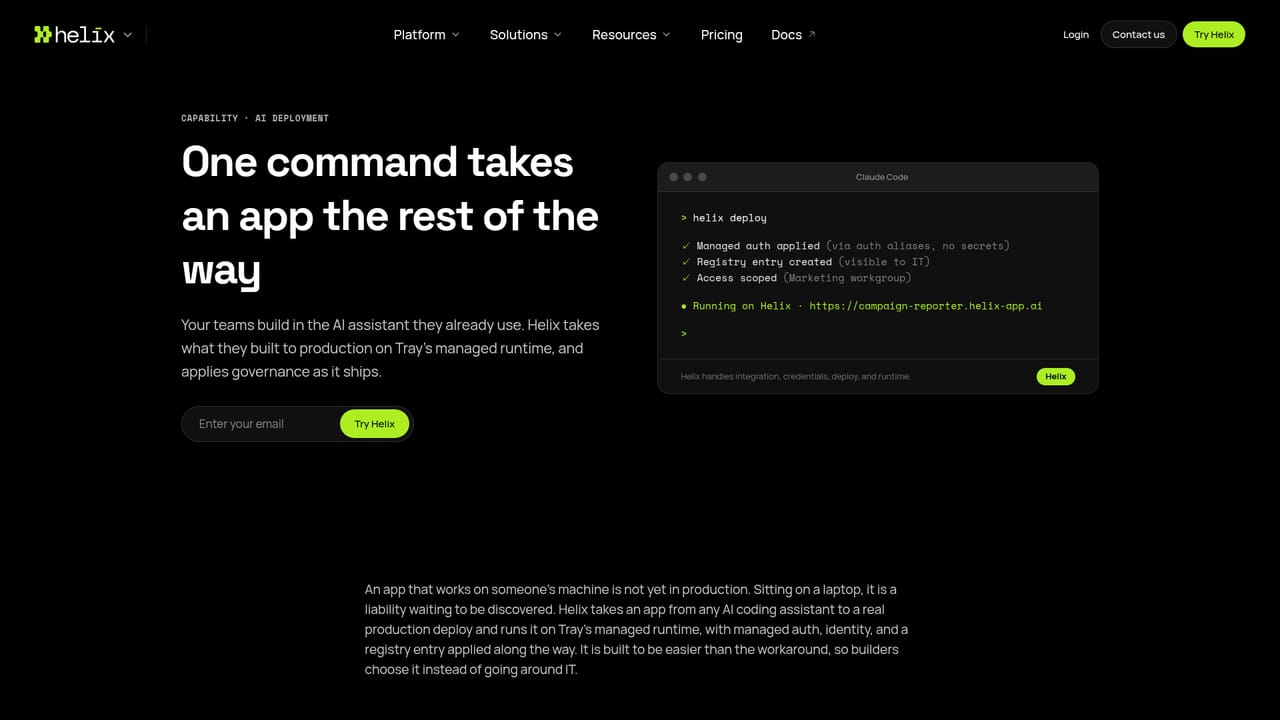
    For AI-built apps, push to the managed runtime and confirm SSO, ownership records and per-app spend limits are in place, then watch activity in the visibility pane.
    Tray.io — Deploy governed and review the audit trail
  6. 6Discuss pricing with the team
    Pricing is not published as a rate card, so use the pricing page to see the plans and then work through volume and connector needs with sales.

Pros and cons

Pros

  • Over 700 connectors share one credential store and one access model, so agents and automations reuse the same authAI
  • Governance is built in rather than bolted on: ownership per artifact, scoped credentials and one audit trail across workflows, agents and MCP callsAI
  • Covers both no-code canvas work and headless development with Claude Code, Codex and similar assistantsAI
  • Tray Helix addresses a real gap by taking vibe-coded apps to production with SSO, cost caps and an internal app registryAI
  • Backed by repeated analyst recognition and published customer results in lead routing and integration delivery speedAI

Cons

  • Enterprise positioning and consultative sales mean individuals and small teams will find it heavy relative to simpler automation toolsAI
  • The platform spans iPaaS, agent building, MCP gateway and app runtime, so the surface area to learn is large and onboarding is not trivialAI
  • Governance features only pay off at organizational scale; smaller deployments carry the overhead without the benefitAI
  • Value depends on the connectors your stack actually needs, and the site does not publish a full connector list with per-connector depthAI
  • Many headline metrics come from vendor analysis or third-party studies rather than independent benchmarkingAI

How much does Tray.io cost?

Pricing

The site has a pricing page, but the homepage does not state plan tiers, per-task rates or starting prices. Tray reads as a sales-led enterprise purchase, and the homepage references cost consolidation and payback rather than published list pricing. Confirm details on the pricing page or with sales.

Learn more

Integrations

More than 700 connectors plus support for any API, all sharing one credential store. Any connector can be exposed as a governed tool through the MCP gateway, so agents and workflows reuse the same connections.

Learn more

Features

Connectors for 700+ services plus any API, a shared credential store and access model, visual low-code building via Tray Build and headless development for coding assistants, Merlin Agent Builder for conversational and autonomous agents, an Agent Gateway for governed MCP servers, and governance covering ownership, scoped credentials, audit trails, RBAC, analytics and compliance. Tray Helix adds deployment, visibility, app security, cost management and an app registry.

Learn more

Frequently asked questions about Tray.io

  • How much does Tray.io cost?
    The site has a pricing page, but the homepage does not state plan tiers, per-task rates or starting prices. Tray reads as a sales-led enterprise purchase, and the homepage references cost consolidation and payback rather than published list pricing. Confirm details on the pricing page or with sales.
  • Does Tray.io have an API?
    Yes, Tray.io offers an API.
  • How do you use Tray.io?
    The walkthrough on this page covers 6 steps: 1. Read the platform overview first 2. Pick your entry point 3. Connect systems through the shared connector layer 4. Build and test an agent or automation 5. Deploy governed and review the audit trail 6. Discuss pricing with the team.
  • What platforms does Tray.io support?
    Tray.io is available on Web App.
  • What does Tray.io integrate with?
    More than 700 connectors plus support for any API, all sharing one credential store. Any connector can be exposed as a governed tool through the MCP gateway, so agents and workflows reuse the same connections.
  • What are the limitations of Tray.io?
    Enterprise positioning and consultative sales mean individuals and small teams will find it heavy relative to simpler automation tools. The platform spans iPaaS, agent building, MCP gateway and app runtime, so the surface area to learn is large and onboarding is not trivial. Governance features only pay off at organizational scale; smaller deployments carry the overhead without the benefit.

Status

StatusActive
Views0
Outbound clicks0
Added10/21/2026

Platforms

Web App

Pricing

PaidSubscription