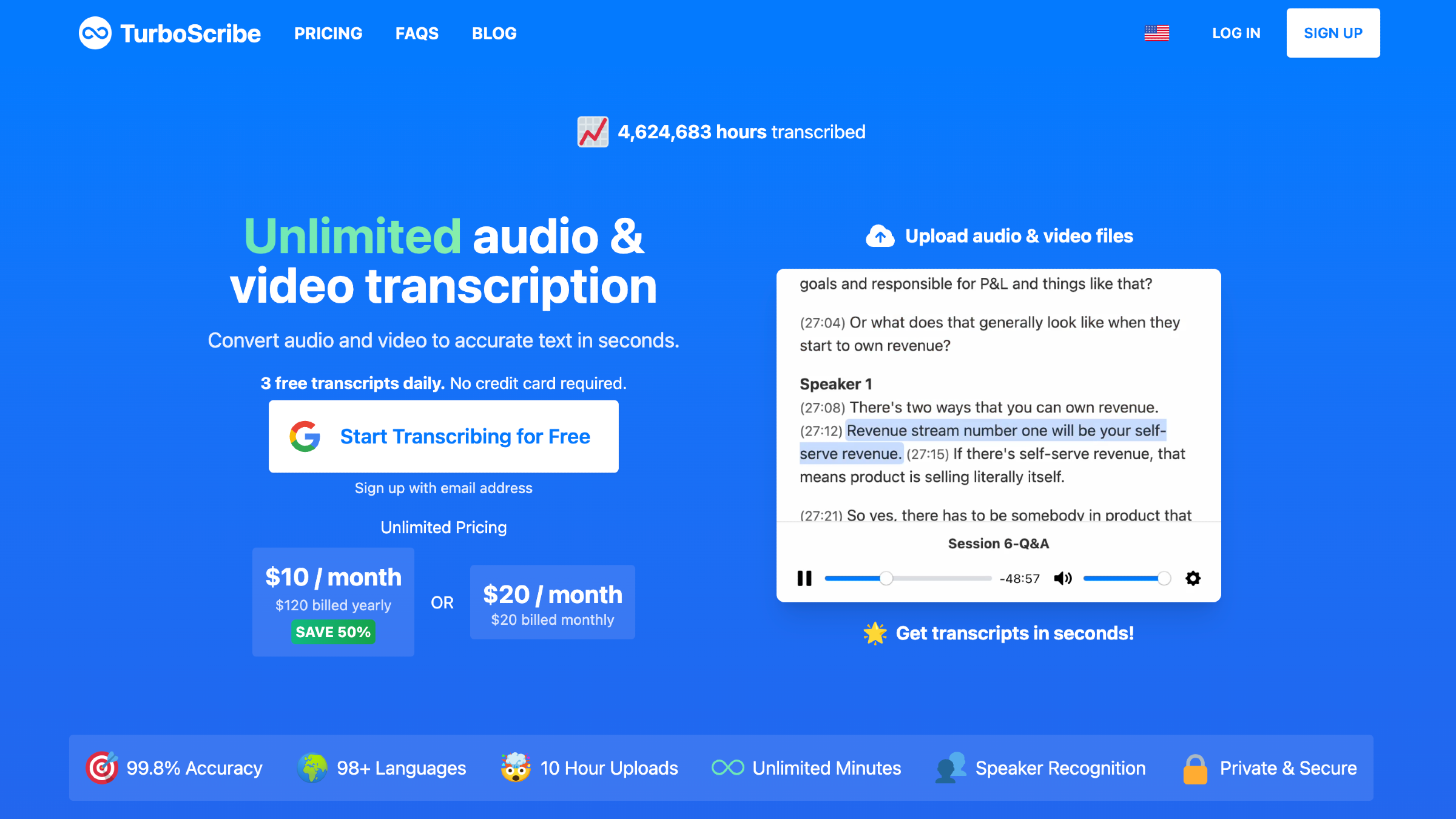
TurboScribe is a web-based transcription tool built on OpenAI's Whisper model. It converts audio and video files into text, offering automatic speaker labeling, translation, and export into several document and subtitle formats. The tool targets anyone who needs spoken content turned into readable, searchable, or captioned text without manually transcribing recordings by hand.
In practice, a user drags an audio or video file onto the homepage (formats include MP3, MP4, M4A, MOV, AAC, WAV, OGG, OPUS, MPEG, and WMA), picks the spoken language from a list of 98+ options, and optionally turns on speaker recognition, direct-to-English transcription, or an AI audio-restoration pass for noisy recordings. The GPU-based engine then returns a transcript within seconds rather than the hours some competing services take. Finished transcripts and subtitles can be downloaded as DOCX, PDF, TXT, SRT, or VTT files, and the platform also offers built-in translation of transcripts into 134+ languages.
TurboScribe is aimed at journalists, podcasters, students, researchers, and anyone handling interviews, lectures, meetings, or long-form video who wants a text version quickly. Free users get three transcripts a day, capped at 30-minute files uploaded one at a time with lower processing priority. The paid Unlimited tier removes the daily cap entirely, supports files up to 10 hours or 5 GB, allows batches of up to 50 files, and adds unlimited cloud storage plus priority processing.
Within the transcription-tool category, TurboScribe positions itself around raw throughput and volume, marketing itself as having no caps or quotas on minutes transcribed, which sets it apart from services that charge or limit by the minute. Buyers comparing options should weigh its per-person pricing and Whisper-based accuracy against tools that add meeting-specific workflow features, real-time transcription, or team collaboration, none of which are described on TurboScribe's homepage.