Free trial
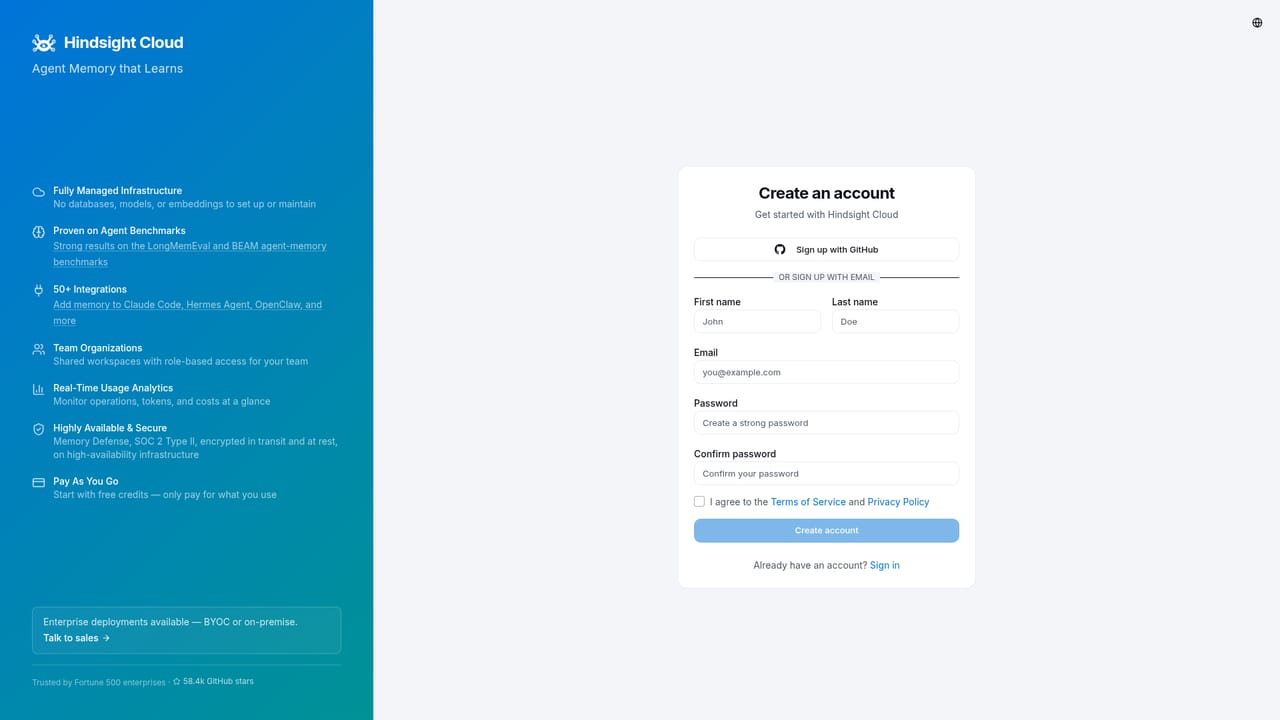
Hindsight Cloud is offered with a free start through the signup page, and the open source edition can be self-hosted at no license cost. No trial duration or usage allowance is stated on the homepage.
Learn moreOpen source memory layer that lets AI agents learn from mistakes

Vectorize.io is a developer tool. Hindsight by Vectorize is an open source, MIT licensed memory layer for AI agents. It stores per-user context across sessions, learns from failed tool calls and corrections through a reflection layer, and plugs into coding agents, personal agents or your own apps via SDKs, MCP or HTTP.
Vectorize's Hindsight is a memory layer for AI agents, built around a simple premise: storing and retrieving facts is not the same as learning. Most memory systems act as a lookup table, so an agent can recall that a tool call failed without ever changing how it behaves next time. Hindsight adds a reflection layer on top of retrieval. Failed tool calls and user corrections are kept as experiences, and the system consolidates raw observations into reusable knowledge, so patterns surface from the data instead of from manual tagging. The product covers per-user memory, where preferences and history stay separated by user, and cross-session persistence, so context survives across weeks of separation. Recall runs as parallel search and the team reports sub-100ms returns. The memory layer is model-agnostic, which means swapping the underlying LLM does not wipe out what the agent has learned. Hindsight is MIT licensed and runs on Postgres; a single Docker command puts it on your own infrastructure. A managed cloud option handles scaling, backups and upgrades on pay-as-you-go usage, and an enterprise tier adds private or bring-your-own-cloud deployment, single-tenant isolation, SSO, audit logs and SLAs. A separate Rust engine, Memlake, targets memory volumes in the billions using object storage. In practice, teams reach Hindsight through three paths. Coding agents get project memory from one npx install that wires Claude Code, Codex CLI, Cursor CLI and other harnesses to a per-repo memory bank built from git history and past sessions. Personal agents such as Hermes and OpenClaw set it up as their memory provider, recalling context before each turn and retaining it afterwards. Custom applications use three primitives (retain, recall and reflect) from Python, TypeScript or Go over MCP or plain HTTP, with extraction, entity linking, four-way retrieval and reranking handled behind the API. The fit is narrow but deep. Hindsight competes with vector database memory add-ons and hosted memory APIs rather than with general agent builders. Teams that want a self-hosted, open source memory engine with published benchmark results and no vendor lock-in to a model provider are the core audience. The team publishes retrieval accuracy comparisons including 94.6% on LongMemEval-S and 92.0% on LoComo, and publishes a comparison only where a competing system has one.
Hindsight Cloud is offered with a free start through the signup page, and the open source edition can be self-hosted at no license cost. No trial duration or usage allowance is stated on the homepage.
Learn moreThree deployment paths share one engine and API. Hindsight 1.0 is open source under MIT and runs on your own Postgres via a Docker command. Hindsight Cloud is fully managed and billed pay-as-you-go on usage. Hindsight Enterprise adds private cloud, BYOC on AWS, Google Cloud or Azure, or on-premises deployment; pricing is quoted by sales.
Learn moreA Slack community offers direct help from the team, and Vectorize sells hands-on implementation services, team training and architecture consulting. Enterprise plans add a shared Slack channel, contracted support and SLAs up to 99.95%.
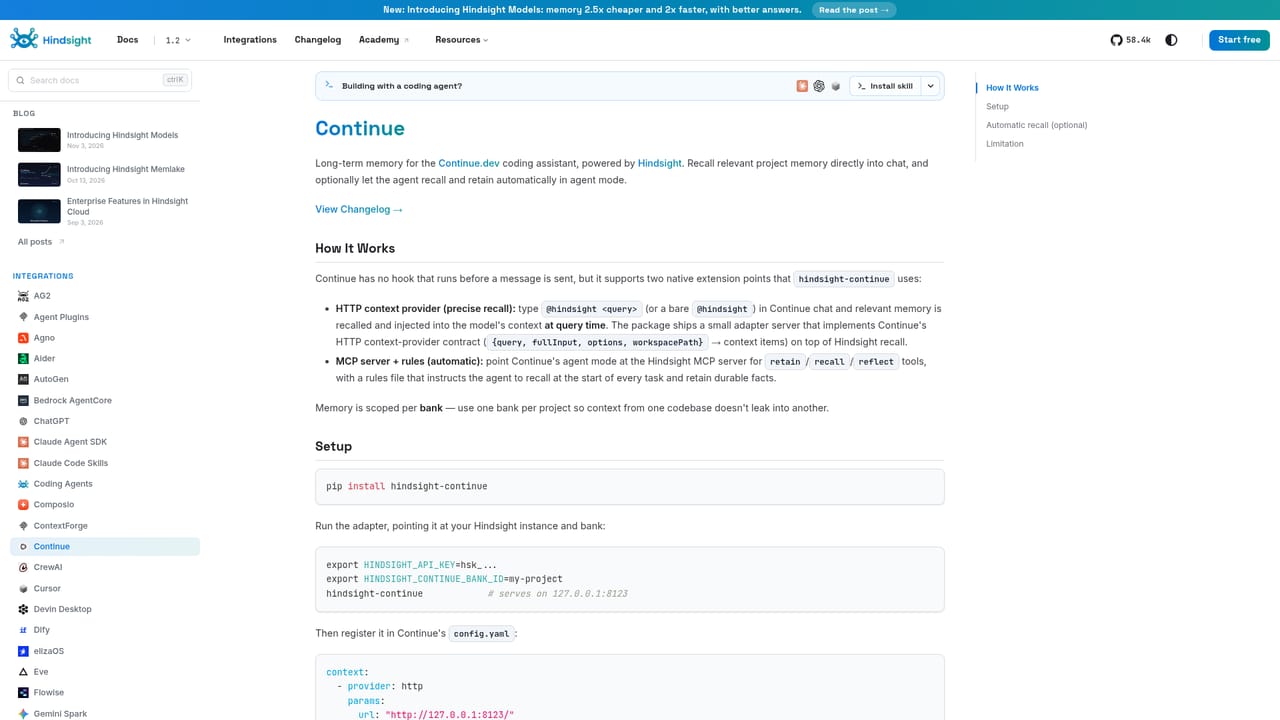
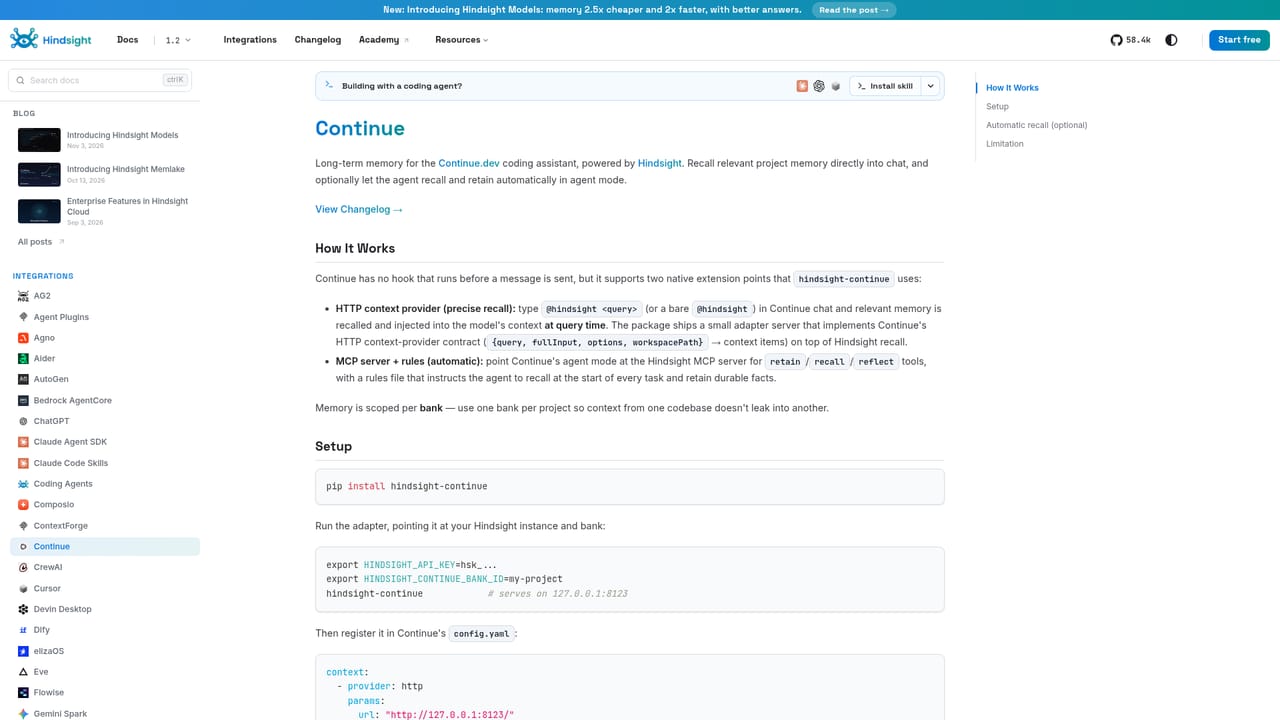
Learn moreOne installer wires 20+ coding agent harnesses including Claude Code, Codex CLI, Cursor CLI, opencode and Copilot CLI to per-repo memory. Hermes and OpenClaw use Hindsight as a memory provider, and frameworks, MCP servers and tools are catalogued in the Integrations Hub.
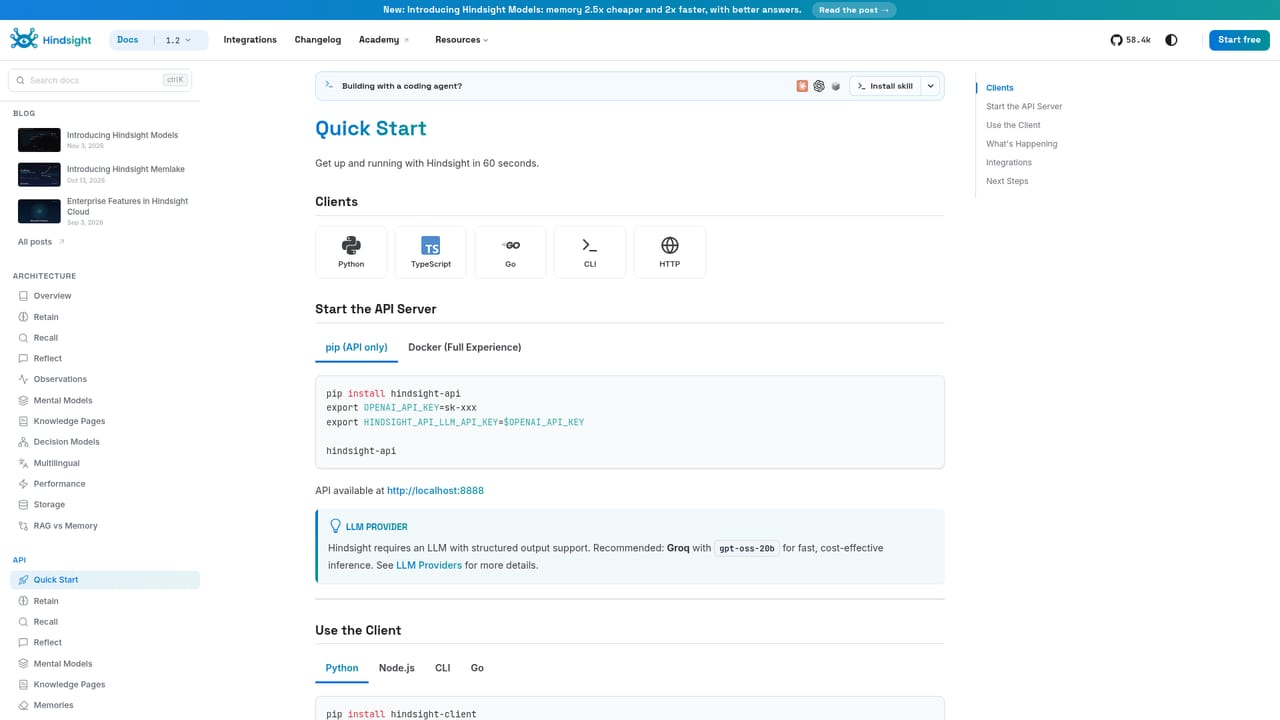
Learn morePer-user memory with persistent context, cross-session persistence, parallel recall returning relevant memories in under 100ms, a reflection layer that consolidates observations into knowledge, automatic pattern detection, and a model-agnostic layer. Three primitives (retain, recall, reflect) work from Python, TypeScript or Go over MCP or HTTP.
 AI Angels400+ customizable AI girlfriends for NSFW chat, voice calls, and roleplay
 Candy AIExperience the future of companionship with AI friends who chat, role-play, and connect with you on a human level.
 ourdream.aiA vast AI roleplay platform with millions of characters for chat, images, video and voiceAI Angels400+ customizable AI girlfriends for NSFW chat, voice calls, and roleplayCandy AIExperience the future of companionship with AI friends who chat, role-play, and connect with you on a human level.ourdream.aiA vast AI roleplay platform with millions of characters for chat, images, video and voice


