
Hedgineer

A governed AI layer built for hedge funds and asset managers

Advanced
Screenshot of Hedgineer, A governed AI layer built for hedge funds and asset managers

What is Hedgineer?

Hedgineer is a governed AI platform for hedge funds and asset managers, deployed into the fund's own cloud with agents, skills, usage observability and review workflows, delivered through a 90 day engagement that also automates 2 to 3 key workflows and trains internal staff.

Hedgineer is a governed AI platform aimed squarely at investment firms, specifically hedge funds and asset managers that have already experimented with frontier models but struggle to push those experiments into production. Rather than selling a standalone chatbot, it positions itself as an AI layer that the fund owns, deployed directly into the firm's own cloud environment. Agents, skills, workflows and connectors built on the platform stay inside that environment and are not exported to outside vendors. The delivery model is unusual for a software directory entry. Hedgineer describes a 90 day engagement run by one team of engineers, financial analysts and product specialists working across three parallel tracks. First the platform is deployed into the client's cloud. Second, two or three high value workflows are automated end to end, with MCP connectors, skills and agents built directly into the firm's instance. Third, the vendor runs teach-ins on tools such as Claude and Codex so internal staff can eventually build and own their own agents. That makes it a fit for funds with fragmented AI pilots, portfolio systems, research tooling and custom automations sitting in silos. Governance is the core selling point. The platform tracks AI usage across subscriptions such as Claude Enterprise and ChatGPT Teams, can flag PII or MNPI detection issues, and routes every skill and agent modification through a review process with stakeholder sign-off before changes go live. A diff view shows reviewers what changed and why, which matters when a skill silently switches to stale factor model data. Separate engagement reports give individuals scores on workflow sophistication, intent clarity and cost efficiency, while managers see adoption trends and gaps across teams. Where it fits: this is not a self-serve tool you sign up for and use the same afternoon. It is closer to a managed platform engagement, competing with in-house platform engineering or general purpose LLM gateways rather than with consumer research assistants. Expect a procurement and onboarding cycle, and expect the value to depend on how well the vendor's first workflow automations land.

How do you use Hedgineer?

  1. 1Request a demo through the site
    Start by emailing the team from the Get started link to arrange a walkthrough. The site does not offer self-serve signup, so this conversation sets the scope for a potential engagement.
    Hedgineer — Request a demo through the site
  2. 2Review the platform capabilities
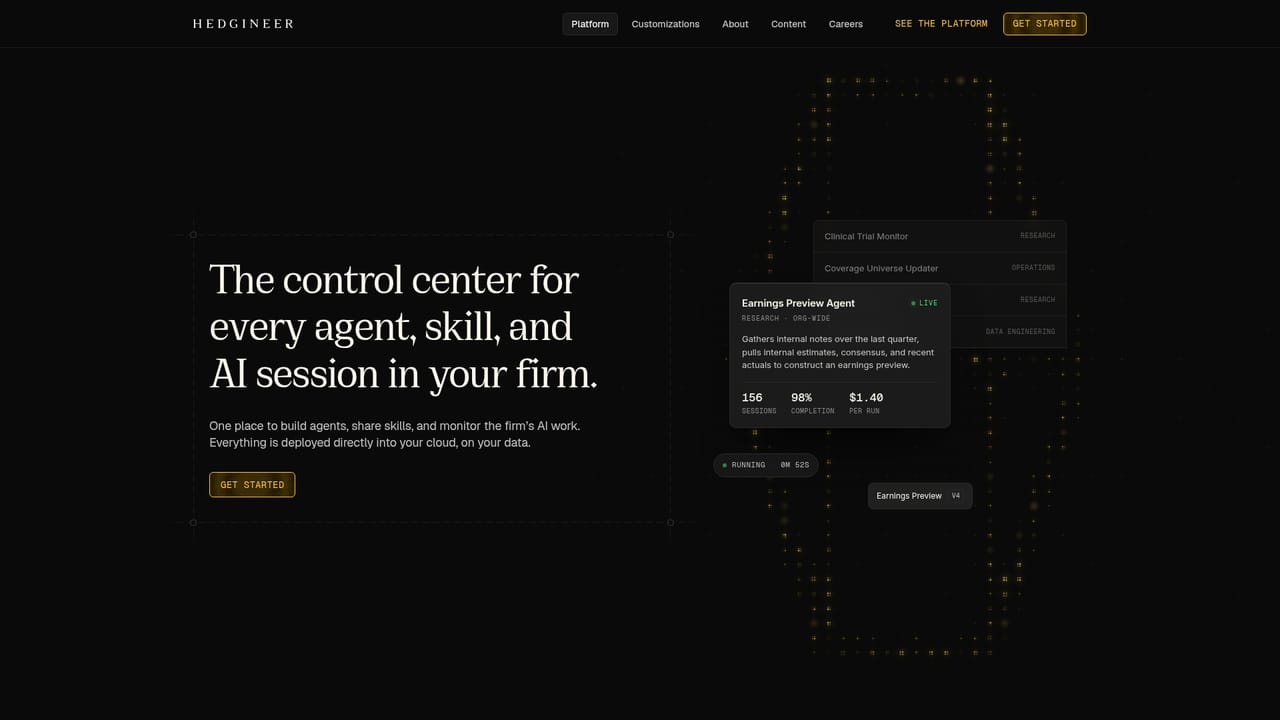
    Read the platform page to understand how agents, skills, observability and automation fit together before discussing deployment options.
    Hedgineer — Review the platform capabilities
  3. 3Map your workflows to customization patterns
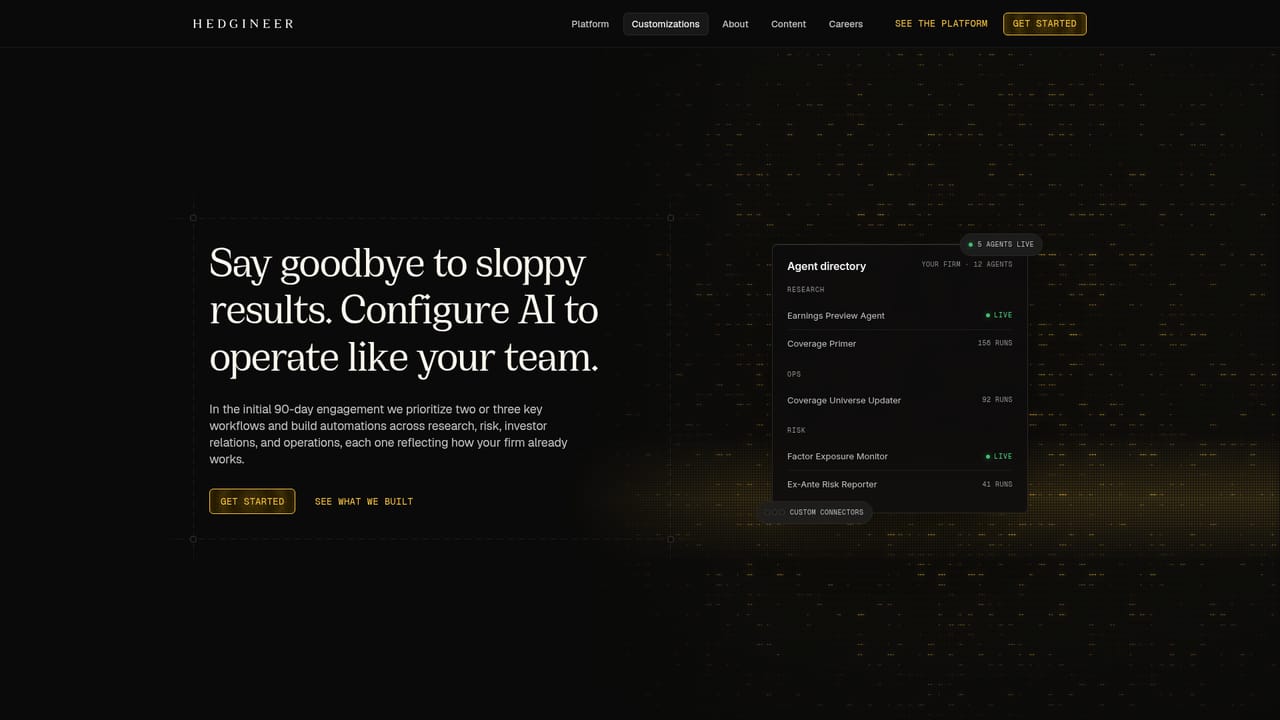
    Look at the customizations page to see the kinds of workflows that get automated end to end and which connectors and skills are involved.
    Hedgineer — Map your workflows to customization patterns
  4. 4Deploy into your cloud environment
    During onboarding the Hedgineer team deploys the platform inside your own cloud, so agents and skills stay under your control. This step happens after the engagement begins, inside your infrastructure.
  5. 5Set up governance and reviews
    Configure the approval flow so skill and agent modifications route to the right stakeholders, and turn on usage tracking across your AI subscriptions. This is configured inside your instance after deployment.
  6. 6Read the team's notes and build skills
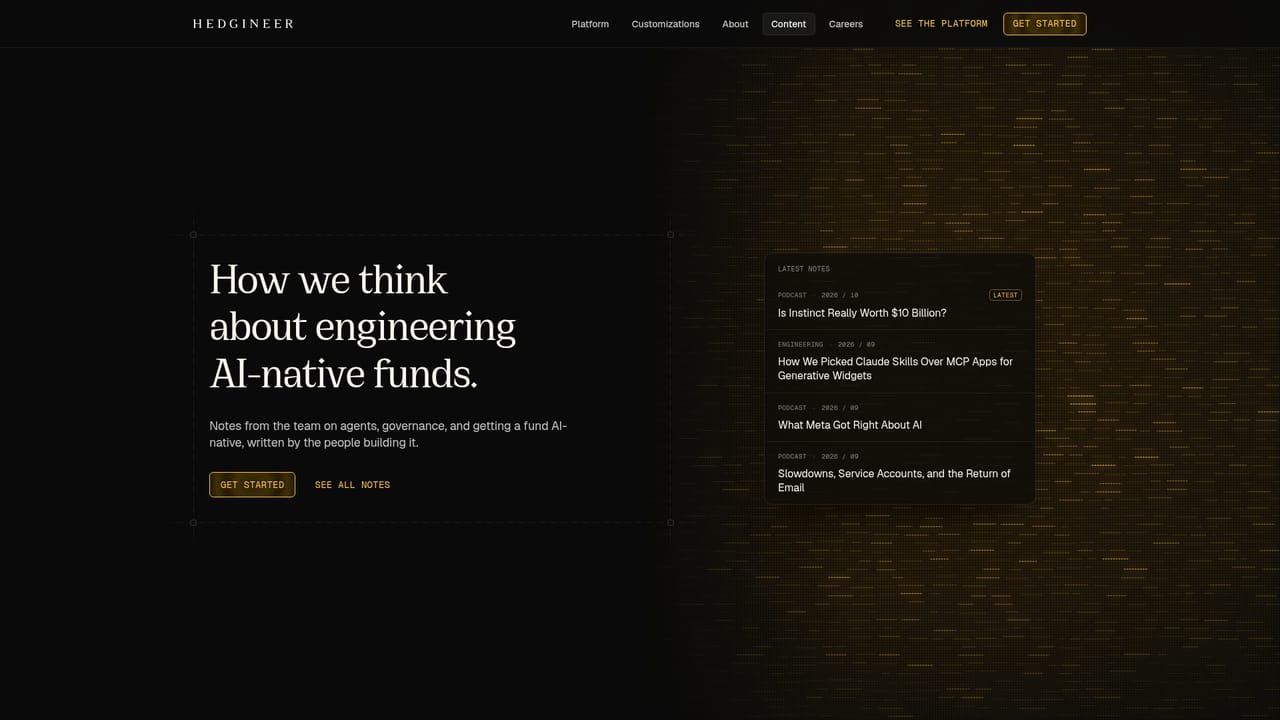
    Use the published content to prepare your team, then take part in the teach-ins so internal staff can start building and owning agents themselves.
    Hedgineer — Read the team's notes and build skills

Pros and cons

Pros

  • Runs inside the fund's own cloud environment, so agents and skills are owned rather than exported to a third party vendorAI
  • Built-in governance layer with review and approval for every skill and agent change, plus a diff view showing what changedAI
  • Tracks usage across multiple AI subscriptions and flags PII or MNPI issues in one placeAI
  • Engagement model combines platform deployment, hands-on workflow automation and teach-ins so staff can build laterAI
  • Engagement review reports score individuals on intent clarity, iteration and cost efficiency, giving managers concrete adoption dataAI

Cons

  • No self-serve signup or published pricing: access starts with an email demo request, which slows evaluationAI
  • The 90 day kickoff-to-live timeline is a commitment, not a quick trial, and suits firms with budget and IT capacityAI
  • Only the first 2 to 3 workflows are automated by the vendor team, so broader value depends on internal staff picking up the build skillsAI
  • Cost reporting is described as partial in the sample report, since some session types are not priced and totals are a lower boundAI
  • Aimed narrowly at investment firms, so teams outside asset management get little from the governance and data integrationsAI

How much does Hedgineer cost?

Support

Support comes through the engagement itself: a single team of engineers, financial analysts and product specialists runs deployment, workflow automation and teach-ins on tools such as Claude and Codex. Public contact is by email at info@hedgineer.ai.

Learn more

Integrations

The homepage lists connectors and partners including Anthropic, OpenAI, AWS, Google Cloud, Microsoft, Snowflake, Databricks, Slack, Linear, Bloomberg, FactSet, S&P Global, PitchBook, Barra, Enfusion and Wolfe. Hedgineer builds MCP connectors into each client's instance during onboarding.

Learn more

Features

A platform for building and running agents, skills and workflows inside the fund's own cloud, with MCP connectors to existing systems. Governance covers approval workflows for every skill and agent change, a diff view of modifications, usage tracking across AI subscriptions, and PII or MNPI flagging. Engagement reporting scores individual AI usage and surfaces adoption trends for managers.

Learn more

Frequently asked questions about Hedgineer

  • How do you use Hedgineer?
    The walkthrough on this page covers 6 steps: 1. Request a demo through the site 2. Review the platform capabilities 3. Map your workflows to customization patterns 4. Deploy into your cloud environment 5. Set up governance and reviews 6. Read the team's notes and build skills.
  • What platforms does Hedgineer support?
    Hedgineer is available on Web App.
  • What does Hedgineer integrate with?
    The homepage lists connectors and partners including Anthropic, OpenAI, AWS, Google Cloud, Microsoft, Snowflake, Databricks, Slack, Linear, Bloomberg, FactSet, S&P Global, PitchBook, Barra, Enfusion and Wolfe. Hedgineer builds MCP connectors into each client's instance during onboarding.
  • What are the limitations of Hedgineer?
    No self-serve signup or published pricing: access starts with an email demo request, which slows evaluation. The 90 day kickoff-to-live timeline is a commitment, not a quick trial, and suits firms with budget and IT capacity. Only the first 2 to 3 workflows are automated by the vendor team, so broader value depends on internal staff picking up the build skills.

Status

StatusActive
Views0
Outbound clicks0
Added10/22/2026

Platforms

Web App

Pricing

Paid