Free trial
The homepage offers a Start Trial link that opens the Qodo app, but it does not state the trial length or which plan features are included.
Learn moreAI code review with full codebase context and governed standards
Own Qodo (Formerly Codium)? Verify ownership to get a dofollow link

Qodo (Formerly Codium) is a code modifier tool. Qodo (formerly Codium) reviews pull requests with agents that read the whole codebase, enforces rules mined from your PR history, and extends the same standards into the IDE and agent workflows. Aimed at engineering teams whose review process cannot keep pace with AI-generated code.
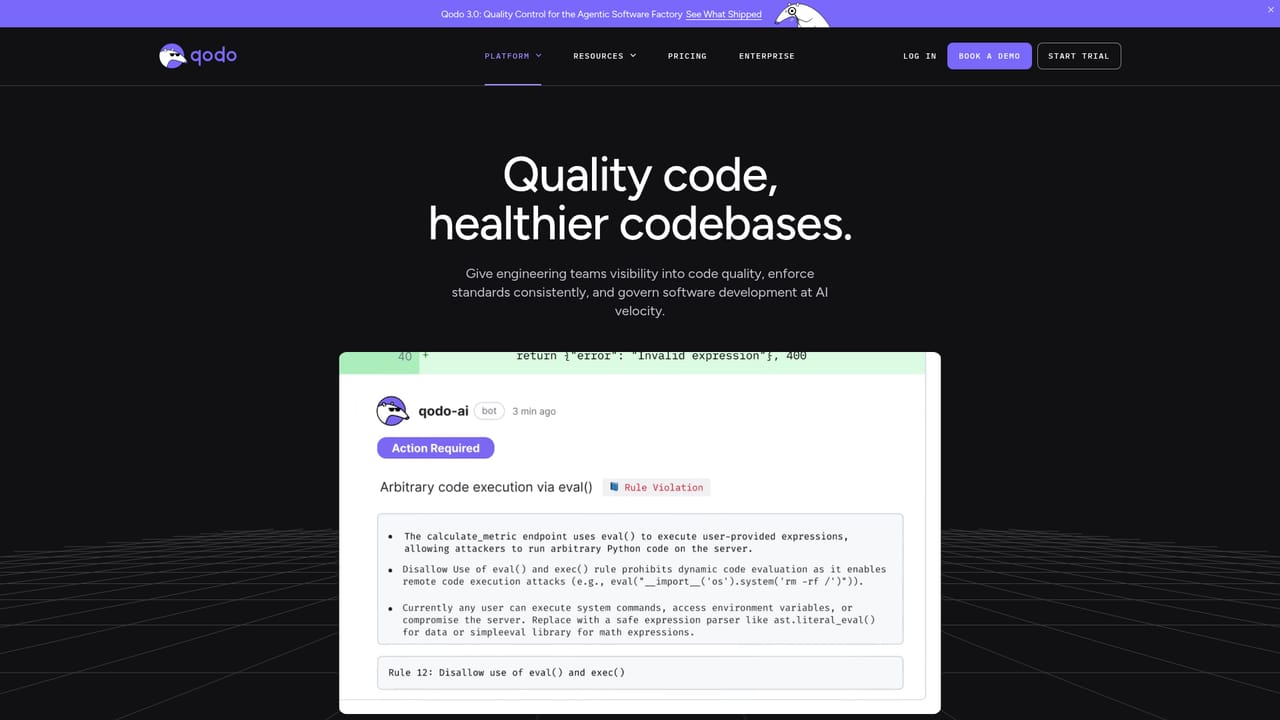
Qodo is an AI code review and governance platform built for engineering teams that are shipping code faster than humans can check it. It runs specialized review agents on every pull request, reasoning over the full codebase rather than just the diff, so findings reflect how a change actually fits into the wider system. The same context and standards carry into the IDE, where developers get validation and fixes while they write rather than after they push. The second half of the product is a standards layer. Qodo mines rules from your pull request history, conventions, architectural decisions and existing skills scattered across repositories, then enforces them on each change. Reviewers can see whether rules are being followed, where violations cluster, and how often issues are resolved before merge. A dependency map shows relationships between repositories, services and teams, and an audit trail logs every finding and compliance flag for traceability. In practice, teams connect Qodo to their Git workflow and let the agents comment on pull requests alongside human reviewers. Developers who want earlier feedback use the IDE surface, and organizations running coding agents inside their software development lifecycle can place Qodo's review loop inside those agent workflows so issues get fixed as code is generated. The vendor positions this as governance infrastructure rather than a process layer. The pitch is precision over volume: fewer false positives and higher signal per comment, backed by a claimed top F1 score on the company's own code review benchmark. That makes it a fit for mid-size and enterprise engineering organizations with real review bottlenecks and standards that currently live in wikis and senior engineers' heads. Smaller teams that just want a lightweight comment bot will find the governance machinery heavier than they need, and anyone comparing it to general coding assistants should note that Qodo is a review and standards tool, not a code generator.
The homepage offers a Start Trial link that opens the Qodo app, but it does not state the trial length or which plan features are included.
Learn moreContext-aware PR review agents with cross-repo codebase knowledge, review skills that run inside developer agents, local IDE review workflows, a rules system mined from code and PR history with enforcement monitoring and rule health checks, plus risk intelligence, audit trails, repository relationship mapping and a system of record for findings and codebase health.
Learn more AI Angels400+ customizable AI girlfriends for NSFW chat, voice calls, and roleplay
 Candy AIExperience the future of companionship with AI friends who chat, role-play, and connect with you on a human level.
 ourdream.aiA vast AI roleplay platform with millions of characters for chat, images, video and voiceAI Angels400+ customizable AI girlfriends for NSFW chat, voice calls, and roleplayCandy AIExperience the future of companionship with AI friends who chat, role-play, and connect with you on a human level.ourdream.aiA vast AI roleplay platform with millions of characters for chat, images, video and voice


